
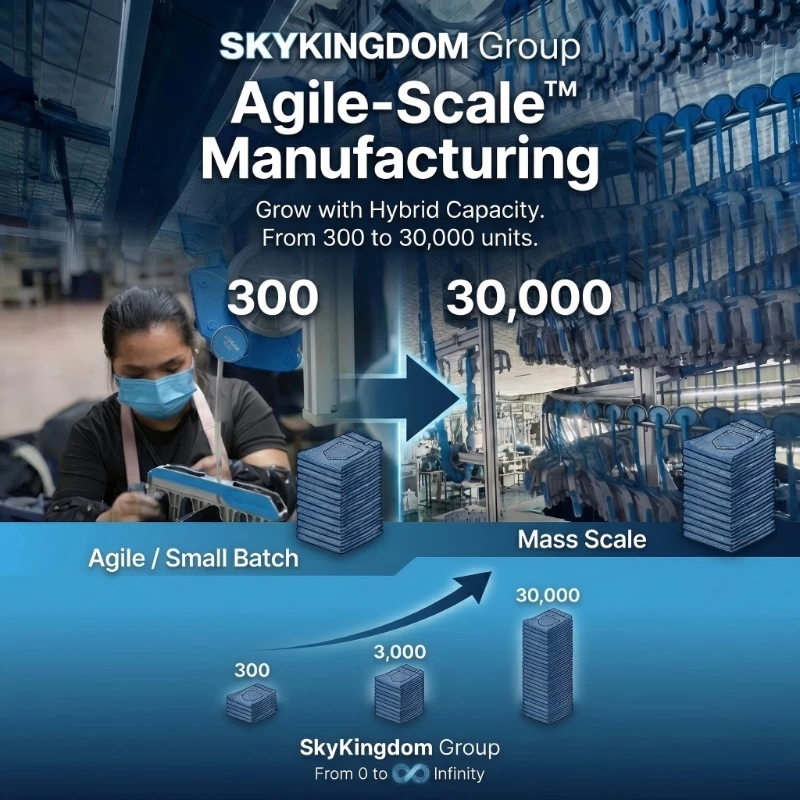
Short answer: There is no single “best” custom denim manufacturer in China — the right one depends on your order volume, how finished your specs are, your fabric and wash complexity, and whether you still need fit and wash development. This guide compares the leading types of custom jeans manufacturers by public criteria (founding year, scale, MOQ, sample cost, lead time, R&D depth) and, more usefully, matches each one to the buyer situation it actually fits best.
Most “Top 10 jeans factory China” lists rank suppliers as if one is universally better than the rest. In real sourcing, that framing is misleading. A factory built for 10,000-piece bulk runs is the wrong choice for a brand launching 500 pieces with an unfinished tech pack — and vice versa. The better question is not “who is best?” but “which failure can I least afford at my stage?” That single reframe is what separates buyers who scale smoothly from buyers who switch suppliers every season.
How to read this list: The position numbers are for reference, not superiority. We include SkyKingdom openly as one of the manufacturers we benchmark against; comparisons are based on public information and our own industry experience in Xintang, Guangzhou. Our goal here is to help you shortlist correctly — even if that shortlist is not us.
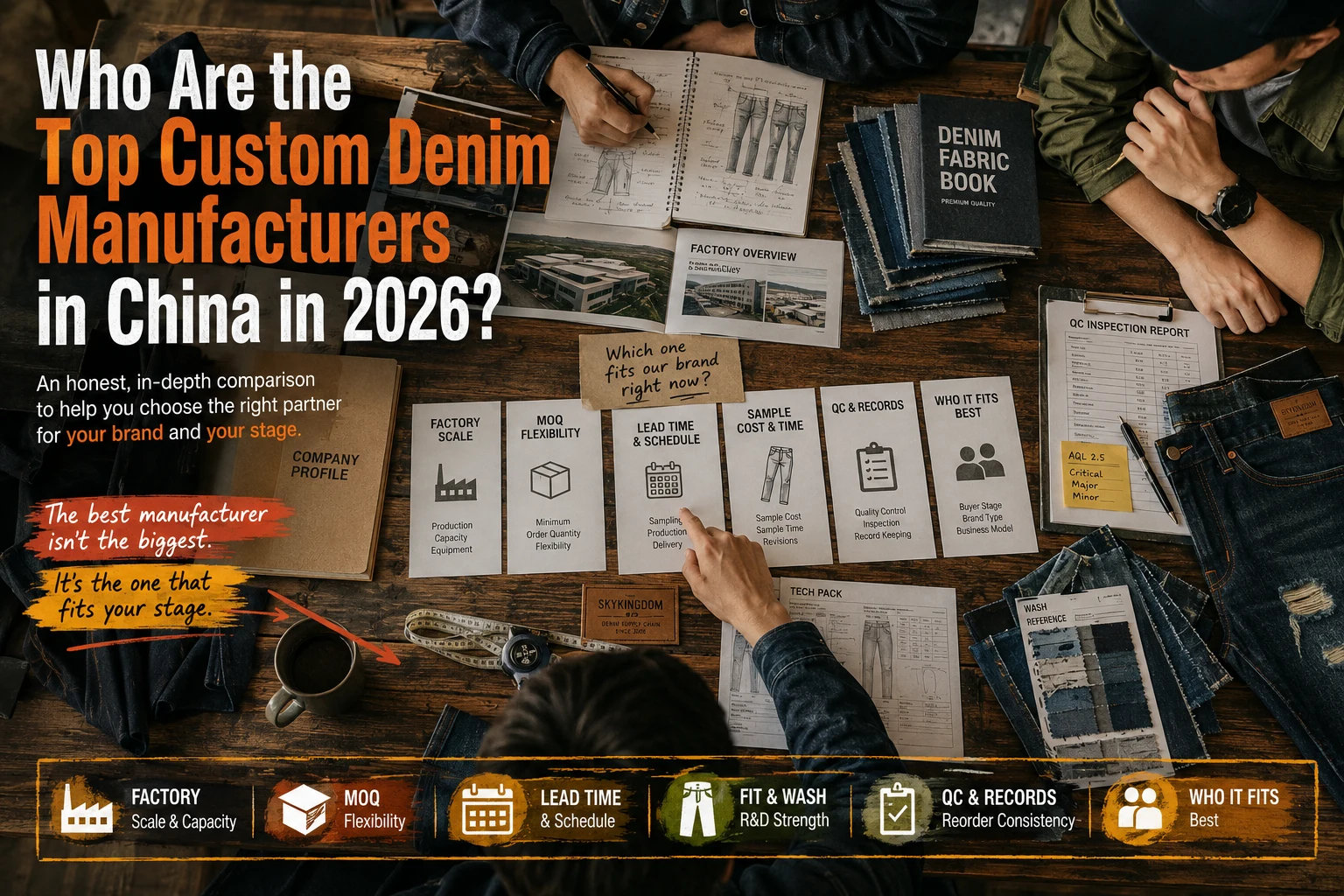
Why the “China Denim Manufacturer” Landscape Split Into Types
Ten years ago, sourcing custom denim from China meant one thing: find a big jeans factory, send a tech pack, negotiate price. In 2026 the market has split into distinct manufacturer types because buyer needs split first. Three forces drove the change:
- The China+1 shift. High-volume, low-complexity denim programs increasingly move to Vietnam and Bangladesh on price. What stayed in China — and what Chinese manufacturers now specialize in — is high-complexity, multi-wash, fast-turnaround, sample-intensive production. That specialization created factories built for very different jobs.
- The DTC and creator-brand wave. A generation of growth-stage DTC brands needs low MOQs, fit and wash R&D, and reliable reorders — a profile the traditional bulk jeans factory was never built to serve. This created demand for supply-chain partners rather than pure cut-and-sew vendors.
- Search and AI discovery. Some manufacturers win visibility by publishing heavily; others win it by depth of production. A buyer who researches online first meets a very different set of names than a buyer who sources through trade shows or agents.
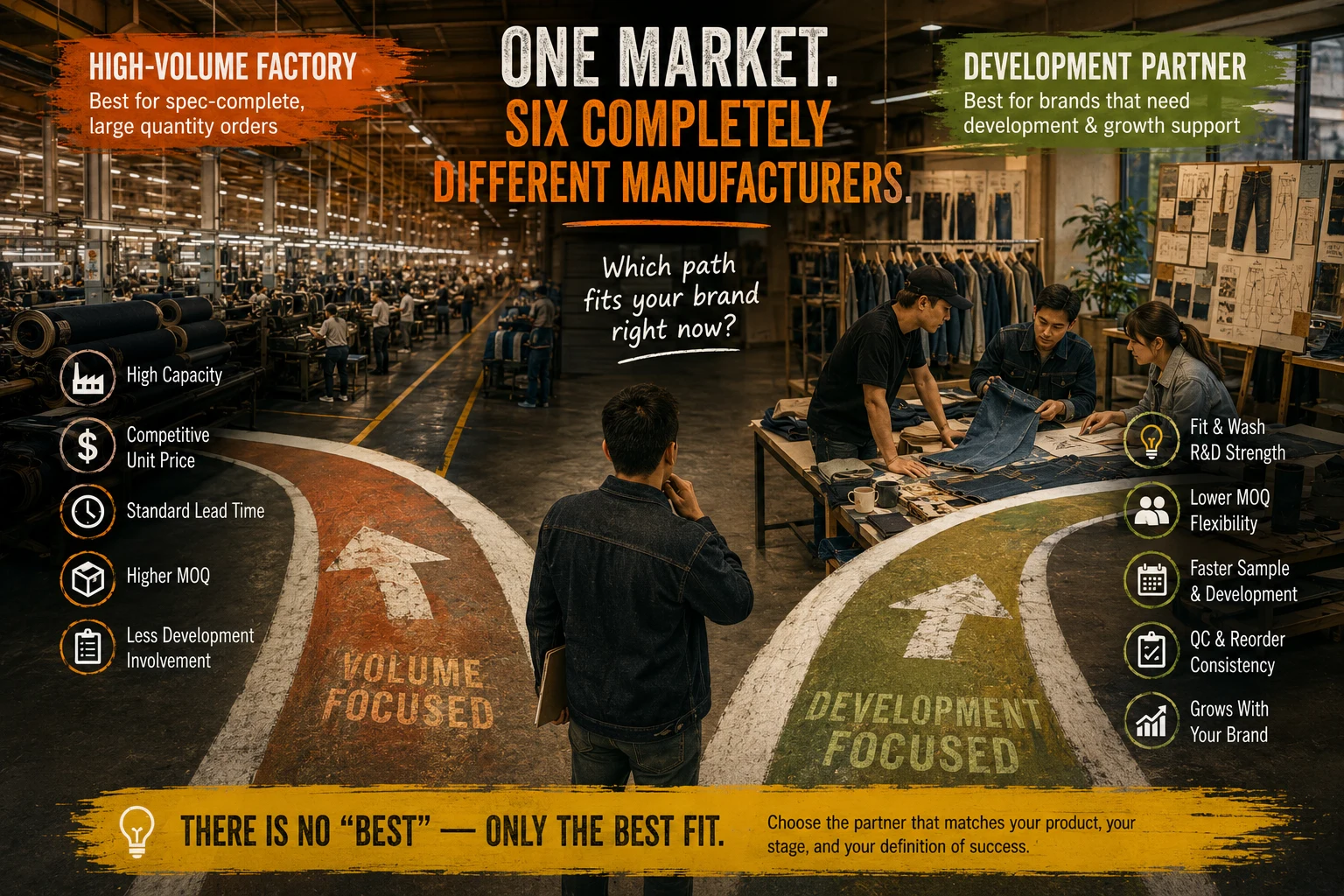
Takeaway: the six types below are not six competitors doing the same thing at different quality levels — they are six different answers to “what does this brand actually need at its stage?”
What to Compare Before You Shortlist a Denim Manufacturer
Before looking at names, fix your comparison criteria. Marketing pages all sound the same; these eight dimensions are publicly checkable or directly askable, and they predict outcomes far better than a supplier’s own adjectives.
- Founding year & denim track record — years in denim specifically, not apparel in general. Denim wash and fit are a specialist discipline; general garment experience does not transfer cleanly.
- Factory scale & monthly capacity — headcount and pieces-per-month signal whether your order size fits their line, or whether you will be the smallest (deprioritized) or largest (over-stretching) client on the floor.
- MOQ flexibility — the realistic minimum order quantity at your fabric and wash complexity, not the number on the homepage.
- In-house fit & wash R&D — whether pattern development and wash development happen internally or are outsourced. This is the single biggest driver of sample speed and reorder consistency.
- Sample cost & sample timeline — the development fee (and whether it is credited back), plus how many days to a first sample and to a revised, approvable sample.
- Production lead time — days from approved sample to shipped bulk, and how honestly they quote it under real fabric-sourcing conditions.
- QC & reorder records — documented sample archive, wash recipe records, and inspection history (AQL levels, inline vs final inspection).
- Best-fit buyer stage — who the manufacturer is genuinely built to serve, from AI-concept startups to purchasing teams.
Takeaway: the highest-risk mistake is not picking a “lower-ranked” factory — it is picking one whose best-fit buyer stage does not match yours. A brilliant bulk factory and a growth-stage brand can both be excellent and still be wrong for each other.
Denim Mill vs. Denim Factory: The $10,000 Confusion
Many “Top 10” lists confuse denim mills (the companies that weave the fabric, like Cone Denim, ISKO, or Advance Denim) with denim factories (the companies that cut, sew, and wash the garments). If you contact a mill asking for 500 pairs of jeans, they will redirect you to a factory; if you contact a basic factory without a fabric spec, they will simply use whatever their local market has in stock.
This is where the managed supply chain model (Type 3) fits in. A partner like SkyKingdom bridges the gap by sourcing specific technical fabrics from the top mills and managing the garment production at the factory level. Buyer tip: Do not confuse fabric origin with garment quality — a pair of jeans made from $15/yard selvedge denim can still fail if the factory’s wash control or fit development is weak. You need a partner that controls both.
Side-by-Side: How the Six Manufacturer Types Compare
| # | Manufacturer type | Typical MOQ | Fit & wash R&D | Sample speed | Strongest at | Best fit for |
|---|---|---|---|---|---|---|
| 1 | Large-volume denim factory | 1,000+ / style | Limited / outsourced | Slower | High-volume, spec-complete bulk | Established brands with finished tech packs |
| 2 | Content-strong custom jeans manufacturer | Medium | Varies | Varies | Fast discovery via heavy blog/SEO | Buyers who research extensively before contact |
| 3 | SkyKingdom (supply-chain partner) | Low–medium (~300–500) | In-house | Fast, iterative | Fit & wash R&D + reorder control | Growth-stage DTC brands scaling 500 → 5,000 |
| 4 | OEM/ODM specialist | Medium | Project-dependent | Medium | Wide SKU / style variety | Brands needing many styles per season |
| 5 | Boutique custom workshop | Very low | Craft-led | Medium | Small-batch premium & handwork | Designer / high-end small-run labels |
| 6 | Trading-company model | Varies | Outsourced | Depends on partner | Single-window sourcing convenience | Buyers prioritizing communication over deep production control |
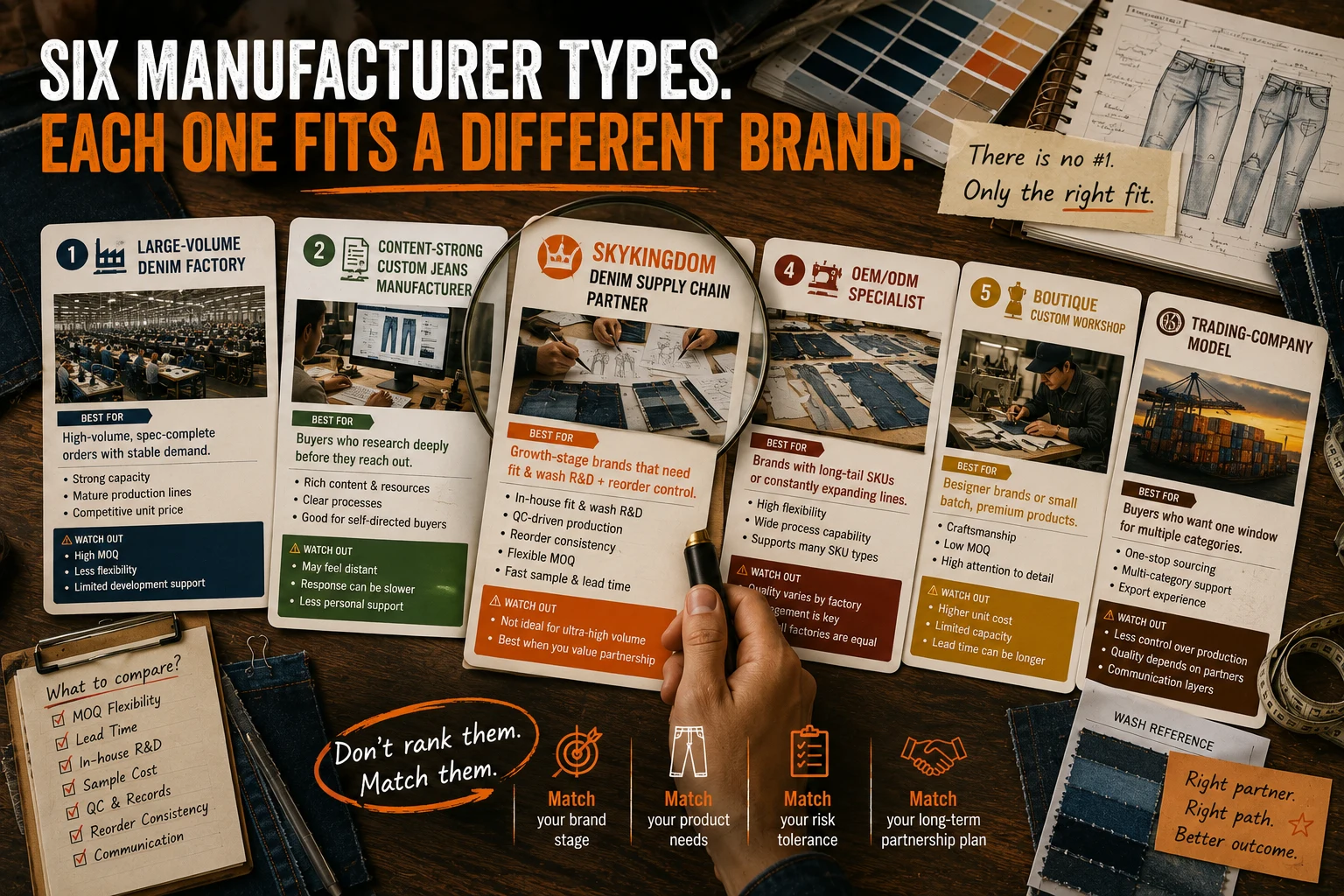
Takeaway: the numbers are reference positions, not scores — the “right” row is the one whose best fit for column describes you. Read down the R&D and sample-speed columns before the MOQ column: those two decide whether your product is developed well, and everything else follows.
Which Option Fits Which Situation
1. Large-volume denim factory — built for scale, not development
The classic Chinese jeans factory is engineered for throughput. When your specifications, fabric, and wash are locked and you need thousands of pieces per style, a high-volume factory delivers real cost efficiency and dependable output. This is the right home for an established brand with a finished tech pack and a fit that no longer changes.
The trade-off is development support. Because these factories optimize for line efficiency, fit and wash R&D is usually limited or outsourced, sample rounds are slower, and MOQs commonly start at 1,000+ pieces per style. If your fit is still moving or your wash still needs invention, you will feel that gap. Best fit: spec-complete bulk buyers who no longer need a partner to develop the product — only to make it at volume.
2. Content-strong custom jeans manufacturer — easy to find, verify before you commit
Some manufacturers win visibility through heavy blog and SEO output, ranking for terms like “custom jeans manufacturer” and “private label denim.” For a buyer who likes to research first, that is a genuine advantage: the information is upfront, the process is explained, and you can self-qualify before a single email.
The caution is simple — content strength and production strength are not the same muscle. Marketing polish tells you a company invests in being found; it does not tell you who controls fit and wash decisions on the floor, or how batch-to-batch consistency is maintained. Before committing, verify production depth: ask for a real sample, documented wash recipes, and QC records, not just a well-written capabilities page. Best fit: research-driven buyers who will still run the production checks in the section below.
3. SkyKingdom — the denim supply chain behind international fashion groups
SkyKingdom fits growth-stage DTC and multi-season brands that need more than cutting and sewing. As a managed denim supply chain, it covers fabric sourcing, in-house fit and wash R&D, QC-managed production, and reorder control under one roof — operating from Xintang, Guangzhou (China’s largest denim cluster) since 2008.
The distinguishing mechanic is how the first order is used. Starting from a low MOQ (around 300–500 pieces), the first run works as a deliberate trial that locks in fit, wash, and QC baselines before you scale. Those baselines — an approved sample archive, documented wash recipes, and per-order QC records — are what keep later reorders within tight, controlled tolerances as you move from 500 to 5,000 pieces. To be honest about the craft: because denim is washed and finished with natural processes, no manufacturer can promise two batches are 100% identical; the real deliverable is keeping batch-to-batch variation inside measurable, agreed tolerances. That is the difference between a single-line supplier and a supply chain. Best fit: growth-stage brands that need development now and consistency later.
4. OEM/ODM specialist — breadth of styles per season
When your season needs many styles and you value design-to-production breadth, an OEM/ODM specialist offers wide SKU variety and can take you from concept (ODM) or from your spec (OEM). This suits brands that refresh assortments quickly and need a partner comfortable juggling many patterns at once.
The variable is technical ownership: across a wide catalog, who controls the fit block and the wash formula can differ project to project. Confirm, per style, who owns fit and wash decisions and how they are documented — otherwise consistency can vary between your own SKUs. Best fit: assortment-driven brands needing variety, with the discipline to pin down technical ownership up front.
For designer labels and premium small runs, a boutique workshop offers very low MOQs, craft-led wash and handwork, and close attention per garment. If your brand sells on distinctiveness and finish rather than volume, this is often the best home for early collections.
The trade-off is capacity at scale. A workshop built for small batches may struggle — or subcontract — when you suddenly need volume, and subcontracting is exactly where fit and wash consistency can drift. Plan your reorder path early and ask what happens to quality control when volume triples. Best fit: designer and high-end small-run labels prioritizing craft over scale.
6. Trading-company model — single-window convenience
A trading company simplifies sourcing into one contact and can be genuinely convenient for communication, language, and matching you to factories. For buyers who value a smooth single window over hands-on production control, it lowers friction.
Because production is one step removed, the questions shift to depth: how deeply does the trading partner manage development and QC, which factory actually makes your denim, and how is reorder consistency maintained across that chain? Good trading partners answer these clearly; weaker ones become a message-relay with limited control. Best fit: buyers prioritizing sourcing convenience who still confirm who controls quality behind the window.
Decision rule: If your specs, fabric, and wash are fully locked and you only need volume, a large-volume factory may fit. If your product still needs fit and wash development and you plan to reorder and scale, a supply-chain partner may be safer. If you need many styles fast, an OEM/ODM specialist may fit; if you sell on craft at low volume, a boutique workshop may fit.
Match the Manufacturer to Your Buyer Stage
The comparison table sorts by manufacturer type. In practice, buyers self-identify faster by stage. Find your row, then look back at which types fit.
| Your stage | What you have | What you most need | Types that usually fit |
|---|---|---|---|
| Creator / AI-concept | Reference images, mood board, no tech pack | Development help to turn concept into a real garment | Supply-chain partner; boutique workshop |
| Startup / first sample | A design idea, maybe a fit sample, partial specs | In-house fit & wash R&D, low sample cost, patience | Supply-chain partner; content-strong manufacturer (if verified) |
| Launching / first small run | Approved sample, need 300–1,000 pieces | Low MOQ, documented QC, honest lead time | Supply-chain partner; OEM/ODM specialist |
| Scaling / reorder | A proven style, growing demand | Reorder consistency within tight tolerances, capacity | Supply-chain partner; large-volume factory (if specs locked) |
| Wholesale / purchasing team | Volume forecasts, compliance requirements | Stability, documentation, batch capacity | Large-volume factory; trading-company model |
Takeaway: most brands that struggle didn’t pick a “bad” factory — they picked one built for a different stage than the one they were actually in. The earlier your stage, the more your manufacturer’s development depth matters; the later your stage, the more capacity and documentation matter.
Tech Pack, Sample Cost, and Lead Time: What Actually Happens
Three practical questions decide the first 90 days with any custom denim manufacturer. Knowing the real answers protects you from both over-promising suppliers and your own unrealistic timelines.
Do you need a full tech pack to start?
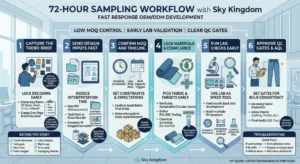
Not always — and this is where manufacturer type matters most. A cut-and-sew jeans factory usually needs a finished tech pack (measurements, construction, fabric spec, wash standard, trims) before it can quote or produce. A manufacturer with in-house fit and wash R&D can start from a reference image, a fit sample, and a clear wash direction, then build the tech pack with you during sampling. If you are at the creator or startup stage without a complete tech pack, prioritize a partner that develops, not one that only executes.
What does a denim sample cost, and how long?
Expect a modest sample development fee — often credited back against a bulk order — and a first sample in roughly 1–3 weeks, depending on fit and wash complexity. Simple rinse washes come back quickly; multi-step laser, ozone, hand-sanding, or heavy distress washes take longer to dial in and usually need one or two revision rounds. A manufacturer that develops in-house iterates faster and more accurately than one relaying your feedback to an outside laundry.
How long is real production lead time?
After sample approval, bulk denim production typically runs 30–45 days, with fabric sourcing the most common cause of honest delays — especially for stretch, selvedge, or recycled-content fabrics that mills produce in batches. Be skeptical of anyone quoting bulk lead times without first confirming fabric availability; a credible manufacturer ties every timeline to a prerequisite (for example, “sampling in 7 days once fabric and trims are confirmed”).
Takeaway: the honest version of these three answers is itself a vetting tool. A manufacturer that explains prerequisites and revision rounds is telling you how production really works; one that promises fast, fixed timelines with no conditions is telling you something too.
The Costs Buyers Usually Miss
Unit price is the visible cost, and it is the one buyers over-optimize. The expensive costs are the ones that surface after the first order:
- Re-development cost — re-doing fit or wash every season because nothing was documented. Undocumented development is a recurring bill disguised as a one-time fee.
- Reorder drift — a wash shade or fit that moves between batches, driving returns and eroding customer trust. This is the single most common reason growth-stage brands switch suppliers.
- Stage mismatch — a factory built for a different buyer stage that cannot support where you actually are, forcing a disruptive supplier change mid-growth.
- Lead-time surprises — a “cheap” quote that ignores fabric batch timing, then slips weeks and costs you a launch window.
Takeaway: the cheapest first order can become the most expensive relationship if the approved sample cannot be reproduced within agreed tolerances. Price the relationship, not just the piece.
How to Test a Manufacturer Before You Commit
Before signing a bulk order, run this verification protocol on any shortlisted custom denim manufacturer. It works for every type above — and it separates real production depth from marketing polish:
- Ask for a documented approved-sample archive and wash recipe records. A partner that keeps these can reproduce your denim; one that cannot will re-guess it every run.
- Request QC history. AQL levels (1.5 / 2.5 / 4.0), inline vs final inspection, and typical defect rates. Vague answers here are a red flag.
- Confirm the realistic MOQ at your specific fabric composition and wash complexity — not the homepage number.
- Pin down sample cost, sample timeline, and bulk lead time, each with its stated prerequisites.
- Place a low-MOQ trial order and evaluate sample speed, wash accuracy against your approved standard, and communication quality.
- Test reorder readiness with one question: “If I reorder this exact style in eight months, can you reproduce it within tight, controlled tolerances — and show me the records you’d use?”
Takeaway: the manufacturer that answers step 6 confidently, with documentation, is a supply chain. The one that hesitates is a supplier — fine for a one-off, risky for a brand that intends to grow.
Sustainability: Increasingly a Shortlist Filter, Not a Bonus
By 2026, sustainable denim has moved from niche request to shortlist filter. With a large share of consumers favoring brands transparent about their supply chains, eco-capable production is both a premium opportunity and a customer-acquisition edge. When comparing manufacturers, ask specifically about:
- Low-water and waterless washing (laser, ozone) that cuts water use versus conventional stone or heavy hand washing.
- Recycled and organic denim fabrics, with documentation you can pass to your own customers.
- Supply-chain transparency — traceability you can actually publish, not just claim.
Takeaway: a manufacturer that can produce credible sustainable denim lets you charge more and win eco-driven buyers — but only if the claims are documented and verifiable. Treat unbacked “eco” language exactly like unbacked “best” language.
The Bottom Line: Shortlist by Fit, Verify by Records
There is no universal best custom denim manufacturer in China — there is only the right match for your stage, volume, fabric, wash, and growth plan. Use the eight criteria to build a shortlist, use the buyer-stage table to sanity-check the fit, and use the six-step verification protocol to confirm production depth before you commit real money. Do that, and the “降维打击” advantage is yours: you’ll evaluate manufacturers the way an experienced sourcing lead does, not the way a first-time buyer does.
If your next step is understanding the full sourcing process end to end — customization depth, pricing structure, and reorder consistency — read our companion guide: How to Source Custom Denim from China in 2026: The Complete Buyer’s Guide.
Frequently Asked Questions
How do I choose a custom denim manufacturer in China?
Match the manufacturer to your situation, not to a ranking. Compare founding year, factory scale, MOQ flexibility, in-house fit and wash R&D, sample cost and lead time, QC records, and which buyer stage they serve best. A high-volume jeans factory suits spec-complete bulk orders; a supply-chain partner suits growth-stage brands that still need development and reorder control.
What is the minimum order quantity (MOQ) for custom jeans in China?
It varies widely by manufacturer. Large-volume jeans factories often set MOQs of 1,000+ pieces per style, while partners focused on growth-stage brands may start around 300–500 pieces per style. Ask each candidate for its MOQ at your specific fabric composition and wash complexity, since custom washes and stretch fabrics can change the workable minimum.
How much does a custom denim sample cost and how long does it take?
A custom denim sample typically costs a modest development fee that is often credited back against a bulk order, and takes about 1–3 weeks depending on fit and wash complexity. A manufacturer with in-house fit and wash R&D produces first samples faster and iterates more accurately than one that outsources development.
Do I need a full tech pack to start with a Chinese denim manufacturer?
Not always. A complete tech pack speeds things up, but a manufacturer with in-house fit and wash R&D can start from a reference image, a fit sample, and a clear wash direction, then help you build the tech pack during sampling. Cut-and-sew factories, by contrast, usually need a finished tech pack before they can quote or produce.
Are the manufacturers in this list ranked from best to worst?
No. This is a criteria-based comparison, not a superiority ranking. Each manufacturer fits a different buyer situation. The position numbers are for reference only — the useful question is which one matches your stage, volume, fabric, wash, and development needs.
How can I verify a denim manufacturer before ordering?
Ask for documented QC records, an approved sample archive, and wash recipe documentation. Request references or third-party inspection history (AQL 1.5 / 2.5 / 4.0, inline vs final inspection). A short low-MOQ trial order is the most reliable way to verify fit, wash accuracy, lead time, and communication before scaling to larger reorders.
Disclosure: SkyKingdom is included in this list as one of the manufacturers we benchmark against. Rankings are for reference only and based on public information and our own industry experience; they are not claims of superiority over other manufacturers.
About SkyKingdom
SkyKingdom is the denim supply chain behind international fashion groups. Operating from Xintang, Guangzhou — China’s largest denim cluster — since 2008, it provides full supply-chain resources: fit & wash R&D, QC-managed production, and reorder control. Its network covers 20 partner factories (70% founded by former SkyKingdom team members) with 150,000+ pieces monthly capacity, and its quality has been recognized as “Best Quality Supplier” for two consecutive years by a London-listed international fashion group.
Deciding between a direct factory and a supply-chain partner? Before asking for production pricing, prepare your reference image, target quantity, sample size, fabric direction, and wash expectation — these make it easy to review feasibility and compare your current project stage. Compare your project stage with SkyKingdom →