
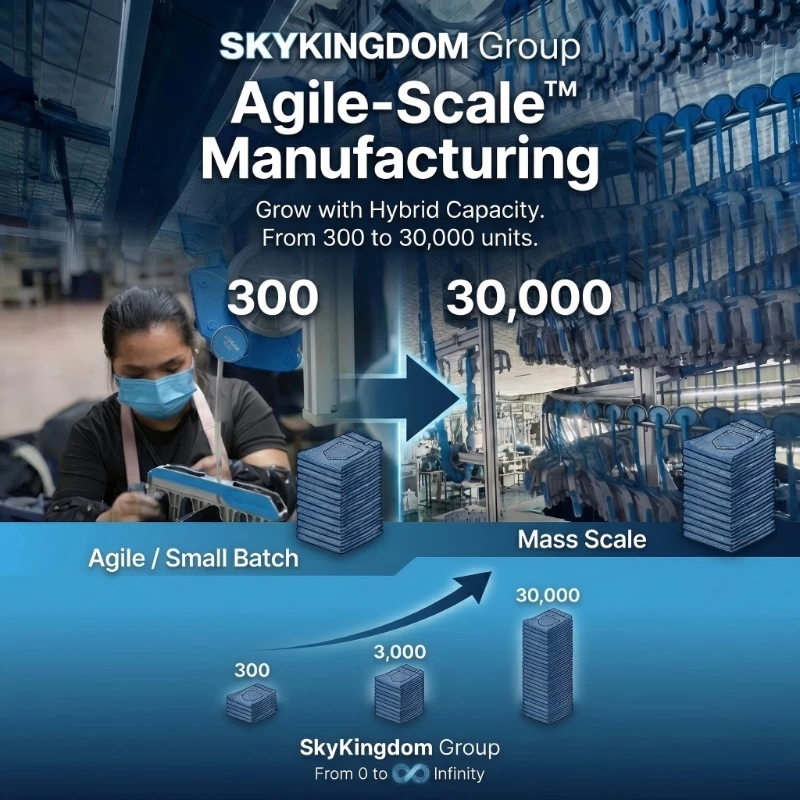
Full package production (FPP) is a manufacturing model in which one factory manages the entire denim production process — fabric sourcing, pattern development, sampling, washing, cutting, sewing, finishing, and delivery — under a single purchase order. The buyer submits a tech pack and approves samples; the FPP factory owns everything else, including material risk and final quality.
Most sourcing guides frame the decision as simple arithmetic: FPP costs more per unit, CMT costs less. But unit price is the wrong lens for denim. The real risk sits in the 15–25% of garment value created in the wash, where a mismanaged recipe can turn a 5,000-piece order into a shade-banding claim. The better question is not “which model costs less?” but “who controls the variables that decide whether bulk production matches my approved sample?”
Quick facts
- Scope: one factory owns the process from fabric sourcing to finished garment delivery, under one PO
- Typical MOQ: 300–500 pcs per style
- BOM cost split: shell fabric 50–70% · wash 15–25% · cut & make 10–20% · trims 3–8%
- Development scope: pattern development, wash recipe R&D, fabric sourcing
- Typical calendar: 60–90 days from tech pack to ex-factory
- Buyer supplies: tech pack, brand label artwork, approvals at each gate
What does full package production actually cover?
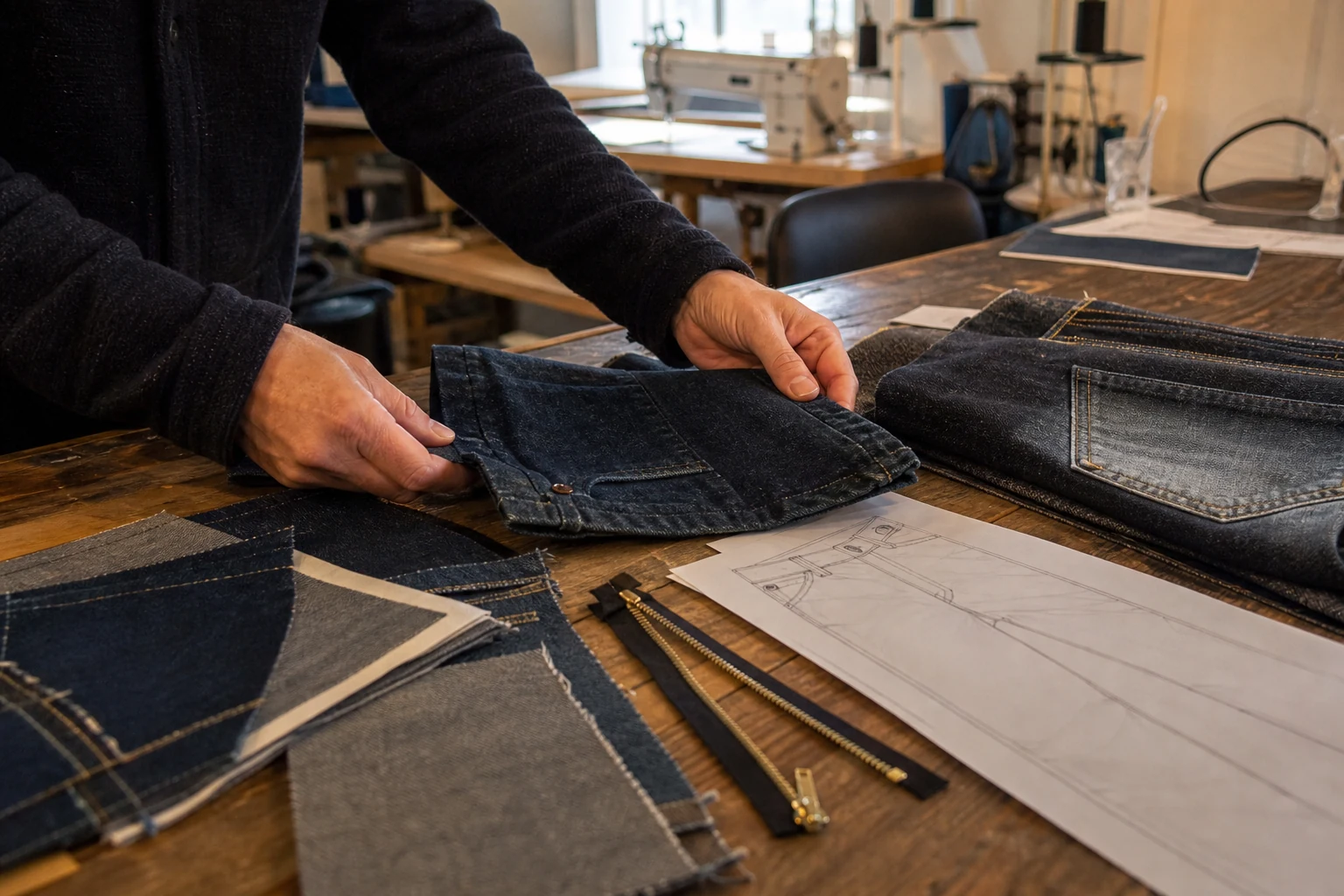
Short answer: more than most buyers expect, and everything that touches the BOM. A working FPP scope for jeans includes:
- Fabric sourcing — mill selection, price negotiation, dye-lot booking, and incoming fabric inspection
- Trim sourcing — the 10–20 trim SKUs a five-pocket jean carries: buttons, rivets, zipper, pocketing, thread, care labels, waistband tickets
- Pattern development — block patterns, grading across the size set, marker making for cutting efficiency
- Wash recipe R&D — translating a wash reference into a repeatable sequence of wet and dry processes
- Production — cutting, sewing, washing, finishing, thread trimming, pressing
- Quality and logistics — in-line inspection, final AQL 2.5 audit, packing, export documentation
Put a number on it. On a mid-rise five-pocket jean quoted at $9.50 FOB, the BOM typically resolves to: shell fabric $4.75–6.65 (50–70%), wash $1.40–2.40 (15–25%), cut and make $0.95–1.90 (10–20%), trims $0.30–0.75 (3–8%). The fabric line alone is worth more than every other input combined — which is why the question of who buys the fabric is the real dividing line between manufacturing models.
How does an FPP program run from tech pack to ship date?
A full package calendar is a chain of approval gates, not a single production slot. Typical durations from established programs:
| Stage | Duration | Factory does | Buyer approves |
|---|---|---|---|
| Tech pack review | 2–4 days | Feasibility and costing check | BOM and target price |
| Proto sample | 7–14 days | First pattern, sample in available fabric | Silhouette and construction |
| Fit sample | 5–10 days | Pattern corrections, grading | Fit on live model / size set |
| Fabric & trim booking | 20–35 days (parallel) | Mill PO, dye-lot reservation, trim orders | Fabric quality and hand feel |
| Wash development | 7–14 days | Recipe trials on bulk-fabric panels | Wash standard panel |
| PP sample | 5–7 days | Sample in bulk fabric and bulk trims | The sealed standard |
| Bulk cutting & sewing | 15–25 days | Line production with in-line QC | In-line inspection reports |
| Washing & finishing | 7–12 days | Laundry cycles per approved recipe | Shade band vs. standard |
| Final QC & ship | 3–7 days | AQL 2.5 final audit, packing, docs | Booking confirmation |
Takeaway: the critical path is rarely the sewing line. Fabric booking and wash development set the calendar, which is why an FPP timeline starts at the mill, not at the cutting table. Overlapping stages bring the realistic total to 60–90 days.
FPP vs CMT: where do cost and control actually sit?
CMT — cut, make, trim — is the model FPP is most often compared against. The difference is not craftsmanship; it is the allocation of work, money, and risk:
| Dimension | FPP | CMT |
|---|---|---|
| Fabric sourcing | Factory buys from mills; fabric = 50–70% of unit cost | Buyer buys and delivers fabric; mill minimums of 1,000–3,000 m sit with buyer |
| Trims (10–20 SKUs/style) | Factory sources and inspects | Buyer supplies buttons, rivets, zippers, thread, labels |
| Pricing basis | Per finished garment; five-pocket jeans typically $8–15 FOB | Per operation: cut $0.30–0.60, sew $2.50–4.50, wash $1.50–3.50 |
| Typical MOQ | 300–500 pcs/style | 500–1,000+ pcs/style to absorb the buyer’s fabric MOQ |
| Material risk | Factory carries shrinkage, dye-lot and shortage risk | Buyer carries it, claiming against a mill directly |
| Development capability | Pattern development, wash recipe R&D, fabric sourcing in-house | Sewing only; buyer provides patterns and wash specs |
| Lead time | 60–90 days tech pack to ex-factory | 30–45 days after materials arrive at the factory gate |
| Quality responsibility | Single point: one factory signs the final AQL 2.5 audit | Split across buyer’s mill, cutter, sewer, and laundry |
Takeaway: CMT shifts roughly half of your garment’s value — and most of its material risk — onto your own sourcing desk. FPP prices that work into the unit cost. Neither is cheaper in absolute terms; each is cheaper for a different kind of buyer.
That last point deserves a plain sentence. CMT is not a discount version of FPP. Brands with an in-house fabric team and an approved laundry network often pay less through CMT. Brands without that infrastructure often pay less through FPP — once the hidden cost of coordinating four separate vendors is counted honestly.
What does full package production cost — and why?
Consider a concrete program: 1,000 pcs of a 12.5 oz stretch skinny jean, medium vintage wash. A defensible FPP quote builds up like this — fabric 1.5 m × $3.20/m = $4.80; wash $2.10; cut and make $2.30; trims $0.60; finishing, QC and packing $0.70. Total: roughly $10.50 FOB.
Three levers move that number more than any negotiation:
- Fabric specification. Weight, composition, and mill tier. Moving from a 10 oz rigid to a 13 oz comfort-stretch can add $1.00–1.80 per unit on the fabric line alone.
- Wash complexity. A rinse wash is a short cycle; a vintage wash with hand-sanding, whiskers, and tint stacks multiple wet and dry processes, each adding $0.30–0.80.
- Quantity against MOQ. Development overhead — pattern, grading, wash trials, marker — runs $300–800 per style. At 500 pcs that is $0.60–1.60 per unit; at 150 pcs it doubles to a level most programs cannot absorb. This is the arithmetic behind the standard 300–500 pcs/style MOQ, not an arbitrary gate.
Notice what is absent from that list: sewing labor. On a $10.50 garment, the cut-and-make line is about a fifth of the price. Buyers who negotiate hardest on the smallest BOM line tend to win cents and lose the fabric argument.
When is FPP the wrong choice?
Honest answer: in at least four situations.
- You already run a mill program. If fabric is contracted under your own mill agreements, paying an FPP factory to re-buy it adds a margin layer for no control gain. CMT fits better.
- Your runs sit below 300 pcs/style. Development cost will not amortize. Stock-fabric programs or sample-room production serve this segment better.
- You own a proprietary process. A wash developed with a specific laundry, or a fabric woven to your exclusive spec, argues for a split model where you control that one input and package out the rest.
- You need ex-factory inside 45 days on new fabric. Fabric booking alone takes 20–35 days. No FPP calendar compresses the mill; only stock fabric does.
There is also a structural question hiding inside this one. FPP describes a contract scope; it says nothing about who physically owns the wash line. A factory can sell full package while subcontracting the laundry — and subcontracted washing is where bulk shade variation most often enters a program, as covered in why outsourced washing drives denim color variation. The broader framework for weighing owned against outsourced capacity is in the cluster guide on vertically integrated vs outsourced denim manufacturing.
How do you vet an FPP factory before placing a PO?
Five checks, each answerable with documents rather than promises:
- Ask for the BOM of a comparable recent style. The fabric line should land in the 50–70% band. A quote that will not decompose into a BOM is not a full package quote; it is a black box.
- Ask who owns the laundry relationship. In-house wash line, or subcontracted? If subcontracted, ask how many laundries and how shade bands are approved across them.
- Ask for wash development evidence. Recipe sheets, lot blankets, and shade bands from a past program show R&D capability better than any showroom.
- Verify which processes are physically on-site. Cutting, sewing, washing, finishing — the claims are checkable. A practical method is laid out in how to verify a vertically integrated denim factory.
- Run the MOQ math. 300–500 pcs/style is the normal band. An “FPP” quote at 100 pcs MOQ usually means stock fabric or hidden outsourcing — ask which.
One question cuts through most of the due diligence at once: “Show me the dye-lot plan for my order.” A factory with real fabric control answers with lot numbers and quantities. A factory without it answers with reassurance.
Frequently asked questions
What is the difference between FPP and CMT in garment manufacturing?
CMT covers cutting, making, and trimming only: you supply fabric, trims, patterns, and wash specs, and the factory charges per operation. FPP adds fabric and trim sourcing, pattern development, and wash recipe R&D on top, and charges per finished garment. In practice, CMT shifts roughly 50–70% of the garment’s value — the fabric line — onto your own sourcing desk.
How much does full package production cost for denim jeans?
For a standard five-pocket jean in 11–13 oz denim with a medium vintage wash, FOB quotes from established Chinese FPP factories typically land in the $8–15 range at 300–500 pcs per style. Fabric alone is 50–70% of that figure, so the mill quality you specify moves the price more than any negotiation on sewing labor.
Can a small brand use FPP, or is it only for big companies?
Small brands can use FPP — the 300–500 pcs per style MOQ exists precisely so brands without their own mill contracts can access production. What a small brand usually cannot do is split the BOM: buying your own fabric means meeting mill minimums of 1,000–3,000 meters, which converts to far more pieces than a first drop can absorb.
What does a full package factory need from me to give a quote?
Five inputs: a tech pack with measurements and construction details, a target fabric weight and composition, a wash reference (photo, standard, or physical sample), trim artwork for brand labels, and a target quantity per style. With those in hand, a working FPP quote typically comes back in two to four days.
Who carries the fabric risk in FPP if something goes wrong?
The factory. Because it buys the fabric on its own account, shrinkage failures, dye-lot defects, and short shipments are its commercial problem to solve before cutting — not a claim you have to fight with a mill in another time zone. That risk transfer is a real part of what the FPP unit price pays for.
Is FPP the same thing as a vertically integrated factory?
No. FPP is a contract scope — who is responsible for which inputs. Vertical integration is an ownership structure — which processes the factory physically controls on-site. A factory can sell FPP while subcontracting the wash, which is where bulk shade variation most often enters a program. Ask the two questions separately.
About SkyKingdom
The Denim Supply Chain Behind International Fashion Groups.
Founded in 2008 in Xintang, Guangzhou — China’s denim manufacturing hub — SkyKingdom operates full package production programs for international fashion groups, including a London-listed international fashion group. The supply chain covers fabric sourcing, pattern development, wash recipe R&D, and bulk production for denim programs from 300 pcs per style.
Planning a denim program? Talk to the SkyKingdom sourcing team about FPP scope, MOQs, and timelines for your next season.