

A denim factory is truly vertically integrated only if it physically owns and manages the stages that determine quality — fabric storage and development, washing, cutting, sewing, finishing, and QC — under one roof and one management system. To verify it, walk each department, trace recipe and inspection records, and confirm in writing that every outsourced step is disclosed.
Here is the uncomfortable part: “fully integrated” is the most overused phrase in denim sourcing. A factory can lease two washing machines, hang a sign, and still send most of your wash development to a subcontractor down the road. The claim costs nothing to make. The first bulk shipment that arrives three shades off your approved wash costs a season.
Why “Fully Integrated” Claims Deserve Skepticism
Vertical integration is not a badge; it is a description of where your production risk sits. Denim quality is decided at handoffs — greige fabric to wash, wash to cutting, cutting to sewing, sewing to finishing. Every time a stage leaves the building, shade bands drift, shrinkage data gets re-measured by someone else, and your approved sample becomes a memory. A factory that owns a stage controls that handoff. A factory that outsources a stage inherits the risk — but often markets the relationship as ownership.
This is why the trade-offs between vertically integrated and outsourced denim manufacturing are not academic. They determine whether your reorder in month nine matches your first delivery. Verification converts a sales claim into observable, documentable evidence. The working rule: if a stage cannot be walked, touched, and traced through records during your visit, treat it as outsourced until proven otherwise.
Walk the Six Departments: What to Look At and What to Ask
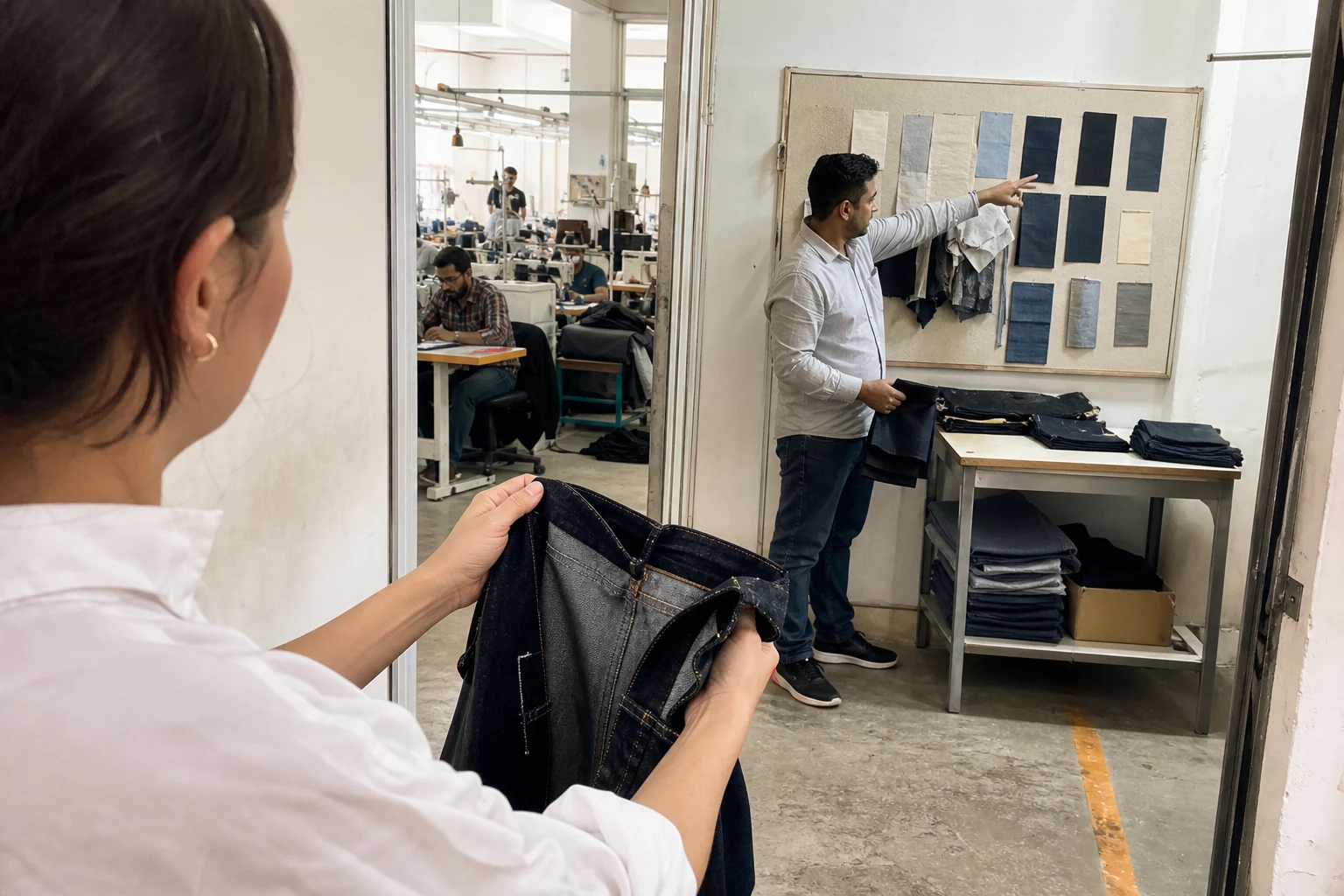
The most reliable verification method is a slow walk through six departments, following one style from fabric roll to packed carton. A genuinely integrated factory will open every door.
| Department | What to look at | What to ask | Red flags |
|---|---|---|---|
| Fabric warehouse | Greige and finished rolls stored by lot; incoming test reports (shrinkage, skew, shade). | Which mills supply your greige? Show me the incoming inspection log for the last three lots. | Rolls without lot IDs; fabric “stored at our partner’s.” |
| Washing workshop | Machines actually running; chemical storage; water treatment; recipe sheets on file. | Show me the recipe record from last month — dosages, bath ratio, temperature curve. | Idle spotless machines; no chemical inventory; recipes “in the master’s head.” |
| Cutting room | Spreading tables; band knives or automated cutters; marker software; fabric relaxation racks. | How do you control shrinkage before cutting — relaxation hours, per-lot markers? | Cutting sent to a nearby workshop “during peak season.” |
| Sewing floor | Lines laid out by operation; heavy-duty chainstitch and feed-off-the-arm machines; in-line inspectors. | What is your in-line defect rate, and where is it logged? | No in-line QC stations; sample-room quality visibly above floor quality. |
| Finishing | Pressing, thread trimming, trim attachment, measurement checks against spec sheets. | Who verifies measurements against the sealed sample, and how often? | Finishing handled by home workers or “a partner unit.” |
| QC laboratory | Wash/dry test machines, D65 light box, spectrophotometer, tensile tester, retained-sample library. | Show me test reports tied to a recent lot number. | A “lab” that is one light box in a meeting room. |
If any stop on the walk happens “at our partner’s facility five minutes away,” that stage is outsourced. Outsourcing can work — but only when it is disclosed and contractually controlled.
Owning Machines Is Not Owning Process Capability
This is the distinction that separates verification from tourism. Any factory can buy washing machines; machines are commodities financed over five years. Process capability is the accumulated, documented knowledge of how to reproduce a look — and it lives in records, not in hardware.
Equipment is bought. Capability is documented.
Ask to see recipe records for a completed style: chemical dosages in grams per liter, bath ratios, temperature curves, cycle times, and the enzyme or stone lots used. Then ask how that record connects to the wash you approved. If the answer is a shrug, a verbal “the master remembers,” or a binder that has not been opened since installation, the factory owns equipment, not capability. Recipe discipline is also why outsourced washing is the biggest driver of denim color variation — the moment formula control leaves the building, shade control leaves with it.
The same logic applies everywhere: a spectrophotometer without calibration logs is furniture; a QC lab without retained samples is a showroom.
Read the Quality Paper Trail: ISO 2859-1, AQL, and the Sealed Sample SOP
Integrated factories produce paper — or at least structured data. Ask for the last three final inspection reports. Serious denim operations sample to ISO 2859-1 (sampling procedures indexed by acceptance quality limit), typically at General Inspection Level II:
| Defect class | Examples | Standard AQL |
|---|---|---|
| Critical | Broken needle, metal contamination | 0 — not accepted |
| Major | Shade out of band, measurement out of tolerance, open seam | 2.5 |
| Minor | Slight slub variation, minor trim mark | 4.0 |
What matters is less the numbers themselves than whether the factory can show reports where lots failed, were reworked, and were re-inspected. A spotless record across three years is a warning sign, not reassurance.
Then walk the sealed sample SOP, step by step:
- Development sample submitted with full spec sheet and wash standard.
- Buyer comments documented and incorporated into a revision.
- Two identical approval samples sealed, signed, and dated — one retained by the buyer, one locked at the factory.
- Photographic log archived, with seal numbers referenced on the purchase order.
- Bulk production measured against the sealed sample at in-line and final inspection.
If sealing exists only as a photo on a salesperson’s phone, the system is decorative.
Check Compliance Documentation Before You Need It
Labeling failures destroy sell-through even when the garment is perfect. Three frameworks belong in every audit:
EU 1007/2011 governs fibre names and fibre composition labelling for the European market; blends must be declared in descending order within regulated tolerances. FTC rules in the United States — the Textile Fiber Products Identification Act — require fiber content, country of origin, and manufacturer or dealer identity on labels. GINETEX care symbols, the five-symbol care labelling system, are trademarked and require a license in several markets.
The verification question is how fiber composition is verified: does the factory test incoming fabric per lot, in its own lab or through a third party, and can it show a test report tied to a lot number? A factory with a real QC lab produces this in minutes. A factory renting a light box will promise to “get it from the mill.”
Verify the Reorder Baseline: Six Dimensions That Must Be Frozen
First orders often succeed through heroics; reorders fail through entropy. The real test of integration is whether the factory can freeze a six-dimension baseline at approval time and hold it for every subsequent lot:
| Dimension | What gets frozen | Evidence to request |
|---|---|---|
| Fabric | Greige supplier, weave and dye parameters, lot specifications. | Incoming inspection logs and mill certificates per lot. |
| Shade band | Approved color gradient range with spectrophotometer readings. | Lab dips and the signed shade band approval. |
| Recipe | Wash formula locked: chemicals, dosages, cycle parameters. | Signed recipe record referenced on the PO. |
| Shrinkage | Residual warp/weft shrinkage targets and relaxation protocol. | Per-lot shrinkage test reports. |
| Hand feel | Softness and surface standard matched to the sealed sample. | Retained samples and comparison records. |
| AQL | The same sampling plan and defect classification every lot. | Final inspection reports to ISO 2859-1. |
If a factory can produce all six evidence trails for a style it shipped last year, its integration is operational, not rhetorical. If two or more dimensions are “managed by partners,” you know exactly where your reorder risk lives.
Making the Call: Score the Evidence, Not the Pitch
After the visit, score what you saw. Four or more departments verified with records, plus minor outsourcing that is disclosed and under contract — that factory is integrated in the way that matters. Washing or finishing quietly outsourced, recipes unrecorded, AQL reports unavailable — you are looking at an assembler with good marketing, whatever the brochure says.
None of this means outsourced models cannot work. Excellent garments come from well-managed networks, and full-package production can be legitimate when the scope is honest. The disqualifier is opacity, not outsourcing itself.
SkyKingdom operates on the opposite assumption: buyers should audit everything. Our fabric warehouse, wash plant, cutting, sewing, finishing, and QC laboratory run on one site in Xintang, Guangzhou, and audit visits — announced or otherwise — are part of how we work with international fashion groups.
Frequently Asked Questions
how to tell if a factory actually owns their washing facility?
Walk the wash floor during working hours and count machines that are actually running, not just installed. Then ask for the recipe record from a recent style and evidence of chemical inventory and water treatment on site. Idle machines, no chemical stock, or a wash floor that is “closed today” usually means the capacity is borrowed.
what questions should I ask during a denim factory audit?
Ask for evidence, not adjectives: Which stages happen inside this building? Show me the recipe record for a recent style. Show me the last three AQL inspection reports, including any failed lots. How is the sealed sample stored and referenced on purchase orders? Which steps are outsourced, and under what written controls?
can I trust a factory that says they are fully integrated?
Trust the records, not the phrase. “Fully integrated” is unregulated marketing language. A factory earns the claim only when every quality-determining stage — fabric, wash, cut, sew, finish, QC — can be physically walked and traced through documents during your visit. Anything you cannot see, treat as outsourced until proven otherwise.
what is the difference between owning machines and owning process capability?
Machines are purchasable; capability is documented repeatability. A factory proves capability when it can show written wash recipes, calibration logs, per-lot test reports, and retained samples — and can reproduce an approved look across lots without heroics. Equipment without records is furniture.
how do I check if a denim factory will keep my reorders consistent?
Ask for the frozen baseline from a style shipped a year ago: fabric lot specifications, shade band readings, the locked wash recipe, shrinkage reports, the sealed sample, and AQL reports. Then compare them against the most recent reorder lot. Factories that hold this data can hold your reorder.
what AQL should I use for denim inspections?
Most apparel buyers sample to ISO 2859-1 at General Inspection Level II, with AQL 2.5 for major defects and AQL 4.0 for minor defects; critical defects carry zero tolerance. What matters most is that the factory applies the same sampling plan and defect classification to every lot, including reorders.


