
Short answer: trial collection denim production should prove whether a small run can become a repeatable product, not just whether a factory can make a few pieces. Evaluate the supplier by MOQ structure, sample approval, fabric and trim readiness, wash control, QC checkpoints, lead-time conditions, and reorder records before you scale.
A trial collection feels safer because the quantity is smaller. But small quantity does not remove denim risk. If the first run is approved without clear wash standards, measurement tolerance, trim records and inspection rules, the next order may become a second product instead of a repeat order.

What Trial Collection Search Results Usually Hide
Search results for small-batch denim, low MOQ jeans and flexible denim production often show two types of pages: supplier pages promising flexibility and list articles naming factories. Those pages may help with discovery, but they often hide the practical question: what exactly is being tested in the trial collection?
| Buyer Search Language | Likely Intent | Common Missing Detail | What to Verify |
|---|---|---|---|
| trial collection denim production | Produce a small launch or test capsule | Whether the trial creates usable records for scale | Approved sample, wash standard, trim file and QC notes |
| low MOQ denim manufacturer | Reduce inventory risk before launch | Whether MOQ is per style, wash, colorway or order | Minimums after fabric, wash, size range and trims are confirmed |
| small batch custom jeans | Test fit, wash and customer response | Whether sample timing includes revisions and approvals | Calendar start point and what approvals stop the clock |
| fast denim sample production | Move from idea to sample quickly | Whether speed depends on ready fabric and simple wash | Preconditions for sample cutting, washing and comments |
Takeaway: a trial collection is not a shortcut around production discipline. It is a controlled test of whether the production path can be repeated.
What a Trial Collection Should Actually Prove
A useful trial denim collection answers five questions. Can the design be translated into a garment? Can the wash be approved and repeated? Can the supplier run the size range without measurement drift? Can QC catch issues before packing? Can the supplier preserve enough records for a reorder?
External sources support this staged view. Techpacker’s garment sampling guidance separates development samples from production samples because each stage tests a different kind of readiness. QIMA’s AQL explanation is useful when a buyer wants inspection rules before shipment, not after defects are found. A marketplace guide such as Alibaba’s low-MOQ manufacturing guide also reflects a core reality: low MOQ varies by product type, factory capability and order conditions.
Decision rule: if a trial collection does not create a sealed sample, approved measurement baseline, wash reference, trim record and inspection plan, it may test demand but it does not yet prove production readiness.
Three Production Paths for Trial Denim Collections
Brands often compare suppliers by price or speed first. A stronger approach is to compare production paths. Each path can work when the project conditions are right; each path can fail when the buyer asks it to solve the wrong problem.
| Production Path | Fits When | Main Risk | Question to Ask |
|---|---|---|---|
| Direct factory | You already have specs, fabric direction, wash target, quantity and approval discipline | The factory may expect finished decisions before it quotes clearly | What exact information must be locked before sample and bulk dates are confirmed? |
| Trading or sourcing route | You need supplier discovery, language support or price comparison | Technical ownership may be unclear if problems appear after approval | Who owns sample comments, wash approval, final inspection and defect decisions? |
| Managed denim product route | You have references or partial specs and need help coordinating fabric, sampling, wash, QC and reorder records | It may be unnecessary if your internal product team already controls every detail | Which records will be created so the next order can repeat the first one? |
Takeaway: the useful comparison is not which path sounds flexible. It is which path controls the part of the trial collection most likely to break.
The Low MOQ Question Is Really a Design-Control Question
Low MOQ helps when you want to validate a collection without holding too much inventory. But denim does not become simple because the order is small. A tiny order can still require fabric sourcing, pattern adjustment, wash testing, trims, care labels, packing and inspection. If the supplier treats the small run as an informal sample rather than a controlled production order, the buyer may learn little that helps with scale.
| Low-MOQ Detail | Weak Answer | Stronger Answer | Why It Matters |
|---|---|---|---|
| MOQ basis | We can do low MOQ | Minimum is explained by style, wash, colorway, size range and fabric status | Prevents surprise minimums after design approval |
| Sample clock | Sample can be fast | Clock starts after reference, size, fabric and wash direction are confirmed | Prevents a speed claim from hiding missing inputs |
| Wash approval | We can copy the wash | Shade, hand feel, shrinkage and abrasion level are recorded before bulk | Denim color and fit can shift after washing |
| QC path | We inspect before shipping | Inline and final checkpoints are defined with measurement tolerance | Small runs still need defect rules |
| Reorder file | We can reorder later | Fabric, trims, wash reference, sample comments and inspection notes are archived | Scale depends on records, not memory |
Takeaway: the real low-MOQ question is not the smallest number. It is whether the trial creates enough control for the next order.

Where Trial Collections Usually Go Wrong
Most failures happen between sample approval and production learning. The brand approves a look, but nobody records why the look worked. The fabric lot changes. The wash load changes. The shrinkage result shifts. The approved waistband measurement is interpreted differently. The trims arrive in a different finish. None of these issues look dramatic at the start; together they turn a small test into unreliable data.
- Approved sample without a sealed reference: both sides remember the sample differently later.
- Wash target without tolerance: color and hand feel become subjective arguments.
- Size set without critical measurement points: grading drift appears only after packing.
- Trim file not locked: buttons, rivets, labels and zippers delay bulk or change product feel.
- No inline inspection: defects are found too late for efficient correction.
- No reorder baseline: the second order restarts from screenshots and memory.
One-line thesis: a trial collection is only useful if it teaches the next order how to repeat itself.
Checklist Before You Commit to a Trial Denim Run
Before paying a deposit or approving the first sample, prepare and request the following:
- Front, back and detail reference images for each style.
- Target quantity by style, wash, colorway and size range.
- Base size measurements and fit expectation.
- Fabric direction: weight, stretch, composition, shade and hand feel.
- Wash direction: rinse, enzyme, stone, acid, laser, ozone, distressed or clean finish.
- Trim direction: buttons, rivets, labels, zipper, thread, hangtag and packaging.
- Sample round rules: how many comments, revisions and approval stages are included.
- Lead-time assumptions: when the clock starts and what buyer approvals can pause it.
- Inspection plan: inline check, final check, AQL logic and measurement tolerance.
- Reorder file: what records will be saved if the trial sells well.
Supplier Comparison Framework for Trial Collection Denim Production
Use the same questions for every supplier. This prevents public claims from controlling the decision and keeps the buyer’s standard at the center.
| Evaluation Area | Question to Ask | Acceptable Evidence | Risk If Missing |
|---|---|---|---|
| Development readiness | Can they work from references or do they require a complete tech pack? | Clear input list and sample approval path | Slow sampling or unclear quote |
| Material readiness | Is fabric stock, custom fabric or mill booking required? | Fabric status, substitute options and booking timeline | Calendar slip after design approval |
| Wash control | How are shade, shrinkage and hand feel approved? | Wash reference, tolerance and sample comments | Bulk does not match sample |
| Quality control | Which checkpoints happen before packing? | Inline inspection, final inspection and defect handling | Problems discovered too late |
| Reorder readiness | What records stay available after shipment? | Fabric, trims, measurement, wash and QC file | Second order becomes unstable |
Takeaway: a supplier that gives slower but specific answers may be safer than a supplier that gives fast but undefined promises.
Fit / Not Fit: When You Need More Than a Factory Quote
Fit / Not Fit block: a direct factory may fit when your trial collection has complete specs, confirmed fabric, approved wash direction, stable trims and internal product management. A sourcing route may help when supplier discovery and quote comparison are the main needs. A managed denim product route may fit better when your project still needs development support, sample translation, wash control, QC coordination and reorder records.
If your team already knows exactly what to make, how to approve it and how to inspect it, extra development support may only add cost. If your team is still working from references, mood boards, partial measurements or an uncertain wash direction, the missing system matters more than the lowest quote.
What to Prepare Next
Send suppliers a short but controlled brief. Include the style count, target quantity, sample size, fabric direction, wash direction, trim needs, target launch date and reorder expectation. Then ask for the supplier’s sample-to-bulk path in writing.
Do not ask only whether they are flexible. Ask what flexibility depends on. A useful answer will name the tradeoffs: fabric availability, wash complexity, trim lead time, sample comments, capacity window and inspection rules.
FAQ
Q1. What is trial collection denim production?
Trial collection denim production is a controlled small run used to test fit, wash, quality, customer response and reorder potential before committing to larger production. It should create production records, not only finished pieces.
Q2. How is a trial collection different from a sample?
A sample tests whether a design can be made. A trial collection tests whether the design can be produced in a small size run with real trims, wash control, packing, QC and customer-facing quality.
Q3. What MOQ is realistic for trial denim production?
There is no universal number. MOQ depends on style complexity, fabric availability, wash type, colorways, size range, trims and factory scheduling. Ask whether the MOQ is per style, per wash, per colorway or across the full order.
Q4. How can I avoid sample-to-bulk drift?
Keep a sealed sample, record measurement tolerance, lock the wash reference, confirm trims before bulk, and agree on inspection rules. Denim can shift through washing and finishing, so approval records matter.
Q5. When should I scale after a trial collection?
Scale only after the product has customer validation and the supplier can repeat the approved standard. Check fabric continuity, wash repeatability, defect rate, measurement stability and reorder records before increasing quantity.
About This Denim Team
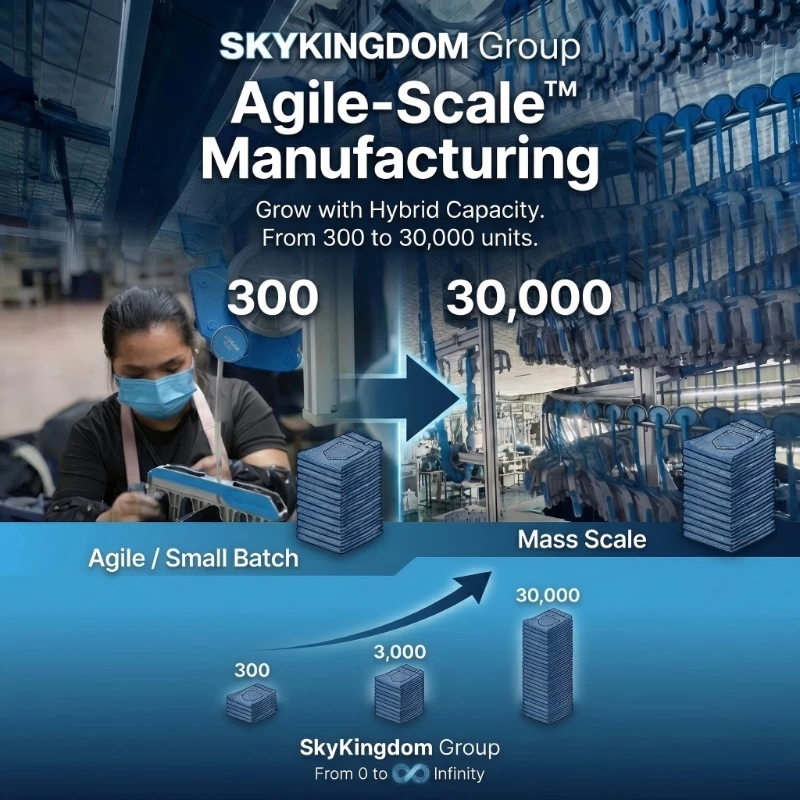
SkyKingdom has operated in Xintang, Guangzhou – China’s largest denim production cluster – since 2008, working as an external denim product team for brands that need development, sampling, wash control, QC and reorder continuity. Before requesting trial collection pricing, prepare your reference images, target quantity, sample size, fabric direction and wash expectation so the project can be reviewed against the right production path.