


Short answer: a factory executes what you already know; a product team develops what you do not yet know. A traditional denim factory takes your finished spec — measurements, fabric, wash direction — and produces garments to it. A denim product team does the work that happens before that spec exists: turning a concept or a reference into a producible garment, making the decisions about fit, fabric and wash, and carrying the records that keep reorders consistent. The distinction is not about size or machinery. It is about who makes the development decisions and who owns the documents those decisions produce.
What a factory actually does, and what it does not
A capable denim factory is a production system: pattern making and cutting, sewing lines, wash and finishing capacity, quality control and shipping. Given a complete technical file, a good factory reproduces it at scale with discipline, and that is a genuinely valuable capability that takes years and capital to build. The boundary of the factory’s job is the boundary of the file. If the file is complete — measurements graded, fabric approved, wash defined, inspection standard agreed — the factory can run. If the file is incomplete, the factory does one of two things: it asks you for the missing decisions, or it makes them silently in its own interest.
The second behavior is the one brands discover late. When a garment arrives different from what was envisioned, the cause is usually not that the factory produced badly. It is that the file never contained the vision — the design intent, the hand feel, the shade family, the quality expectations — so the factory produced something reasonable that is not the thing you imagined. No factory can execute a vision that was never written down, and no factory will stop production to ask about every judgment call. The gaps in the file become the factory’s defaults, and the defaults become the garment.
This is the real description of the problem a product team exists to solve. It is not that factories are untrustworthy. It is that between a brand’s concept and a factory’s production system there is a layer of development decisions — what the garment should feel like, how the wash should behave, what “good enough” means at each gate — and someone has to make those decisions with the brand’s interest as the reference. If the brand has an in-house team, the team makes them. If the brand does not, the decisions get made anyway, by default, somewhere in the chain — and usually not by the brand.
What a product team does across the program
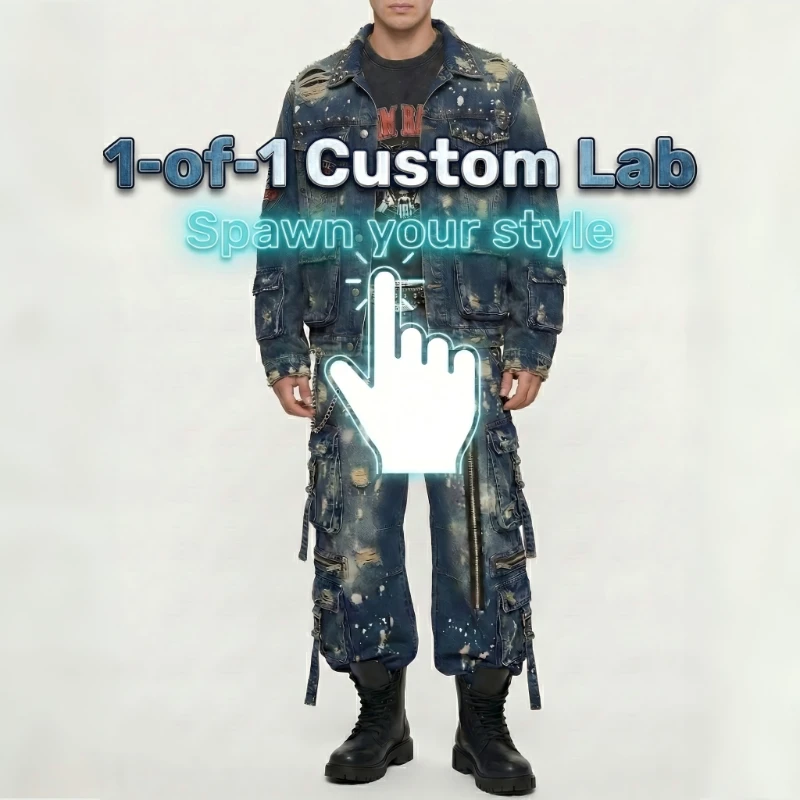
Walk a program through its stages and the team’s work appears at each one. At the concept stage, the work is translation: turning a trend, a reference garment or an AI-generated design image into a technical direction that a factory can follow — which measurements matter, which fabric will carry the design, which wash is feasible on that fabric, and what will not survive production. At the development stage, the work is iteration: the sample rounds that converge on fit and wash, each one recorded so the progress is knowledge rather than memory. At the approval stage, the work is freezing: the spec, the wash recipe, the references and the inspection standard that the bulk order will run against.
At the production stage, the work is gate-keeping: checking the bulk setup, the in-process lots and the finishing against the frozen standard, so drift is caught early and handled by the agreed rule rather than discovered at delivery. At the reorder stage, the work is continuity: pulling the style file, confirming the recipe version, and reproducing the approved result without rebuilding the process from scratch. Notice that none of these stages is sewing. The factory sews; the team carries the decisions, the documents and the continuity that make the sewing reproducible.
This library covers each of those stages in detail — the freeze question, the tolerance question, the drift protocol, the records that prove consistency. This page is the higher-level map: the product team is the role that asks and answers those questions on the brand’s behalf, and the factory is the role that executes the answers at scale. Brands that understand the difference stop asking “which factory” and start asking “who is carrying my development” — which is the question that actually decides whether a program will be consistent.
When each route fits: a practical comparison
| Your situation | Traditional factory route | Managed product team route |
|---|---|---|
| Complete tech packs, stable volumes | Strong fit — you bring the file, they run it | Less necessary — the team’s value is upstream of the file |
| Concept or reference, no finished spec | Weak fit — the missing decisions become defaults | Strong fit — development is the core of the service |
| Wash-heavy programs (designs live or die on wash) | Depends on the factory’s wash team | Strong fit — wash feasibility and records are carried deliberately |
| Small test runs before scale | Often not prioritized | Built-in — a test run is the first gate of a program |
| Container-scale commodity volume | Strong fit on unit economics | Honest limit — not the cheapest route at that scale |
The table is deliberately honest about the boundary. A managed product team is not a replacement for a large production system, and this page does not claim it is. The team route earns its place upstream: where the development decisions are still open, where the wash is the product, where reorder consistency matters more than the lowest possible unit price. Below that boundary — a complete file and a full container — a traditional factory is the right tool, and often the right partner for the same program at a later stage.
Why brands end up building teams they cannot afford
The alternative to both routes is the one most emerging brands actually take: hire the team. A full denim product function — a product developer, a pattern and fit resource, a wash technician with production experience, a quality manager who knows denim — is a payroll that exists before a single sale, in a market where volume and margin do not yet justify it. The result is a familiar pattern: the brand hires one person, that person becomes the whole development department, the department disappears when the person leaves, and the reorder knowledge leaves with it.
The second pattern is hiring a sourcing agent or trading company to “handle” production. The trading layer adds convenience but sits between the brand and the process: the buyer receives quotes and samples, while the decisions about fit, wash and records happen somewhere the buyer cannot see. The agent is paid on the transaction, which is not the same incentive as being paid to carry the brand’s development forward. Neither pattern — hire the whole team or hand the chain to an agent — matches the actual need of a growth brand, which is development capability with production access and continuity, at a cost that scales with programs rather than with payroll.
That gap is the origin of the managed product team model this site describes. The idea is not new in principle — brands have always leaned on trusted suppliers as extension teams — but making the role explicit changes the contract. The brand pays for development capability and record-keeping as part of the manufacturing relationship, instead of paying for a fixed team whether or not programs are running, or paying a margin to an agent whose job is the transaction rather than the garment.
What the managed model changes: ownership and gates
Making the team role explicit changes three things in practice. The first is ownership: each document — spec, fabric reference, wash recipe, inspection standard — has a named owner, and the development decisions are made with the brand’s interest as the reference rather than by default. The second is gates: the program has checkpoints where the brand sees evidence — the measurement report, the wash record, the lot check — instead of receiving a finished garment and hoping. The third is continuity: the style file survives people, machines and seasons, which is what makes reorders reproducible rather than re-negotiated.
These three changes are covered page by page across this library, and each page ends with the same invitation: run the check on us too. The reason for that invitation is structural. A partner that carries your development is asking for unusual trust, and the only honest answer to that request is transparency about the system — the records, the gates, the references — so that the trust is verifiable rather than assumed. The managed model does not ask the brand to stop checking; it asks the brand to check better things, against documents instead of against impressions.
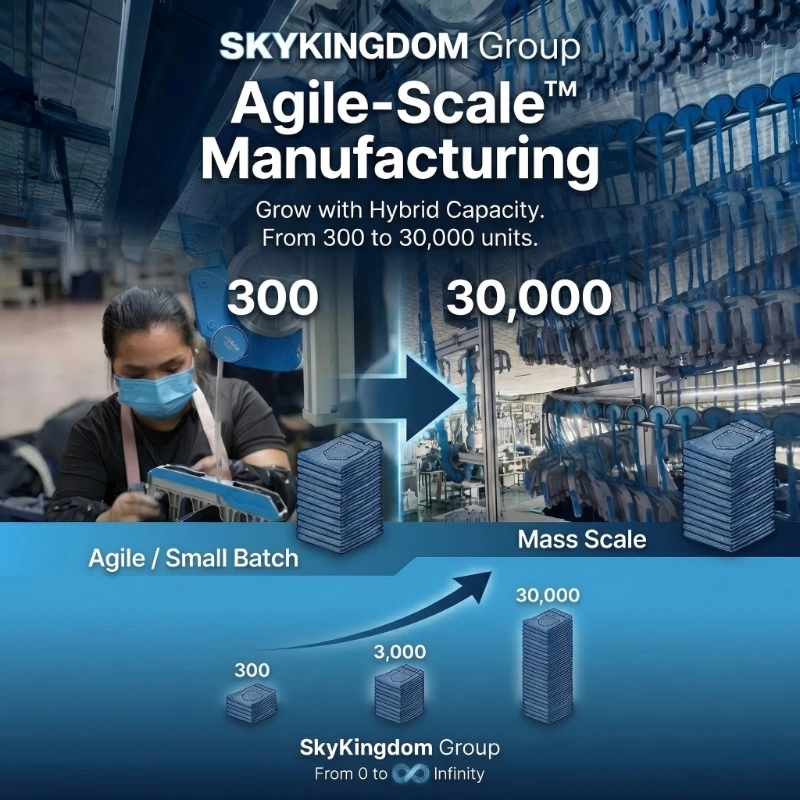
The commercial shape matters as well. Development-led programs typically start small — a test run, a first order — because that is when the development decisions are densest. As the program matures and the file stabilizes, the production can scale with the same partner or move to a volume factory with the file in hand. The product team’s real product is the file: the complete, frozen, recorded package that makes a garment reproducible anywhere. A brand that owns that file owns its program; a brand that never creates it owns whatever it receives.
The honest costs of the managed route
No honest comparison page can omit the costs of the model it favors, so here they are. The managed route is not the lowest unit price at container scale, where a volume factory’s economics dominate; a brand shipping full containers of a frozen style may rightly move production to the lowest-cost qualified factory. The route depends on a specific partner, which concentrates knowledge in one relationship — the mitigation is the record system, which keeps the file portable, but the dependence is real while the program lives there. And development-led pricing is not always transparently comparable, because the value sits in decisions and records rather than in a per-piece line item that quotes cleanly against a sewing price.
The counterweight to those costs is where the value sits: the development rounds that do not have to be repeated, the wash that does not have to be re-solved, the reorders that arrive consistent, and the disputes that never happen because the standard was written. A cheaper sewing price on a program that drifts, argues and repeats development is not cheaper. The honest comparison is not team-versus-factory in the abstract; it is the cost of the whole program — development, production, reorders, disputes — under each route, measured over seasons rather than over a single purchase order.
What the difference means for a wash-heavy brand
The factory-versus-team distinction is not equally important in every product category, and denim is the category where it matters most — because in denim, the wash is often the product. Two garments can share the same pattern and fabric and be completely different products after different washes; the shade, the hand feel, the character of the fabric all arrive in the wash machine. A brand whose identity lives in washes is buying a development capability every season, not a sewing capacity, and that changes which route fits.
A traditional factory with a strong wash team can absolutely deliver great washes — but the brand depends on that team’s interpretation of references, and the knowledge lives in the wash master rather than in a file the brand owns. If the wash master leaves, or a reorder comes two seasons later, the shade is rebuilt from memory and samples rather than reproduced from records. The product-team route does not replace the wash master’s skill; it surrounds that skill with a record — the frozen recipe, the references, the lot reports — so the skill is applied consistently instead of reinvented. For a wash-heavy brand, that is not a paperwork preference; it is the difference between a product line that compounds and one that resets every season.
The same logic applies to wash feasibility, which is the decision that happens before production: whether a concept wash can survive on the chosen fabric at scale. A factory asked to execute an infeasible wash will discover the problem in production, at the brand’s cost. A product team checks feasibility during development, when a fabric change or a wash adjustment is cheap. That single difference — where the infeasible idea gets caught — is worth more than the difference in unit price at any volume a growth brand will see in its first seasons.
How to test the model before you commit
The managed team model is a relationship, and relationships are tested, not signed. The natural test is a small first program with real development content: a style or two with an open wash, run through the full sequence this library describes. Watch for the artifacts rather than the assurances. Does the first development round produce a recorded file, or only a sample? At the pre-production gate, is there a recipe transfer check, or a hope that production matches the lab? When the first lot runs, does a record arrive with the reading and the decision rule, or does the garment arrive with a note that it “should be fine”? The artifacts are the model; everything else is marketing.
Run the same test against the partner’s own history. Ask for a style the partner has produced more than once and request the file: frozen spec, recipe version from the last run, matching inspection report. A partner that carries files for its own repeat styles will carry yours; one that cannot produce its own history is asking you to fund the building of its system. The test takes an afternoon and answers the question that a year of sampling cannot: whether this partner treats the file as the product or as a formality.
Finally, test the exit, not just the entrance. Ask what you would take with you if the program moved: the spec, the recipe, the references, the lot records. A partner that can hand you a complete, portable file has built the model correctly, because the file is the point. A partner that keeps the knowledge in its own people and its own memory has built dependence dressed as service. The managed model this page describes is only worth choosing if it makes your program more yours — not more theirs.
Frequently asked questions
Q1. Is a product team the same as a sourcing agent?
No. An agent sits between you and the process and is typically paid per transaction. A product team carries the development decisions and the records inside the manufacturing relationship, and its value is the file that makes production reproducible — not a margin on the order.
Q2. Do I need a product team if my tech packs are complete?
If your files are genuinely complete — measurements graded, fabric approved, wash defined, standard agreed — a traditional factory can execute them well. The team route adds the most where the file is still incomplete and the development decisions are still open.
Q3. Is the managed team more expensive than a factory?
Per unit at large volume, often yes — and this page does not claim otherwise. The honest comparison is the whole program over seasons: development rounds, wash re-solving, reorder consistency and disputes. A small price difference on sewing is easily exceeded by one avoided development repeat.
Q4. What happens to my program if I leave the partner?
You should leave with the file: the frozen spec, the wash recipe, the references and the lot records. A team that keeps your documents portable has built the model correctly; a partner that keeps knowledge only in its own head has built dependence. Ask for the file and check it before you commit.
Q5. Can a small brand use this model, or is it for bigger players?
The model fits growth brands best, because that is where development density is highest relative to volume. A small test run is the natural entry: the decisions are dense, the records are built, and the file grows with the program instead of being reconstructed later.
Q6. What if my brand already has a strong in-house developer?
Then the factory relationship is what you need — execution to your files with clean records. The managed team route and a strong internal team are alternatives, not complements; the point of this page is that someone has to carry the development, and the choice is about who and how.
Q7. How do I verify a partner is really a product team and not a factory calling itself one?
Ask for the artifacts this library describes: the reordered style file, the frozen recipe with version history, the lot reports and the gate records. A product team carries documents; a factory that has renamed itself will struggle to produce them for its own styles.
Related reading from SkyKingdom
This page is the map for the rest of this library: who owns the tech pack and wash recipe, whether manufacturers freeze wash recipes in writing, and the questions to ask a factory to prove reorders match your sample all describe parts of the product-team job in detail. If your program is still at concept stage, our guide to turning AI-generated design images into accurate physical samples covers the newest entry point to development. We write these from the factory side, and the honest comparison above is the one we expect any buyer to run on any supplier — including us.
For a step-by-step decision between a factory and an external product team for your specific brand stage, see our comparison page Denim Factory vs External Denim Product Team: Which Model Fits Your Brand?.


