

How Denim Brands Reduce Inventory Risk on a First Order
Short answer: inventory risk on a first denim order is reduced before the order is placed — by right-sizing the first run to what the brand can genuinely sell, by keeping the unit economics honest instead of chasing a low per-piece number that forces overstocking, and by building a reorder path that lets the brand buy small and replenish fast rather than betting the season on one big buy. The goal of a first order is not the cheapest unit cost; it is a sellable test that does not leave the brand holding stock it cannot move.
Inventory risk on a first order is not the risk that the product fails — that risk is visible and manageable. The hidden risk is the structure of the order itself. A brand that orders too much to chase a lower unit price is converting a product test into a warehouse bet: if the style does not sell at the expected rate, the “savings” on unit cost are repaid many times over in cash tied to unsold stock. A brand that orders too little, by contrast, faces the opposite failure: the style sells out, the reorder takes too long, and the momentum the brand worked to build is handed to competitors.
The first-order problem is therefore not one problem but two — overstocking and stockout — and both are caused by the same underlying error: treating the first order as a one-time purchase decision rather than as the first step of a repeatable ordering system. A first order that is designed to be reordered behaves differently from a first order that is designed to be final. It is smaller, it is documented, and it is placed with a supplier that can actually replenish it on a timeline that matches sales rather than a timeline that suits production.
Denim adds a layer of difficulty specific to the category. Denim is a product whose character — the wash, the shade, the hand feel — is developed, not assembled from standard parts. A reorder of a denim style only reproduces the first batch if the first batch was documented: the frozen baseline, the wash recipe as a technical record, the shrinkage and measurement data. A brand that places a small first order with a supplier that does not keep these records has not reduced its risk; it has deferred the risk to the reorder, where it will surface as a shade that no longer matches and a sellable style that cannot be replenished. The records are not paperwork; they are the mechanism that makes small-first-buy safe.
Right-sizing the first run: what “enough” actually means
The first instinct of a new brand is often to ask “how few can I order” — the smallest number that lets the brand test without betting the company. The better question is “what is the smallest order that still makes the product economics honest.” In denim, development carries fixed costs: pattern, grading, wash development, chemical setup, inspection. Those costs do not shrink with the order size; they are spread across whatever quantity is ordered. Below a certain point, the unit price rises sharply not because anyone is overcharging but because the fixed costs of making a proper denim garment have fewer units to share across.
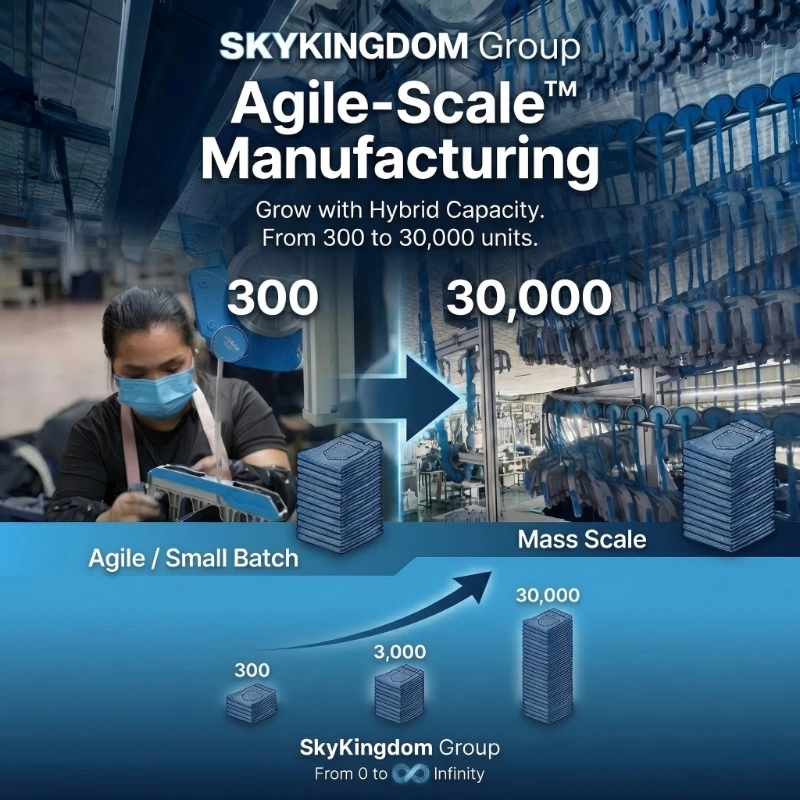
In our practice, the working line is around three hundred pieces. A first order at or above that level runs on the regular production program, where the cost structure is designed for efficient repeat production. Below three hundred pieces — down to the fifties — the order runs on what we call the boutique small-batch program: the same development discipline and the same documentation, but with a cost structure that reflects the reality that small runs spread fixed costs over fewer units. The honest way to say it is simple: the smaller the run, the higher the per-piece cost, and any supplier that promises small-batch pricing identical to volume pricing is either hiding the difference somewhere else or not doing the development work at all.
Right-sizing, then, is a trade the brand makes consciously: order enough that the unit economics are not punishing, but no more than the brand can sell through in a realistic first season. For most new denim brands testing their first original style, that lands in the fifty-to-three-hundred-piece range — small enough to test without warehouse risk, large enough that the price per piece reflects real development rather than a vanity run. The number is not the goal; the goal is a first order whose economics the brand can honestly model, and whose result the brand can honestly read as a test.
Keeping unit economics honest at small quantity
The unit price on a small first order deserves a clear explanation, because it is where brands most often feel they are being taken advantage of. A fifty-piece run and a five-thousand-piece run of the same style both need a pattern, a graded size set, a wash development programme and an inspection. On the five-thousand-piece run, those costs are a rounding error per unit; on the fifty-piece run, they are a meaningful part of each garment’s price. The higher per-piece price at small quantity is arithmetic, not markup — and a brand that understands the arithmetic will ask the right follow-up questions: what exactly is included in this price (development, samples, records, inspection), and what would be excluded if the brand chose the cheaper quote?
Honest economics also means not letting the unit price push the brand into over-ordering. The temptation is real: at five hundred pieces the price per piece drops meaningfully below the price at one hundred and fifty. A brand that orders five hundred “because the economics are better” has just converted a product test into a stock position — and has paid for the privilege with cash that could have been spent on a second style, a second colour, or the marketing that actually sells the first run. The cheapest unit cost in the world is expensive if it sits in a warehouse. The discipline is to size the order to the test, accept the honest small-run economics, and let the reorder — not the first order — capture the volume savings once the style has proven itself.
Splitting risk by style and by process
A second lever for reducing first-order risk is structural: do not put the whole test into one style, one colour or one wash. A brand testing a denim line is better served by two or three styles in smaller quantities than by one style in a larger quantity, because the information gained — which silhouette, which wash, which price point the market responds to — is worth more than the marginal unit saving of concentrating the buy. The same logic applies within a style: a core colour in the main quantity, with a second colour in a deliberately small test quantity, tells the brand whether the colour sells without betting on it.
Risk is also reduced by how the order is planned at the process level, not just the style level. In our practice, we start by breaking the customer’s order — or the customer’s idea — apart to identify which parts carry production risk or process risk. A style may be straightforward in construction but carry a wash that is genuinely difficult to reproduce; another may be simple in wash but demanding in fit or trim. Identifying those risk points before production, and giving the customer our day-to-day production advice on them, is where a factory with real denim experience earns its keep. The brand that knows in advance which part of its order is the risk is the brand that can decide, consciously, whether to accept, adjust or redesign that part — instead of discovering the risk in the middle of production, when every change is expensive.
This risk-splitting conversation is one of the reasons a first order should be placed with a supplier that carries development rather than one that merely executes instructions. An executor quotes on what it is given and discovers problems during production, billing the surprises as change orders. A development partner reads the order for risk in advance, raises the questions before the fabric is cut, and lets the brand make the trade-offs with full information. The second conversation is slower on day one and dramatically cheaper by the end of the season — which is exactly the trade a brand reducing first-order risk should want to make.
Building the reorder path: why replenishment matters more than the first buy
The single most underrated risk-reduction lever is the reorder path. A brand that can buy small and replenish fast carries dramatically less inventory risk than a brand that must commit to a season’s volume up front — because the second brand is guessing demand months ahead, while the first is buying against actual sell-through. The entire model of small-first-buy-plus-fast-reorder depends on one thing: a supplier that can actually deliver the reorder on a timeline that matches the brand’s sales, with the style reproduced faithfully from documentation rather than from memory.
This is the capability we have spent twenty years building, and it is the reason the customer cases on our website are the validation rather than the decoration: the fast-replenishment capacity is reserved for customers who meet the baseline conditions of a well-documented, well-planned program. That reservation matters. A supplier that promises fast reorders to everyone delivers fast reorders to no one; a supplier that reserves its fast-replenishment capacity for programs that are run properly — documented baselines, realistic planning, committed communication — can actually deliver it when it matters. The brand that wants the reorder safety net should therefore behave like the kind of customer who can use it: plan the program, keep the records, and treat the relationship as a partnership rather than a spot buy.
The documentation requirement connects directly to inventory risk. A style whose reorder can be produced from its frozen baseline and reorder file can be replenished in weeks rather than re-developed in months. That difference in replenishment speed is what lets the brand buy the first run small and confident — because the cost of being wrong about demand is a reorder wait, not a warehouse. The records that make fast replenishment possible are the same records that make the first order a genuine test: the file is the bridge between a small, safe first buy and a scalable, profitable reorder program.
The other failure: selling out and not being able to reorder
Inventory risk has a mirror image that new brands rarely plan for until it happens: the style sells out — and the reorder cannot reproduce it. The brand that orders small has done the right thing on the downside, but if the supplier cannot replenish the style to match the approved sample, the upside is capped exactly when the brand needs it most. This is where denim’s specific difficulty returns. A reorder of a washed denim style reproduces the first batch only if somebody kept the record: the wash recipe as a technical data sheet, the fabric details, the shade references, the measurements, the decisions made between sample rounds.
A brand that tested small with a supplier that keeps no such record has not eliminated inventory risk — it has traded a warehouse risk for a stockout risk, and the stockout may be worse, because it caps the brand’s best-selling style at the size of the first cautious run. The mitigation is not to order more; it is to verify, before the first order, that the supplier can actually reproduce the style. Ask to see how a past style’s reorder was run: was it produced from a file or from memory? Ask what records the supplier keeps for each style and whether the brand will hold copies. The answers tell the brand whether the small-first-buy strategy is safe — whether “small” is a risk-reduction lever or just a delay of the risk to a moment when the brand is least able to absorb it.
This is also why the fast-replenishment conversation belongs before the first order, not after the sellout. A supplier’s reorder speed is not a number in a brochure; it is the product of its planning discipline, its documentation habits and its reserved capacity. A brand that asks about reorder speed only after selling out is negotiating from weakness — the style is proven, the stock is gone, and every week of delay is lost sales. A brand that asks before the first order — what will a reorder cost, how fast can it run, what records will make it faithful — is negotiating from strength, and will discover which suppliers treat replenishment as a real service rather than a hopeful promise.
Planning the first order as a program, not a purchase
The brands that manage first-order risk best share one habit: they plan the first order as the first step of a program rather than as an isolated purchase. The program frame changes every decision. The quantity is chosen with the reorder in mind — small enough to test, structured enough to scale. The documentation is agreed before production — what the supplier will keep, what the brand will hold, how a reorder will be quoted and scheduled. The calendar is planned across two or three order cycles rather than one — when the first run should land, when the sell-through read will happen, when the reorder window opens. And the supplier is chosen on the reorder capability as much as the first-order price, because the reorder is where the program either compounds or collapses.
The program frame also changes how the brand reads the results. A first order is not a success because it sells out instantly, nor a failure because it sells slowly; it is a source of information either way. The brand that planned a program reads the first run’s sell-through curve, listens to which styles and colours moved, and feeds that information into the second order — adjusting quantity, colour mix and wash direction on the basis of evidence rather than hope. That is the actual mechanism of inventory-risk reduction: not a clever formula at the first order, but a learning loop that makes every subsequent order smaller relative to the information it carries. The first order buys the data; the second order spends it.
None of this requires the brand to become a supply chain expert. It requires the brand to work with a supplier that runs this way — that documents styles, reads orders for risk, reserves fast-replenishment capacity for well-run programs, and treats the first order as the beginning of a relationship rather than the end of a transaction. The supplier’s discipline is the brand’s risk reduction, and it is visible in the first conversation: in how the supplier talks about records, reorders and risk, before a single garment is ordered.
Frequently asked questions
What is a safe first order quantity for a new denim brand?
In our practice, the working line is around three hundred pieces for the regular production program; below that, down to the fifties, the order runs on the boutique small-batch program with a cost structure that reflects the fixed costs of development spread over fewer units. The right quantity is the smallest run whose economics are honest and that the brand can realistically sell through — for most new brands testing an original style, roughly fifty to three hundred pieces.
Why is the per-piece price higher on a small order?
Because denim development carries fixed costs — pattern, grading, wash development, chemical setup, inspection — that do not shrink with order size. On a large run those costs are a rounding error per unit; on a small run they are a real part of each garment’s price. The higher unit price is arithmetic, not markup. What matters is what the price includes and whether the economics are honest at the quantity ordered.
How do brands avoid overstocking on a first order?
By sizing the order to the test rather than to the unit price. The discipline is: order the smallest quantity whose economics are honest, split the test across styles or colours rather than concentrating it, and build the reorder path before placing the first order so that sell-through can be met with replenishment rather than with a season-sized bet.
What makes a first denim order a genuine test rather than a gamble?
A genuine test has four features: the quantity is sized to what the brand can sell, the unit economics are honest (not artificially low through over-ordering), the risk points of the style — construction, wash, fit — are identified before production, and the style is documented so that a reorder can reproduce it. Without the documentation, even a small first order defers its risk to the reorder.
Can a small first order be replenished quickly if it sells out?
It can, when the supplier has fast-replenishment capacity reserved for well-run programs and the style is documented to the level where a reorder runs from the file rather than from memory. This is why the reorder path — not just the first price — should be part of the supplier conversation before the first order is placed.
Summary
Inventory risk on a first denim order is decided before the order is placed: by right-sizing the first run to an honest test rather than to a tempting unit price, by splitting risk across styles and processes, by identifying the production and process risk points before the fabric is cut, and by building a reorder path that lets the brand buy small and replenish fast. The supplier matters as much as the quantity — a development partner that reads the order for risk and documents the style for replenishment converts a first order from a warehouse bet into a genuine, scalable test. The brands that reduce inventory risk are not the ones that order least; they are the ones that order smallest, honestly, with a reorder plan already in place.
Related reading
30-piece MOQ supplier vs development partner · What a frozen production baseline contains · A realistic first sample revision loop


