SkyKingdom Group | Empowering Creators Globally




Home / What We Handle / Denim Washing & Finishing
Stone wash, enzyme wash, mud wash, dirty wash, acid effects, whiskers, shade development, shrinkage and stretch recovery. Nine finishing areas, the risk each one carries, and what has to be sealed before a batch is produced.
HOW TO READ THIS PAGE
Denim finishing is where a reference image is converted into something a production line can repeat. That conversion is technical. The same visual reference can be produced by very different routes, and each route leaves a different fingerprint on the fabric: how much surface the process removes, how the colour behaves after repeated laundering, how the garment measures after washing, and how the fabric recovers if it contains stretch.
The nine sections below follow the order in which these decisions bind: what the finish does to the surface, how the colour is developed and matched, and what the wash does to the measurements and the elasticity of the finished garment. Each section states the risk and what we ask to be confirmed.
Two related pages complete the picture. The dark, mottled and tinted family is developed in detail on custom dirty-wash denim development, and the physical destruction of denim is handled separately on ripped and distressed denim. Comparisons between finishes live in Denim Decision Tools.
MECHANICAL FADE
Stone wash is a mechanical finish. The garment is tumbled with abrasive stone, whose friction wears the indigo off the raised surfaces of the fabric and softens the hand. The result is the classic all-over faded cast with a harder surface character, and it remains the reference point for brands whose look depends on that worn, vintage appearance.
The risk sits in control rather than in concept. The same nominal process produces visibly different results depending on the fabric, the garment weight and how the load is run, and the abrasion can thin the fibre at high-wear points if it is pushed. What we ask to be confirmed before a stone-wash batch is the target fade depth, the hand the brand wants, and which points on the garment must not be weakened.
The waste side matters commercially as well as environmentally: the process produces stone residue and dust, and it consumes water to move the load. That is part of why many brands now treat stone wash as one step in a sequence rather than as the whole recipe.
BIOLOGICAL FADE
Enzyme wash replaces part of the mechanical action with a biological one. Cellulase enzymes act on the surface cellulose of the denim, releasing indigo and producing a softer, more natural fade without stone. Because the action is at the surface rather than a mechanical abrasion of the fibre, the process is generally gentler on the yarn and leaves a softer hand.
The control variables are narrower and less forgiving. Enzyme activity depends on temperature, pH, dwell time and the ratio of liquor to garment, so the same recipe can drift if any of those move. This is why an enzyme finish is developed and sealed on the production fabric rather than approved from a photograph, and why the sealed sample, not the written recipe alone, is the production standard.
The measurable environmental difference is real but modest. Published research comparing enzyme wash with stone wash measured savings in the region of ten percent on water and a low single-digit percentage on energy, under that study’s own conditions. Any figure far larger than that should be treated as marketing until it is attached to a source that can be read.
TONE AND CAST
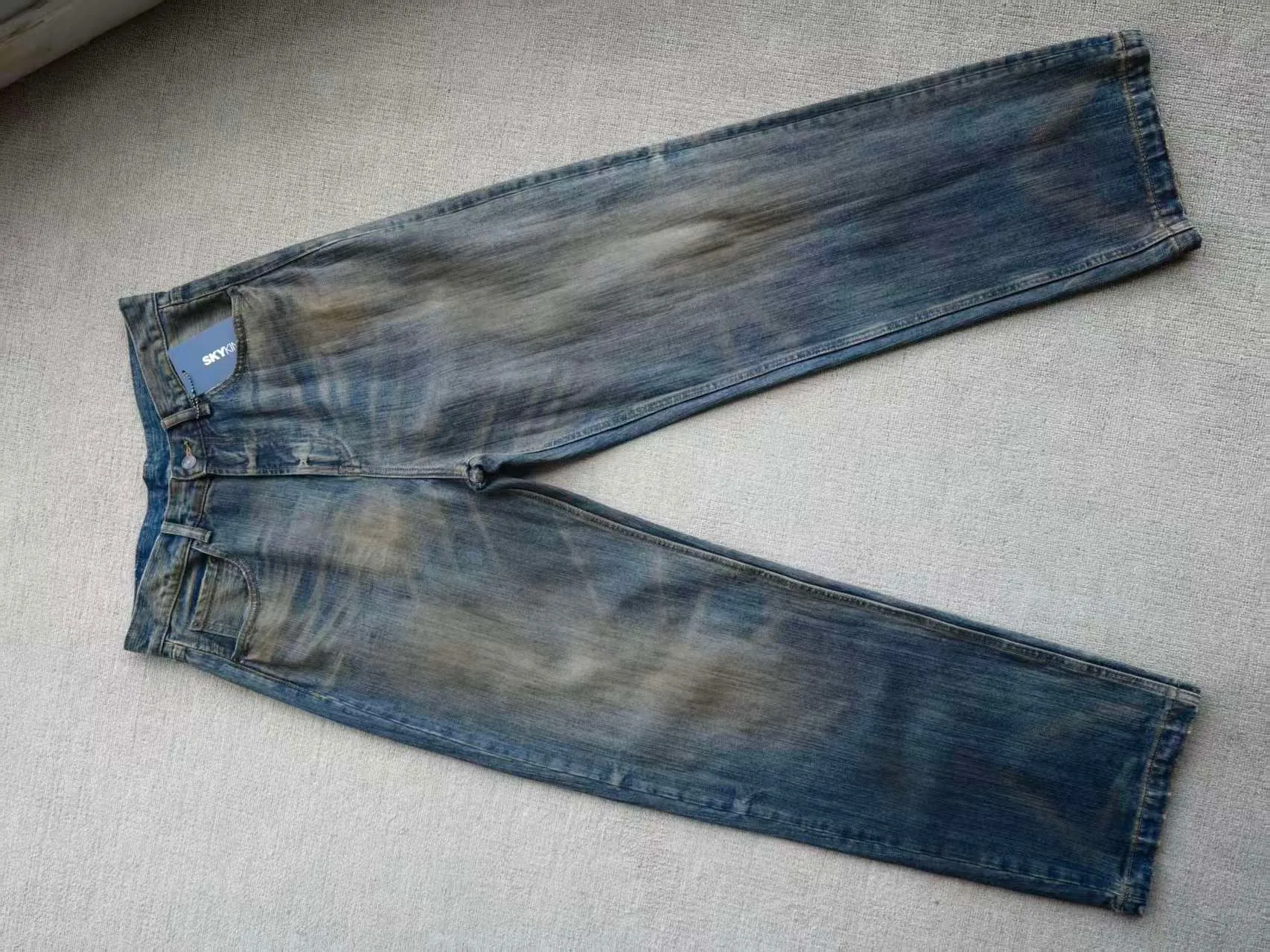
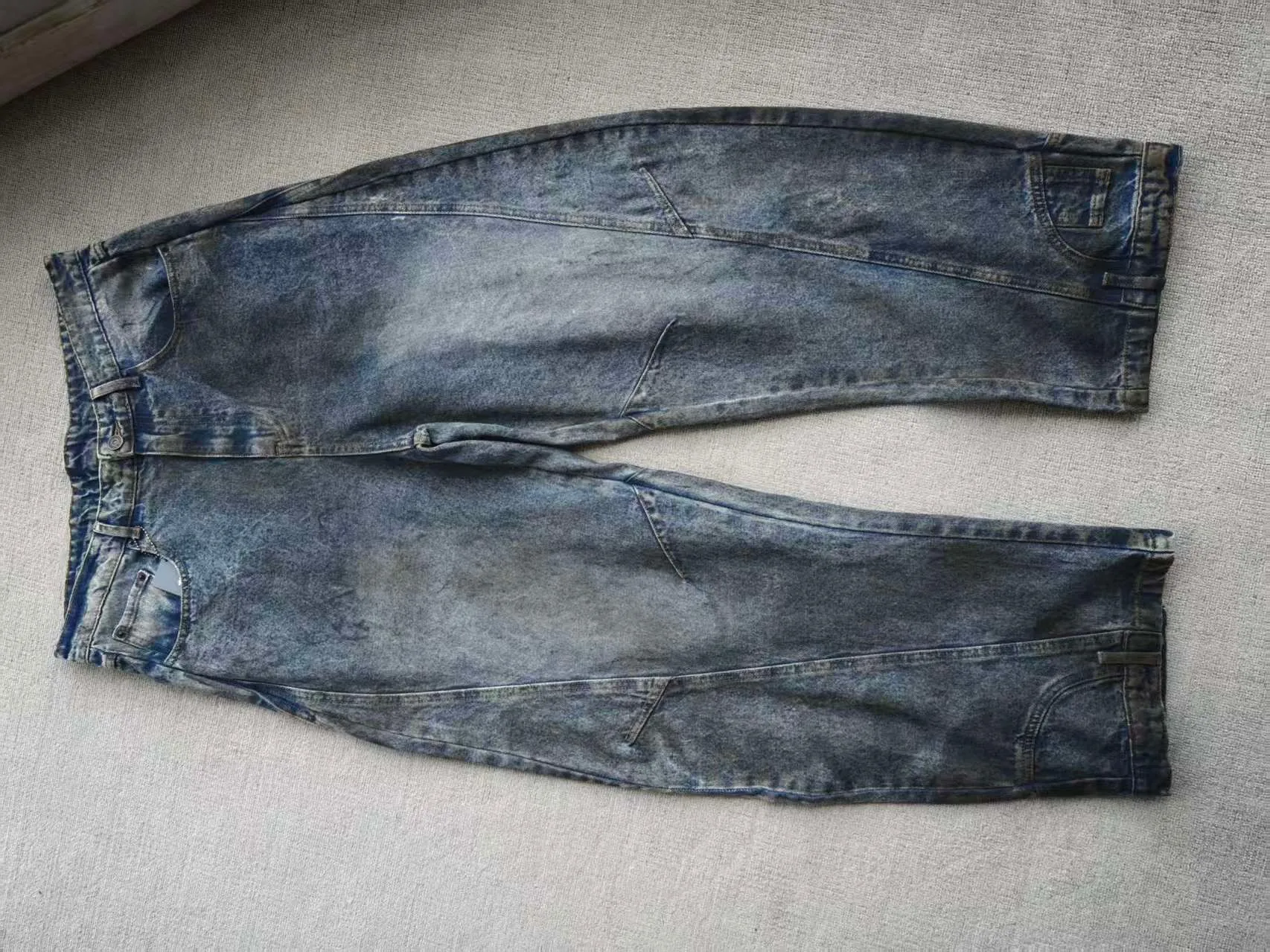
Mud wash is a tone-driven finish. Rather than removing colour evenly, it deposits and layers pigment so the garment reads as mottled and earthy, with the blue base showing through unevenly. The effect is closer to a stained or weathered surface than to a uniform fade, which is exactly why it is difficult to approve from a photograph alone.
The control question for mud wash is distribution. The point of the finish is that it is uneven, so the specification has to define where the unevenness is acceptable and where it is not, particularly at seams, pockets and the front panel where the eye lands first. Batch-to-batch comparison is done against a sealed physical reference, not against the original reference image.
TONE AND CAST
Dirty wash sits next to mud wash and shares its logic: the finish adds rather than only removes. It covers the family of layered, grimy, lived-in finishes where several passes are used to build depth, and where the character of the result comes from the sequence rather than from any single step.
Because layering is the mechanism, reproducibility depends on the sequence being documented and on a physical approval standard existing. Industry practice for this family of finishes typically runs through a sequence of stages, from preparation of the fabric through to setting the final shade and hand. SkyKingdom’s own sequence and parameters are internal to production and are not published on this page; what is published is that the standard is a sealed sample plus a written record.
One consequence for brands: a dirty wash should be developed and approved before quantities are discussed, because the number of passes needed is not knowable until the finish is tried on the actual fabric.
CHEMICAL EFFECTS
Acid wash and bleach-based effects create localised colour removal. The classic acid-washed look comes from the uneven action of the treatment across the garment, producing a high-contrast, mottled surface rather than a smooth fade. Bleach-based effects are used where a lighter, more deliberate lift is wanted in selected areas.
This is the family with the highest risk to the fabric, because strong chemical action does not discriminate between the surface and the structure. The questions that matter are how far the treatment is allowed to travel into the yarn, what the fabric strength is afterwards, and how the treated areas behave after laundering. Treated areas are also where colourfastness and residue problems are most likely to appear, so testing is agreed per project rather than assumed.
In practice, the safest route is to keep the treatment local, approve it on a full garment rather than on a swatch, and define the maximum travel into the fabric as part of the sealed standard.
SURFACE DETAIL
These are the hand-applied details that give a washed garment its placement: whisker creases across the front hip, scraping along pocket edges and seams, grinding at the hem and around the hardware. They are positional effects, which means their quality is judged by where they sit and how symmetrically the left and right panels agree, not only by how strong they are.
Because they are applied garment by garment, this is the area where sample-to-bulk consistency is hardest to hold. The practical control is to define the placement on an approved garment with reference points noted, to keep the same set of placements across the batch, and to inspect left and right panels as a pair. Laser and machine-assisted methods can improve repeatability where the equipment suits the effect, but they do not remove the need for an approved placement standard.
COLOUR CONTROL
Shade development is the discipline that makes a finish repeatable. The output of development is not a recipe on paper but a sealed reference garment, together with the record of how it was produced. Every later comparison, whether in the same batch, in a later batch or on a reorder, is made against that reference.
The reason is that written wash descriptions are ambiguous. Terms such as medium, light or vintage mean different things to different lines, and the same term produces different results on different fabrics. A physical reference plus documented measurements removes that ambiguity and gives both parties something to inspect rather than to interpret.
For reorders, the useful practice is to keep the reference and its records with the style, and to compare each repeat against them. Where shade tolerance has to be agreed, it is agreed explicitly, because an implicit tolerance is the usual cause of a reorder dispute.
FIT AFTER WASH
A washed garment is measured after washing, not before. Indigo denim moves during finishing: warp and weft behave differently, and the amount of movement depends on the fabric construction, the pre-shrinkage treatment it received, and the intensity of the wash it then went through.
This is why the measurement sheet for a washed style has to state the conditions under which the measurements were taken. A measurement taken on a flat, unwashed panel is not the same specification as the same measurement taken after a defined wash cycle, and comparing the two produces fit arguments that neither side can win.
The working sequence is to establish shrinkage behaviour on the actual fabric before finalising the pattern, then to define the measurement points and the wash condition on the approved sample, and finally to inspect the batch against those points. Where a style is expected to be washed repeatedly by the consumer, the tolerance is agreed with that in mind.
STRETCH FABRIC
Stretch denim adds a variable that rigid denim does not have: the fabric changes not only in size but in elasticity. After washing, a stretch fabric can lose part of its ability to return, which shows up as a garment that grows at the knee, seat or waistband and does not come back.
The controlling factors are the elastane content and quality, the temperature and mechanical action of the wash, and the drying method. Aggressive heat and heavy tumbling are the usual causes of recovery loss, which is why the wash route for a stretch style is chosen with the fibre in mind rather than only with the desired appearance in mind.
In practice, the assessment should be made on the finished garment: measure the approved sample, wash it through the agreed cycle, measure it again and check the recovery. Where recovery is marginal for the intended wear, the corrective action is normally a change to the fabric or to the wash route, and it is cheaper to make that decision before the batch than after it.
WORKFLOW
REAL WORK
The garments below are SkyKingdom’s own washed styles, photographed as produced. They are shown as examples of the finish family, not as a catalogue: the point is that the finish was developed, sampled and produced rather than illustrated.
Where a finish has not been developed on a comparable fabric, we say so before quoting rather than after sampling.
Finishing sits between fabric choice, construction and quality control. These are the pages that continue each thread.
A reference image, a physical sample or a wash target is enough to start. The first pass says which route fits the fabric, what has to be sealed, and what still has to be confirmed before a batch is produced.