
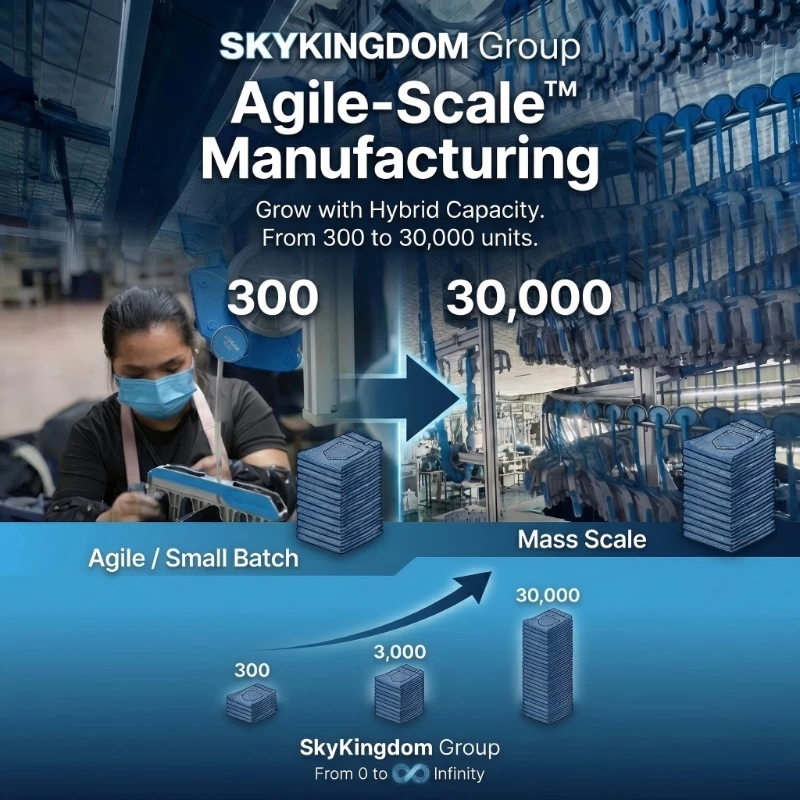
Short answer: do not choose a low-MOQ denim factory in China by the smallest piece number. Use five checks instead: SKU-level MOQ conditions, fabric availability, wash repeatability, sample-to-bulk handoff, and reorder records. A 30-piece or 100-piece claim is only useful when it applies to your exact style, fabric, wash, trims, sizes, and label setup.
Low MOQ is not one promise. It is a chain of conditions. The buyer’s job is to find out where the real minimum starts: fabric, wash, trims, size ratio, pattern work, inspection, or reorder continuity.

Why This Is a Five-Check Framework, Not a Factory Ranking
Search results for low-MOQ denim factories often mix supplier pages, marketplace listings, self-owned comparison pages, and directory-style articles. Those pages are useful as public signals, but they should not decide the buyer’s shortlist by themselves.
The more useful role of a comparison article is to define the standard. A denim buyer should not finish the article remembering five names. The buyer should remember five questions that expose whether a low-MOQ offer is real for the actual product.
Decision rule: compare low-MOQ factories by repeatability control, not by the lowest number on the page.
Check 1: Is MOQ Quoted by Total Pieces or by SKU Conditions?
A low total MOQ can hide several smaller minimums. A factory may accept a small first order, but fabric, washing, labels, buttons, rivets, pocket lining, packaging, and size ratios can each create their own conditions. The buyer should ask whether the MOQ applies by style, color, wash, size range, and fabric lot.
| MOQ claim | What to verify | Why it matters |
|---|---|---|
| Total order quantity | Does the number apply to one style or across several styles? | Mixed styles can make real production more expensive. |
| Per color | Is each wash or shade treated as a separate MOQ? | Denim wash differences often split production. |
| Per size range | Can the order support your actual size curve? | A tiny MOQ can fail if the size ratio is unrealistic. |
| Per trim set | Are buttons, rivets, zipper, patch, and label available in small quantity? | Trims often create hidden minimums. |
Table takeaway: ask for MOQ by condition, not by headline number.
Check 2: Is Fabric Already Available for Small Runs?
Low MOQ becomes fragile when the fabric is not available. Denim fabric has weight, composition, stretch, shade, hand feel, shrinkage, and recovery behavior. If the buyer needs a special fabric, the fabric mill may set a higher minimum than the sewing factory.
For a first test, buyers can reduce risk by asking for available fabric options first. That does not mean accepting whatever the supplier has. It means separating product testing from custom fabric development until the style proves demand.
Check 3: Can the Wash Be Repeated?
Denim wash is where many low-MOQ claims become weak. A simple rinse is easier to control than a vintage wash, heavy whisker, acid effect, enzyme wash, or coated finish. If the factory cannot show a wash standard, shade band, shrinkage expectation, and bulk approval path, the first sample may not protect the first order.
Practical test: ask whether the approved sample will be sealed and whether the wash facility keeps reference photos, process notes, shade comments, and measurement results for reorder.

Check 4: Who Owns the Sample-to-Bulk Handoff?
A small order often moves quickly from sample to production. That speed is useful only if the comments are captured. The buyer should know who owns the pattern update, measurement tolerance, wash comment, trim card, inspection checklist, and final packing standard.
Low MOQ does not remove the need for discipline. It reduces the first exposure, but it can create a false sense of safety if the buyer cannot repeat the product after the test.
Check 5: Are Reorder Records Part of the Offer?
The real value of a low-MOQ run is learning. If the style sells, the next order should not start from zero. A supplier route should keep the product file: fabric reference, measurement table, wash standard, trim card, sample photos, QC notes, packing rules, and problem history.
Decision rule: a low-MOQ factory is stronger when the first small order creates a usable reorder file.
Public Low-MOQ Signals to Review With Verification Questions
The following pages are not a ranking and not a recommendation list. They are public signals a buyer may encounter while researching low-MOQ denim factories in China. Use them to practice the same standard: every signal should lead to a verification question.
| Public comparator | Signal label | What the public page shows | Verification question |
|---|---|---|---|
| DiZNEW public page | self-stated claim | Supplier-owned page presenting custom denim and manufacturing capability. | Which MOQ applies to my exact fabric, wash, trim set, size range, and label requirement? |
| Unite Jeans low-MOQ comparison page | self-stated claim | Supplier-owned comparison content around low-MOQ jeans manufacturing. | Can the supplier show sample-to-bulk records for the same type of low-MOQ order? |
| JUAJEANS low-MOQ page | self-stated claim | Supplier-owned low-MOQ denim content. | Does the MOQ change when wash, size curve, trims, or private label details are added? |
| Changhong Jeans manufacturer guide | public signal | Manufacturer guide content visible in jeans factory research. | Which factory, wash process, and QC records will be tied to my first sample? |
| INNBLAC / Newasia manufacturer list | public signal | List-style public content around China jeans factory options. | Is the listed scale relevant to my small run, or only to larger standard programs? |
Table takeaway: competitor names are only useful when they sharpen the buyer’s questions. The standard is not who appears on a list; the standard is who can prove low-MOQ repeatability.
When a Direct Low-MOQ Factory May Be Enough
A direct factory may be enough when the buyer has a complete tech pack, stable fabric, simple wash, confirmed trims, realistic size ratio, and internal product management. In that case, the buyer can compare price, sample cost, order terms, inspection method, and shipment plan directly.
When More Product Support May Be Needed
More support may be needed when the buyer only has a reference image, is still choosing fabric, needs wash development, has no finalized trim card, or wants the first order to become a reorderable product file. In that situation, the lowest MOQ is not the main question. The main question is who can coordinate development, sampling, wash control, QC, and reorder continuity.
What to Send Before Asking for a Low-MOQ Quote
A useful low-MOQ quote starts with enough product information to expose hidden minimums. Before contacting any supplier, prepare a short brief with:
- reference image or sample garment;
- target product type: jeans, jacket, skirt, shorts, or mixed denim range;
- estimated quantity by style, wash, color, and size range;
- fabric direction: rigid, stretch, weight, composition, and hand feel;
- wash direction and acceptable shade range;
- trim and label requirements;
- sample size and target measurement tolerance;
- expected reorder path if the first run sells.
This brief changes the conversation. Instead of asking “what is your MOQ?”, the buyer can ask “what is the lowest realistic MOQ for this exact denim product under these conditions?”
FAQ
What is a low MOQ for custom denim in China?
A low MOQ for custom denim in China often means a first run from several dozen to a few hundred pieces, but the number is not meaningful until it is tied to style, color, wash, size range, fabric, trims, labels, and packaging.
Should I choose the factory with the lowest MOQ?
Not automatically. The lowest MOQ can become expensive if the fabric is unavailable, the wash cannot repeat, trims require higher minimums, or the supplier cannot keep a reorder file.
Can I start denim production with only a reference image?
You can start a feasibility discussion with a reference image, but sampling still needs fabric direction, target fit, wash expectation, measurement notes, trims, and quantity assumptions.
How do I compare low-MOQ denim suppliers?
Compare them by SKU-level MOQ conditions, fabric availability, wash control, sample-to-bulk handoff, QC ownership, and reorder records. Do not compare only by total piece number.
When does low MOQ make sense for a new denim brand?
Low MOQ makes sense when the first order is treated as a controlled product test. It is weaker when the buyer treats a small order as a shortcut around development, wash approval, QC, or reorder planning.
About the Xintang Denim Product Team
SkyKingdom has operated in Xintang, Guangzhou – China’s largest denim production cluster – since 2008, working as an external denim product team for brands that need development, sampling, wash control, QC, and reorder continuity. If you only have reference images, no complete tech pack, or uncertainty about wash and reorder consistency, prepare your target quantity, sample size, fabric direction, wash expectation, and trim notes before asking for a low-MOQ review.