

November 2026 | SkyKingdom Denim Consumer Research | Analysis by SkyKingdom
Two shoppers bought the same stretch jeans. One came back for a smaller size. The other paid to exchange theirs for a larger one. Both kept the jeans. Only one was happy with the waistband.
We found their reviews while reading Japanese marketplace listings for SkyKingdom’s November denim report. The question behind the research was simple enough to ask at any fitting: once these jeans go home, what would make someone reach for them again?
Two sizes, one waistband problem
One repeat shopper had needed a belt with the 5L size. Buying the same length in 4L solved the waist problem, and the hem landed where they wanted without rolling it up. Another shopper went up from 3L to 4L after finding the waistband uncomfortable. The larger size added room below the hips, yet the waistband felt much the same. The shopper reported keeping the jeans after paying for the exchange. To the retailer, both purchases might look like jeans that customers kept. Only one wearer described getting the fit they wanted. Original shopper reviews, July 24 and October 3, 2024

A third wearer on the same listing described a problem that a standing fit photograph would easily miss. The fabric stretched enough to pull the jeans on, but when the wearer stood up from a chair the hem caught on the calf. The useful question for a fit session is whether the leg falls back into place after sitting. Measuring the inseam alone would miss that detail. Original shopper review, July 5, 2024
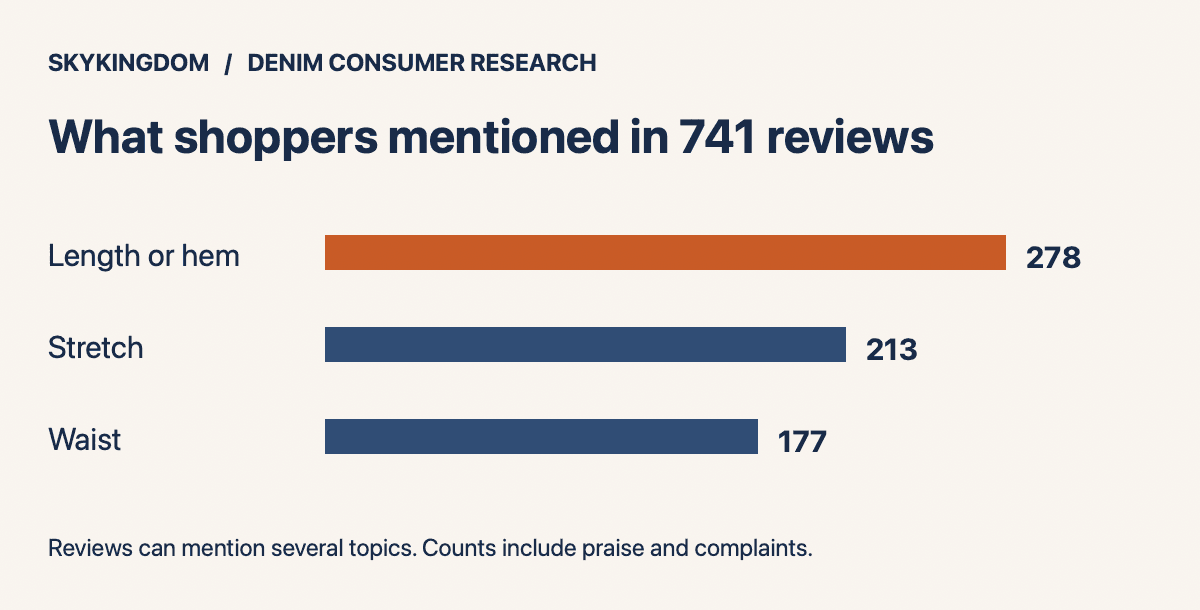
We collected 741 Japanese-language reviews from 56 Rakuten listings. Among those reviews, 278 contained terms for length, inseam or hem, 213 mentioned stretch-related wording, and 177 mentioned the waist. These are overlapping text matches, including praise and complaints. We searched for product listings in several styles, including wide, skinny and straight jeans, and retained reviews containing at least one of seven product-experience vocabulary groups. This selection favours reviews with specific product details. It cannot tell us how often a typical buyer has a fit problem. Nor do the 56 listing IDs establish 56 distinct designs: sellers can list the same model.
What people wanted when they bought jeans
Cotton Incorporated asked 10,183 consumers in 13 countries what mattered when they bought jeans. In its 2024 survey, 87% rated fit very important, followed by comfort at 85%, quality at 82% and durability at 77%. Those four answers would make a plausible brief for almost any denim collection. They still leave the pattern maker with a question. What exactly should change when the customer says a pair does not fit? Cotton Incorporated, Global Denim Jeans Outlook, published 2025
Our starting point was a collection of 127 Chinese- and English-language accounts. Eighty accounts mentioned a drawback. Fit or sizing came up in 45, well ahead of any other complaint. Here is what those broad categories meant at the fitting rail or at home.
| Drawback mentioned | Accounts among the 80 with a drawback | Decision a brand could investigate |
|---|---|---|
| Fit or sizing | 45 | Which dimensions need to work together for this customer? |
| Physical comfort or movement | 13 | At what point in a normal day does the garment become uncomfortable? |
| Durability or shape retention | 12 | What changed between first try-on and a later wear or wash? |
| Effort of sizing, alteration or exchange | 11 | What work does the customer take on to make the purchase usable? |
| Colour mismatch or transfer | 9 | Does the problem start with the product image or when the jeans touch another item? |
| Appearance or styling | 8 | Which part of the silhouette differs from what the shopper expected? |
| Pocket function | 3 | Can the wearer carry an everyday object while seated? |
Each row counts an account once. The same account can appear in several rows. A shopper who liked the silhouette, disliked the length and paid for hemming can tell a brand something about design, fit and the cost of keeping a purchase.
When sizing up solves only half the problem
In 25 accounts, the problem involved the proportions of the waist, hips and thighs. The direction of the mismatch mattered. One shopper went up in waist size to accommodate their thighs and still found several cuts too tight. Another described the reverse experience: when the jeans fit through the hips and legs, the waistband pinched. A blanket instruction to “size up” gives these shoppers the same advice despite their different needs. Discussion of thigh room in men’s jeans · Discussion of waist-to-hip fit
Length and the way the hem met the shoe came up in 18 accounts. Some shoppers deliberately sought a longer inseam to get the break they wanted. Others paid for alterations or returned the jeans. For a brand developing a flare, a full-length fitting photo with the wearer’s inseam, the garment inseam and the shoes in view would give the team a reference it can reproduce. Shortening every pair on the strength of a return could remove the very detail another customer wanted.
Four accounts mentioned both body proportions and length. Taken together, the two issues appeared in 39 distinct accounts out of the 45 with fit complaints (25 plus 18, less four overlaps). That gives a team with one fitting session a defensible starting point: record waist, seat and thigh together, then have the wearer step back in their own shoes. An overall score out of ten would discard much of what these shoppers were able to explain.
One Gap reviewer supplied a different kind of lead. After buying several pairs in the same labelled size and range, the reviewer reported a two-inch length difference between zip-fly and button-fly versions. That is one purchaser’s comparison. Before adjusting a pattern, the team could identify the variants, retrieve the specifications and measure the finished garments consistently. An intentional difference would call for clearer product information. A measured departure from the specification would send the team to production records. The public review alone cannot resolve the cause. Gap product review page
A pair can look right and still stay in the drawer
Appearance and style drew positive mentions in 50 accounts, comfort and movement in 40, and fit in 31. Of 93 accounts that mentioned something positive, 47 also described a drawback. One wearer liked how jeans looked on them and disliked the experience of wearing them. Others described repeatedly reaching for a familiar pair because it worked with clothes they already owned. First-person discussion of wearing jeans
That distinction changes the question a developer asks. “Which pair looks best?” captures a choice in front of the mirror. “Which pair did you wear the last time you left home, and what did you leave behind?” can uncover a waistband that digs in after lunch, a preferred silhouette or simply an easier outfit. A softer fabric deserves a trial alongside a structured one: some contributors valued the feel and wear marks of rigid denim.
The positive accounts also explain what a redesign could accidentally take away. One Douban contributor wore a longer pair across the seasons and chose raised shoes to get the desired hem. Another valued being able to layer underneath a stretch straight leg. In a workwear discussion, a long-time raw-denim wearer valued the fading that accumulated with use. For one customer, wearing in is part of owning the product. For another, a pair that demands a different shoe or a day of discomfort may never enter the weekly rotation. Ask what the existing garment gets right before changing its fabric or length. Douban wardrobe discussion · Raw-denim workwear discussion
An external check on what a recommendation means
A separately published archive of women’s clothing reviews offers a way to check the distinction between liking and keeping. We analysed 1,103 distinct jeans reviews there. Of 73 records using return-related wording, 49 carried a positive recommendation. In row 1002 a shopper reported an actual return because the thighs and hips felt tight while the waist felt loose. In row 960 the writer had tried on a pair somebody else had returned. This is why a returns dashboard needs a transaction outcome before counting a text match as a return. These archive records provide external context and are excluded from our directly collected sample. Public review archive
What a return record misses
Eleven accounts described the effort of finding a size, altering a pair or handling an exchange. The distinction matters to anyone measuring product success. A pair may stay with its owner because a tailor fixed the hem, because another exchange felt like too much trouble, or because the wearer would gladly buy it again. Each would appear as a retained sale. Only a follow-up question can separate them. A useful question for a brand to add after purchase is, “What, if anything, did you have to change before you could wear it the way you wanted?”
Washing introduces another point at which the answer can change. In the JD material, one reviewer described jeans that fit before washing and finished around the ankles afterwards. Another was happy with the colour and shape after two washes. These accounts cover different experiences and may concern different garments. For the first report, record the exact style, starting inseam, care method and measurement after washing. For the second, establish which part of the shape the wearer wants to preserve. Neither review supplies a controlled shrinkage measurement. JD review collection
A rare complaint can still justify a quick physical check. Only three accounts mentioned pocket function. Separately, in 2018, The Pudding measured pockets in 80 pairs of jeans across 20 brands, all with a labelled 32-inch waist. Women’s front pockets averaged 48% shorter than men’s in that sample. That historical comparison makes pocket depth a credible thing to measure; it supplies no estimate for current collections. A developer can check today’s actual sample with a phone in its case, first standing and then sitting. The cost of that check is low even when the complaint count is small. The Pudding, measurements and method
How much did our choice of sources shape the result?
Reddit supplied 56 of the 127 accounts. Fit complaints appeared in 24 of those 56. Removing Reddit entirely leaves 21 fit complaints among 71 accounts from other sources. Even within the same language, the source changes what a researcher sees. Of 28 JD accounts, 25 included a positive observation and 11 a drawback. All four Black Cat complaint records included a drawback. A customer writing to a complaint service has already made a decision that a shopper leaving a store review may never face.
The stricter check is to remove conversations chosen precisely because people were discussing their proportions. Taking out five such threads removed 30 accounts, including 23 of the 45 fit complaints. Fit still led the remaining set, with 22 mentions, followed by durability or shape retention at 12 and comfort or movement at 10. Our confidence is therefore greater in the decision to test fit first than in the size of its lead. The language split likewise describes where we found the accounts. It gives no basis for assigning individual wearers to countries or comparing national preferences.
What we would test at the next fitting
| Question for the product team | A practical comparison | What to record |
|---|---|---|
| Would another waist-to-hip proportion help? | Keep fabric and wash constant. Try two cuts with different waist-to-hip proportions. Have each wearer stand, sit and squat. | Where the waistband gaps or presses, where movement is restricted, and which cut the wearer chooses. |
| Does the intended hem work outside the studio? | Ask wearers to bring their usual shoes. Try two inseams in the same cut. | Preferred break, floor contact while walking, and whether the wearer would keep, hem or return each pair. |
| Does the mirror favourite become the everyday pair? | Record the first choice, then propose a seven-day wear diary with a wash and a chance to choose other trousers. | Days voluntarily worn, when another pair was chosen, and any change in length, knee shape or comfort. |
These are proposed tests. This edition reports public accounts; it includes no SkyKingdom wear-trial results. Teams preparing a fitting can use our denim sample review guide to document the garment they tested.
How brands in other categories can use the research
A footwear team could try the same interview with a pair the customer bought for its appearance and a pair they actually wore on their last long day out. A bag team could ask someone to pack for their last commute, then show which possessions ended up in a coat pocket. These are proposed applications beyond denim. What transfers is the question and the observation method. Each category needs its own evidence about what customers choose and why.
For denim, our proposed first field study would recruit 12 people across two markets, including frequent wearers, people who have shifted to other trousers and people who recently returned or altered a pair. We would record the first mirror preference before disclosing fabric descriptions, alternate sample order, and record the choice again after sitting, moving and wearing the jeans at home. If the first preference survives those tests, the design team learns what to preserve. If it changes, the wearer can identify when and why. Twelve participants would support case-by-case development decisions; estimating demand for an additional fit block would require broader evidence, including sales by size and the availability of alternatives.
For the next fitting, ask each participant to bring two things: the jeans they reach for most and a pair they like but rarely wear. Seeing both on the same person, with their usual shoes, gives the team a concrete starting point for deciding what to change and what to keep.
Sources and sampling
For the initial 127 accounts, we coded 67 Chinese-language and 60 English-language accounts across 41 pages, including retailer reviews, community discussions and complaint platforms. Most source material dates from 2021–2026. November 2026 is the compilation date. One coding process grouped the accounts. We merged identifiable duplicates and continuous updates by the same contributor within a discussion and excluded product descriptions and recommendations without a personal experience. Reviewer identity and purchases could not be independently confirmed. We counted each theme once per deduplicated account, and an account could contribute to several themes. We read 104 accounts on the source pages and relied on public search excerpts for 23.
Search terms and discussion topics influence what turns up. Looking only at the 104 accounts available on the source pages, 41 mentioned fit problems. These checks give us a reason to put fit first in a trial. The sample cannot establish a market return rate, a difference between countries or a month-over-month trend.
Japanese review collection. On November 23 we recorded each retained review’s listing, posting date, star rating, text locator and vocabulary matches. We removed repeated extracted texts. Several sellers can list the same design. The reviews appeared over multiple years and their authors’ purchases were not independently verified.
Third-party comparison. We downloaded the public Women’s E-Commerce Clothing Reviews CSV, selected the exact product class Jeans, and retained 1,104 rows with review text. Lowercasing, extracting word tokens and normalising their spacing identified one repeated text, leaving 1,103. The external check counted return-related wording once per review and used the supplied recommendation flag. The archive supplies neither transaction outcomes nor review dates. It covers women’s apparel and cannot establish November demand. The original 127 accounts retain their separate, manually defined thematic categories. We kept all three collections separate because their sources and coding methods differ. SkyKingdom conducted the analysis; the public reviews and external survey are attributed to their respective sources. Dataset and field definitions