
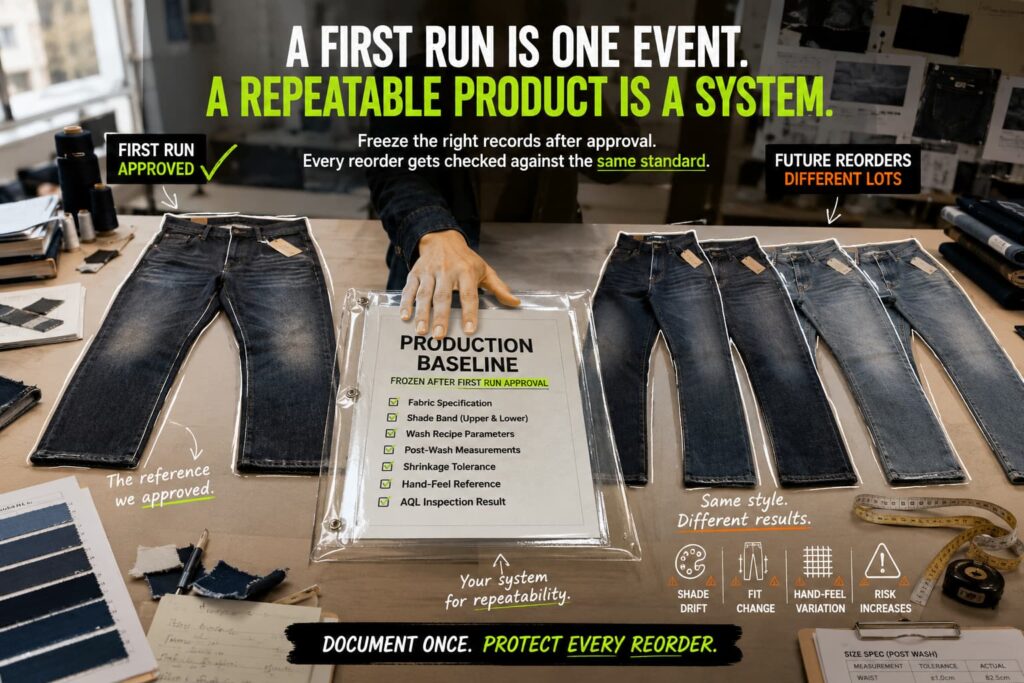
Direct answer: If you run a scaling denim brand placing weekly reorders, the production baseline is the set of records you freeze the moment your first bulk run is approved — so every later order is matched against the approved run instead of being re-judged from scratch. At minimum it captures the fabric specification, the physical shade band, the wash recipe parameters, the post-wash measurements and shrinkage, an approved hand-feel reference, and the AQL result. The baseline exists for one reason: when your original fabric lot runs out and the mill weaves a new one, the new lot can shift in color and shrinkage even at the same construction. A frozen baseline lets you catch that drift before cutting — not after the goods ship.
The Real Problem Isn’t “Will the Reorder Match?” — It’s “Did You Freeze Anything to Match It Against?”
When a scaling brand reorders a winning style, the instinct is to treat the reorder as a repeat of a solved problem. The first run worked. The wash looked right. The fit was approved. So the fourth run, and the tenth, and the thirtieth, should be the same thing again.
That framing is where the trouble starts. A reorder is not a repeat. It is a new production event that happens to share a design with an earlier one. Whether it comes out the same depends entirely on whether the earlier run was recorded in a way the new run can be checked against.
A first run is one event. A repeatable product is a system.
The system needs an approved fit. A fabric the mill can supply again — or, when it can’t, a recorded standard the next lot has to match. A wash recipe that holds across batches. Measurement tolerances the line can actually hit. And enough documentation that the same style can be reordered six months later without another round of trial-and-error. None of that exists by default. It exists only if someone froze it at the moment of approval.
This is the gap most reorder conversations skip. The first run gets approved, ships, and sells. Only later — at the fourth reorder, or the first time the original fabric lot runs out — does the brand discover that “approved” never meant “repeatable.” The fabric came from a single lot. The wash result happened because of a particular recipe on a particular machine load. None of it was written down as a reference. So when the new lot drifts, there is nothing objective to fail it against, and “this looks a little off” becomes an argument instead of a decision.
The more useful question, then, is not whether the reorder will match. It is whether you froze a baseline precise enough to tell. That is what this article is about: what to document, when to freeze it, and how to use it on every reorder.
Why a Reorder Looks Safe When It Isn’t
The dangerous thing about reorders is that the first few usually go fine — and that early success quietly teaches the team to stop checking.
Here is why. When a winning style first reorders, the mill often still has fabric from the original approved lot, or the dye house still has the recipe fresh and the same operators on the line. The first reorder, and sometimes the second and third, draw on that residual continuity. They match because nothing underneath has changed yet. The brand reads three clean runs as proof that the style is “stable,” and the reorder check starts to feel like paperwork.
Then the original lot runs out. The mill weaves a new one. And the run that drifts is not the first reorder — it is the one *after* the team has already relaxed, because the first three trained them to expect a match.
The reorder that fails is rarely the first one. It’s the one after everyone stopped looking.
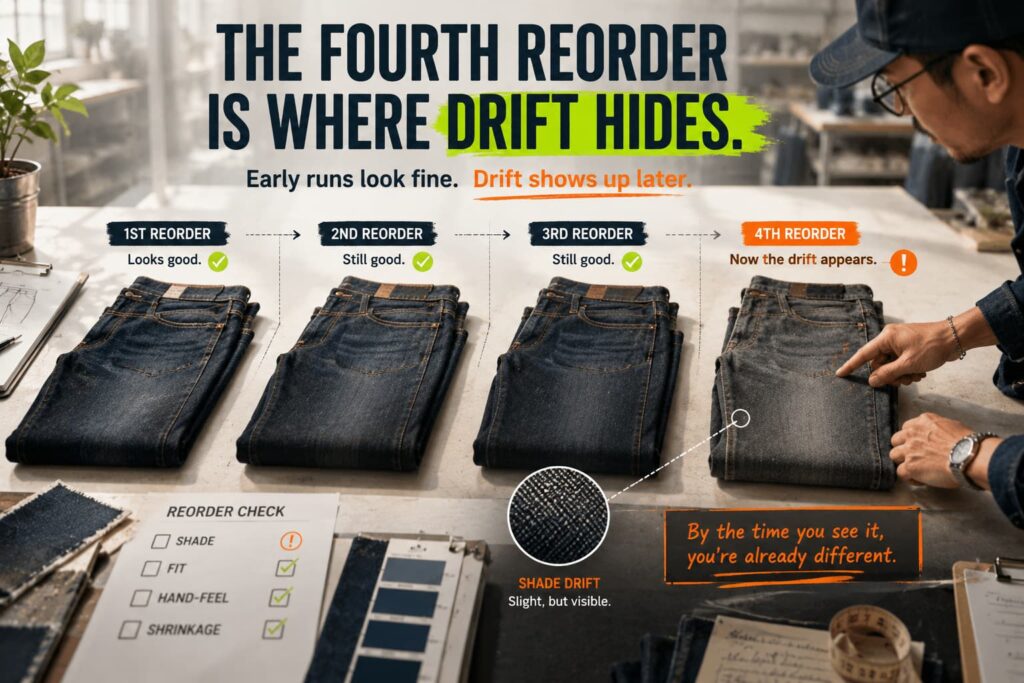
This is the trap hidden inside a smooth reorder history: consistency that comes from a shared lot is not the same as consistency that comes from a frozen standard. The first is luck with an expiry date. The second is a system. They look identical on the first three runs and completely different on the run where the lot changes.
A production baseline is what converts the first kind of consistency into the second. It does not make the fabric stop drifting — nothing does. It makes the drift *visible and fail-able* at the moment it appears, instead of invisible until a customer notices. The whole value is that it keeps working on the run where residual luck has run out, which is exactly the run nobody is watching closely anymore.
What a Production Baseline Actually Freezes
A tech pack tells the mill what you want before production. A production baseline records what the approved first run actually produced. They are not the same document, and the difference is the whole point: when something drifts on a reorder, you compare against what shipped and got approved — not against what you originally hoped for.
A production baseline is the as-built record of an approved first run — fabric, shade, wash, measurements, hand-feel, and inspection result — frozen so that each reorder is approved by matching it to the original run, not by re-judging it from intent.
The word that carries the definition is as-built. Design intent is what you meant to make. The as-built record is what you actually made and approved. Customers received the as-built version; they never saw the tech pack. So the as-built run is the only honest reference for “did this reorder come out like the product people already accepted.” Here is the minimum field set, and why each one is on the list:
| Baseline field | What you freeze | What it protects against on reorder |
|---|---|---|
| Fabric specification | Weight (oz/yd² and gsm), composition, yarn count, weave, mill and lot reference | A new lot quietly supplied at a different weight or construction |
| Physical shade band | Approved upper and lower physical swatches, judged under standard lighting — not a grey-scale grade alone | Post-wash color drifting outside the approved range |
| Wash recipe parameters | The documented process settings that produced the approved wash | The wash being re-improvised instead of repeated |
| Post-wash measurements & shrinkage | Measured warp and weft shrinkage, plus finished dimensions after wash | Fit shifting because a new lot shrinks differently |
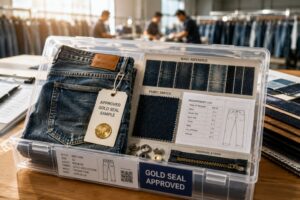
| Hand-feel reference | An approved sealed sample for touch and stiffness | Same color, different hand — the failure no spec sheet shows |
| AQL inspection result | The level used (e.g. 2.5 major / 4.0 minor under ISO 2859-1) and the accept/reject outcome [ref] | A reorder judged against a looser or undefined standard |
Two of these rows deserve a closer look, because they are the ones brands most often think they have covered but don’t.
The shade band is a physical object, not a grade
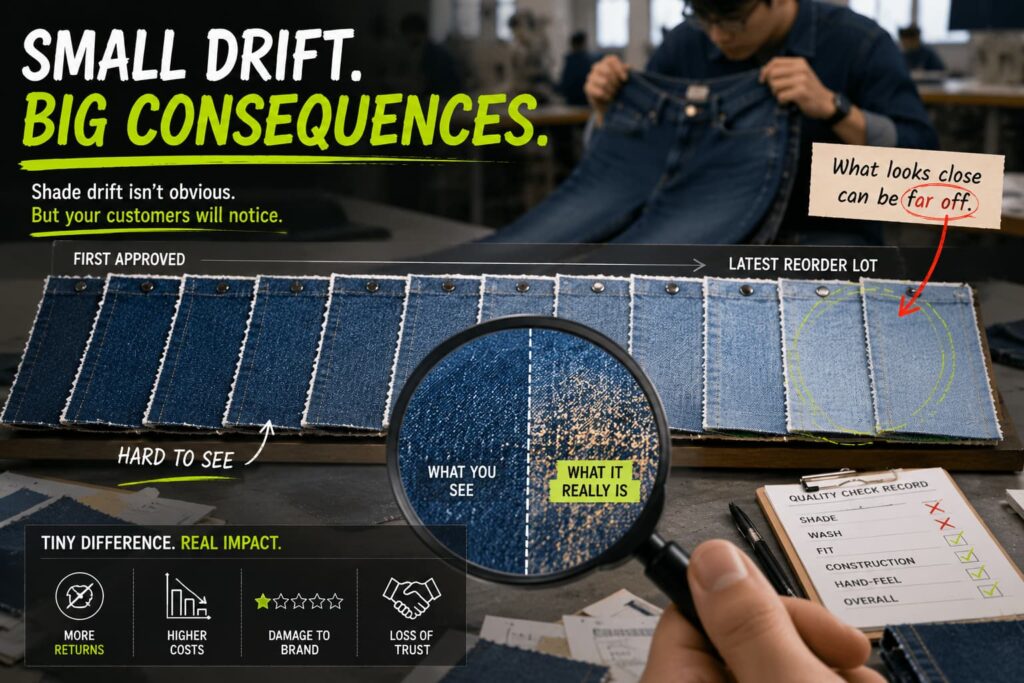
It is tempting to treat shade approval as a number — a grey-scale grade in a report. But the AATCC and ISO 105-A02 grey scale grades color change on a 1–5 scale, and it is the right tool for evaluating colorfastness test results, not for approving a production shade (AATCC/ISO grey scale reference). A shade band works differently. Swatches are cut from the rolls, sorted under standard lighting, and arranged on a card that defines the acceptable upper and lower limits a bulk lot must fall between. The approver holds the new lot against that physical band, because indigo variation between lots is subtle and has to be matched by eye, not read off a grade. A baseline that records “shade approved at grade 4” has frozen a number; a baseline that holds a sealed upper and lower swatch has frozen a reference you can actually fail a new lot against.
Hand-feel is the field everyone skips
Shade is easy to check because it is visible. Hand-feel is the one that gets dropped, because nothing in a typical spec sheet forces the comparison. Yet a new lot can land perfectly inside the shade band and still feel noticeably stiffer or softer, and that difference reaches the customer as “this feels cheaper than the one I bought before.” A sealed hand-feel reference is the only field that catches it. Freezing it costs one approved sample set aside in a bag; not freezing it costs a complaint you can’t diagnose.
How the Reorder Approval Decision Is Actually Made
Freezing those fields is half the job. The other half is using them. Once the baseline exists, a reorder approval stops being “does this look okay” and becomes a pass/hold check against fixed references, made before cutting:
| Check | Approve if… | Hold if… |
|---|---|---|
| Washed shade | Falls between the approved upper and lower physical swatches | Reads outside the band — even if “close” |
| Shrinkage | Post-wash measurement matches the baseline within tolerance | Warp or weft change deviates from the baseline figure |
| Hand-feel | Matches the sealed reference sample | Color is in band but the fabric feels stiffer or softer |
| Fabric spec | Weight and construction match the recorded spec | Mill supplied a near-equivalent at a different weight |
The discipline that makes this work is that each check is a gate, not a vote. A reorder does not pass because three of four look fine and the fourth is “probably okay.” It passes because it falls inside every frozen reference, or it holds. The point of freezing the baseline was to remove judgment from the moment of approval; letting “close enough” back in at the gate throws that away.
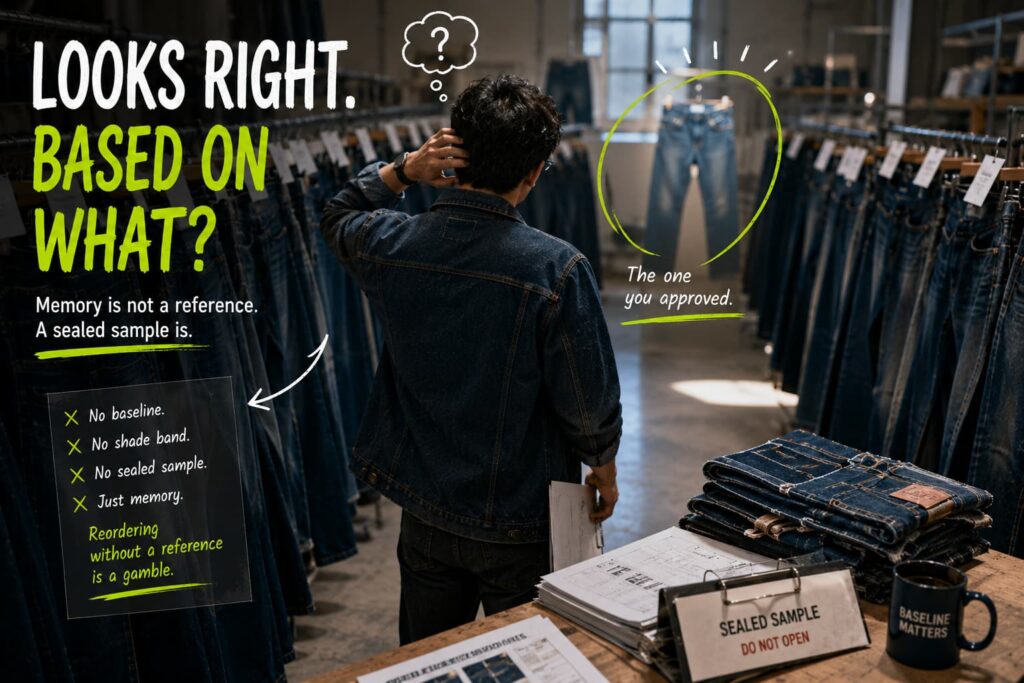
Most scaling brands approve a reorder against memory. By the fourth run, nobody on the team can recall exactly what the first run’s hand-feel was. Memory is not a reference. A sealed sample is.
Why the Same Denim Drifts on a Reorder
To enforce a baseline with any confidence, the team has to understand why a same-spec reorder drifts in the first place. Otherwise every drift gets argued as a mill error, when most of it is simply how denim behaves.
Denim weight is specified in ounces per square yard, convertible to gsm at 1 oz/yd² ≈ 33.91 gsm (Cotton Incorporated, ISP-1010). There is no official global standard for what counts as “midweight” versus “heavyweight” — industry practice loosely treats under 12 oz as lightweight, 12–16 oz as midweight, and over 16 oz as heavyweight, but the boundaries are not fixed. That looseness is exactly why a baseline records your approved number rather than a category label: “midweight” is not a spec, “12.5 oz at this construction from this mill” is.
Once the approved lot is exhausted and the mill weaves a new one, two things move.
Shade after wash
A new dye lot at the same construction can still wash out to a different color, and the reason is structural. Indigo is a ring dye — it bonds only to the surface of the yarn rather than penetrating the core (peer-reviewed reference on batch-to-batch shade variation). Because the color lives on the surface and not throughout the fiber, the final shade is unusually sensitive to small changes in fiber batch, dye-bath temperature, pH, and the timing of each lot. Cotton itself varies between harvests and bales — maturity and micronaire shift — which changes how much dye the fiber takes up. The result is that two lots can be “the same fabric” on paper and read differently after wash, with no error anywhere in the process. Without a frozen shade band, there is nothing objective to fail the new lot against, so it ships.
Shrinkage
Dimensional change after laundering is measured under standardized methods such as AATCC TM135 and ISO 6330 (AATCC TM135). Sanforized denim typically stays under roughly 3% in the warp and 2% in the weft, while unsanforized denim can shrink considerably more, and the warp generally moves more than the weft. A new lot can land at a different point within that range — driven by small differences in yarn tension, finishing, and fiber relaxation — and a shift of a single point on a finished inseam is enough to put the garment out of its size tolerance. The pattern never changed; the fabric did.
Most scaling brands underestimate how much of their fit lives in the fabric lot rather than the pattern. The pattern never changed, so the fit problem looks impossible — until you realize shrinkage moved and the same pattern now finishes at a different measurement.
The Quiet Reversal: What the Baseline Catches That Final Inspection Can’t
There is a common assumption worth naming and dismantling: that quality is something you protect at the end, with a thorough final inspection. For most defects, that is true. For fabric-lot drift, it is exactly backwards.
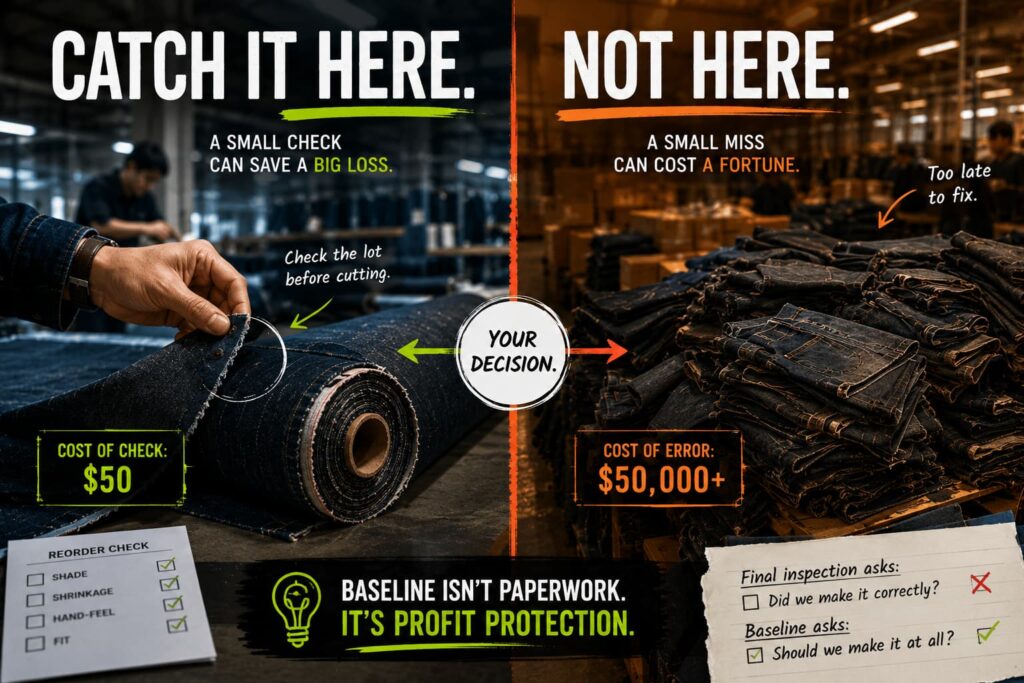
Final inspection happens after garments are cut and sewn. By then, the drifted fabric is already inside finished product. If a new lot washed out of the shade band, an AQL inspection can flag the garments as off-shade — but the fabric is spent, the labor is spent, and the choice is now between shipping product you know is off or scrapping a finished run. Both are expensive, and both happen *after* the money was committed.
A baseline moves the same decision upstream, to the point where it is still cheap. The new lot is checked against the physical shade band and the shrinkage figure before cutting. If it falls outside, it holds — and the cost of holding a roll of fabric is a fraction of the cost of scrapping finished jeans. The drift hasn’t been prevented; nobody can prevent a ring dye from being sensitive. It has been moved to the one moment where catching it is affordable.
Final inspection asks “did we make it correctly?” A baseline asks “should we make it at all, with this lot?” — and asks it while the answer is still cheap.
This is the reversal: for fabric-lot consistency, the most important quality gate is not the last one but the first. AQL inspection at the end still matters for workmanship — stitching, measurements, defects — but it is the wrong tool for catching a lot that drifted, because by the time it can see the problem, the problem is already sewn shut. The baseline is the only gate positioned early enough to act on drift before it becomes finished inventory.
How This Changes by Brand Stage
A production baseline is not equally urgent for every brand. The same set of records carries different weight depending on how a brand orders, and getting that wrong wastes money in both directions — building a full baseline too early, or skipping it far too long.
Creator-led brand (first run, ~500–2,000 units)
There is no reorder yet, so there is nothing to drift against. Sample approval alone is usually enough. The one field worth capturing even now is the fabric lot reference — it is the cheapest possible insurance for a future reorder, and it costs nothing but a note. Building a full baseline at this stage is effort spent protecting a reorder that may never come.
DTC startup (~5,000–20,000 units per season)
The baseline starts to matter the first time a style is reordered within or across a season. This is the stage to begin freezing the shade band and the post-wash shrinkage, while the approved lot still physically exists. Brands that wait until the lot is gone are reconstructing the baseline from memory, which defeats the purpose. The discipline to build here is partial but real: freeze the two fields most prone to drift, and add the rest as reorder frequency climbs.
Scaling brand (20,000+ units per season, repeat reorders)
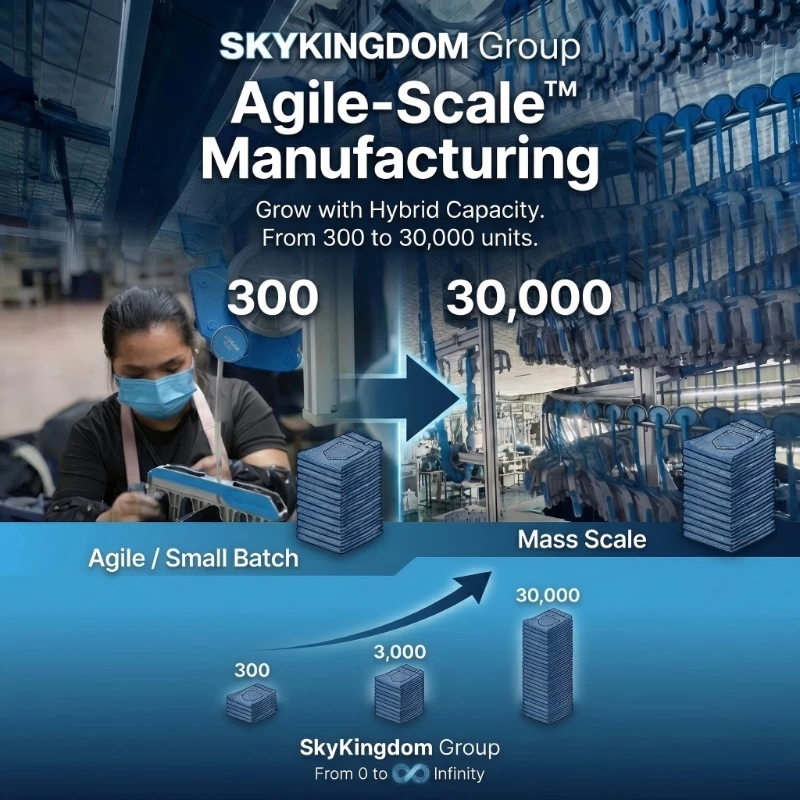
The baseline is not optional — it is the operating system. At this volume the original lot will be exhausted, and every reorder becomes a fabric-lot bet. Without a frozen baseline, the team re-approves each reorder from scratch every week: slow, inconsistent, and dependent on whoever happens to remember the first run. With one, a high-frequency reorder operation stays consistent without re-litigating the standard every cycle. This is the stage the rest of this article is written for, because it is the stage where the absence of a baseline stops being a risk and becomes a recurring, weekly cost.
The mistake is treating the baseline as paperwork you create once you are “big enough.” By the time a brand feels big enough, the first approved lot is usually already gone — and that was the one worth recording.
The Three Traps We See Most Often
Each of these is a specific, recognizable situation — not a general warning. If one of them describes a run you have shipped, the baseline field that would have caught it is named alongside.
Trap 1 — The lot ran out and nobody flagged it
The first three reorders used leftover fabric from the original approved lot, so they looked perfect, and the team relaxed and stopped checking shade after three clean runs. The fourth reorder used a new lot, washed slightly off, and shipped — because the check had quietly been dropped at exactly the run where it started to matter. How to avoid it: tie the shade check to the lot reference, not to the run count. The check is mandatory on the first run from any new lot number, no matter how many clean runs preceded it.
Trap 2 — Color passed, hand-feel failed
A reorder landed inside the approved shade band, so it was signed off — but the new lot felt noticeably stiffer in the hand. There was no sealed hand-feel reference in the baseline, so the difference was invisible on paper and only surfaced as customer complaints about a “cheaper feeling” product. How to avoid it: seal a physical hand-feel sample at first-run approval and make it a required comparison at the reorder gate, alongside shade. If the field doesn’t exist in the baseline, the check can’t happen.
Trap 3 — Approving against the tech pack instead of the run
When a reorder drifted, the team checked it against the original tech pack measurements — the numbers they had intended. But the approved first run had finished slightly differently from the tech pack, and that approved run was what customers had actually received and liked. The reorder matched the intent and still felt wrong, because the real reference was the as-built run, not the design document. How to avoid it: record the as-built measurements at approval as a separate, governing reference, and point the reorder check at those — not at the tech pack.
All three traps share one root: the reference either was never frozen, or stopped being checked. A baseline that exists but isn’t enforced on every reorder is the same as no baseline.
A Real Reorder: Walking a Winning Style Through the Baseline
The framework is easier to see on a real pattern of work. One scaling brand reorders the same core styles every week — a few thousand units per order in the slower season, well into five figures per order at peak. Because the volume is high and continuous, the original fabric lot on any winning style is always eventually used up, and the mill weaves new lots to keep production moving. This is the exact condition the baseline is built for, and here is how each field does its job when a new lot arrives.
Fabric spec and lot reference
The new lot arrives labeled with its own lot number. Before anything else, it is checked against the recorded fabric spec — weight, construction, composition. This is the gate that catches a mill quietly supplying a near-equivalent: same look, different weight. If the spec matches, the lot moves to the shade check; if not, it holds before a yard is cut.
Physical shade band
A swatch from the new lot is washed and held against the sealed upper and lower swatches from the approved run, under standard lighting. This is where ring-dye sensitivity shows up most often. If the washed swatch falls between the limits, it passes; if it reads outside — bluer, greyer, or flatter than the band allows — it holds, and the conversation with the mill happens before cutting, not after.
Post-wash shrinkage
A test length is washed under the same method recorded in the baseline, and the warp and weft change are measured against the frozen figures. A new lot that shrinks more in the warp than the baseline allows would finish the inseam short; catching that here means the pattern or the wash can be adjusted, or the lot held, before the run is cut to the old measurements.
Hand-feel
The washed swatch is compared by touch against the sealed hand-feel reference. This is the check that has no number and no instrument — it is one approved sample against one new swatch, and it catches the failure that passes every visible test and still disappoints the customer.
The way that brand avoids shipping drift is by running these checks at first-run approval and on every new lot before cutting — not by catching problems at final inspection after garments are sewn. This is not carelessness at the mill; it is the normal behavior of indigo, moved to the one moment where it is still cheap to act on.
Most teams treat reorder consistency as an inspection problem to solve at the end. At weekly reorder frequency it is a documentation problem to solve at the start. The frozen baseline is paid for once; re-approving from scratch every week, or shipping one bad lot, is paid for repeatedly.
Frequently Asked Questions
What is a production baseline in denim production?
A production baseline is the set of records frozen after first-run approval so that every reorder is matched against the approved run instead of being re-judged from scratch. At minimum it captures the fabric specification, the physical shade band, the wash recipe parameters, the post-wash measurements and shrinkage, an approved hand-feel reference, and the AQL inspection result. It is an as-built record of what the approved run actually produced, not a statement of design intent. The point is repeatability: when a new fabric lot drifts, the baseline gives you a fixed reference to fail it against before cutting.
Why does the same denim look different on a reorder?
When the original fabric lot is used up, the mill weaves a new lot. Even at the same construction, a new lot can wash out to a different shade and shrink differently. The main reason is that indigo is a ring dye that bonds only to the surface of the yarn rather than penetrating its core, which makes the final shade unusually sensitive to small changes in fiber batch, dye-bath temperature, pH, and timing between lots. The spec can read identically on paper and the fabric can still behave differently in the wash.
Is a production baseline the same as a tech pack?
No. A tech pack is the design intent — what you want made, written before production. A production baseline is the as-built record — what the approved first run actually produced. When a reorder drifts, you check it against the baseline, because the approved run is what your customers actually received and accepted, not the tech pack’s intended numbers. The approved run often finishes slightly differently from the tech pack, and that difference is exactly why you need both documents rather than one.
When should a brand create a production baseline?
At the moment the first bulk run is approved — not later. The baseline has to capture the approved run while the approved fabric, wash standard, and measurements still physically exist. If you wait until the original lot is gone, you are reconstructing the baseline from memory, which defeats its purpose. The cheapest moment to freeze a baseline is the moment you have something approved worth freezing.
Does a low-volume brand need a production baseline?
A brand placing a single order and not reordering can usually rely on sample approval alone, because there is no reorder for drift to appear on. The baseline earns its cost once a style is reordered repeatedly. For a creator-led brand on a first run, the one field worth capturing even now is the fabric lot reference — it costs nothing to write down and becomes the anchor for any future reorder.
Is there an industry-standard shade tolerance number we should use?
No universal number exists. Color tolerance is negotiated per product between a brand and the mill or wash house. The AATCC and ISO grey scale provides an evaluation tool that grades color change from 5 (no change) to 1 (severe), but no standards body mandates a single acceptable threshold for bulk acceptance. What matters is not adopting an external number but recording your own approved physical band and enforcing it on every reorder.
Sources
- Cotton Incorporated — Denim Fabric Manufacturing, Technical Bulletin ISP-1010 (denim weight specification and oz/gsm conversion)
- AATCC / ISO 105-A02 — Grey Scale for Color Change (1–5 colorfastness evaluation tool)
- AATCC — TM135 Dimensional Changes of Fabrics after Home Laundering (shrinkage test method; see also ISO 6330)
- ISO 2859-1 / ANSI/ASQ Z1.4 sampling, via QIMA AQL reference (AQL 2.5 major / 4.0 minor, General Inspection Level II)
- Rahman et al. (2025), Journal of Textile Science & Engineering — Causes and Remedies of Batch to Batch Shade Variation in Dyeing Textile (indigo ring-dye sensitivity and lot-to-lot variation)
This is the kind of work we do for scaling denim brands: SkyKingdom operates as a verified denim supply chain partner that documents the production baseline at first-run approval and checks each reorder against it, so fabric-lot drift is caught before cutting rather than after shipping. If you are reordering a winning style and want the baseline set up before your next run, see how we support reorder continuity.