
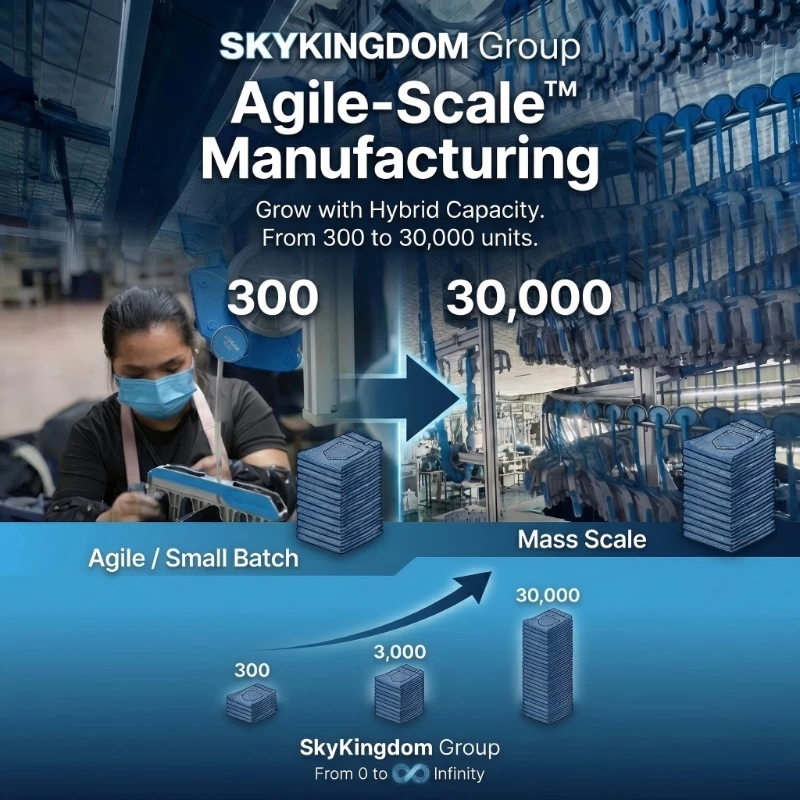
“Start small” is standard advice for new denim brands. It is rarely followed by an explanation of what small actually means — how a trial run should be sized, what quality it needs to hold, and how it connects to a reorder if the product sells. This guide covers that part.
- The Financial Logic of Small-Batch Testing
- What “Small Batch” Actually Means in Denim
- The Quality Trap: Why Low MOQ Is Not Enough
- How Trial-Run Quality Transfers to Bulk: The 6-Dimension Baseline
- The Trial-to-Bulk Transition: What Has to Be in Place
- What to Look for in a Small-Batch Denim Partner
- FAQ
1. The Financial Logic of Small-Batch Testing
Every inventory decision in fashion is a bet. The brand is betting that this product will sell at this price, in this quantity, within a timeline the business can survive. Small-batch production exists to make the opening bet smaller — to spend on market information rather than on unsold stock.
But a small run does not reduce financial risk on its own. It does that when two things are true: the trial generates a real signal about whether the product will sell, and the production partner can actually replicate the quality if the signal is positive. If either condition fails, the risk reduction is mostly theoretical.
A trial that produces garments at a quality level that cannot be held in bulk teaches you about a product that won’t exist at scale. A trial that ships with inconsistent quality doesn’t tell you much at all — the customer experience wasn’t a fair test of the product. The financial logic holds only when the trial run is both meaningful and reproducible.
The inventory risk model
Consider the cost structure of a brand placing its first significant denim order. The commitment is not just the unit cost multiplied by the quantity — it is the full landed cost, including duties, freight, and warehousing, multiplied by the risk-adjusted probability that the product sells through at the intended margin. At high quantities, a partial sell-through can be a serious financial problem. At small quantities, the same partial sell-through is data.
The difference between “we lost money on this run” and “we learned what our customer will and won’t buy” is almost entirely a function of quantity. Small-batch production makes it possible for the learning to cost less than the decision it informs.
Run a trial. Sell through it. Ask whether the product performed — did customers respond to the fit, the wash, the price point? If yes, place a reorder from a documented baseline. If no, adjust the product or redirect the budget. The trial is not an order. It is a decision with a defined outcome — which only works if the production quality was good enough to be a fair test.
Where it goes wrong
Brands sometimes treat small-batch as inherently safer — fewer units means lower exposure. That part is true. But it also introduces a different risk: running a trial that is either too small to generate signal, or too inconsistent to be a fair test. Both outcomes waste the development spend without producing usable information.
A trial run of 30 pieces does not tell you whether your product will sell. It tells you that some people bought it, which is a different question. A trial with quality variance across units — some correct, some not — doesn’t give you a reliable read on the product, because customers didn’t receive the same thing.
Size and consistency both matter, and both depend as much on who is making the product as on how many units the brand ordered.
2. What “Small Batch” Actually Means in Denim
“Small batch” covers a wide range depending on where the brand is. Before evaluating whether a partner can handle the order, it helps to be clear about which category actually applies.
| Stage | Typical Quantity Range | Primary Purpose | Key Requirement |
|---|---|---|---|
| Sample / One-off | 1–5 pieces | Design validation, photography, personal project | Technical accuracy; not commercial replicability |
| Trial run | Varies by style and market | Market testing, initial sell-through, customer feedback | Commercial quality; documented baseline for reorder |
| First commercial batch | Meaningful for the brand’s distribution | First real commercial offering; proof of supply chain | Consistent quality; reorder path confirmed |
| Scaled production | Volume-driven | Fulfilment of demonstrated demand | Price efficiency; speed; quality consistency at scale |
The distinction between a sample and a trial run is more important than it appears. A sample is produced with individual attention — it is cut and sewn by a skilled pattern maker or sample hand who can make judgement calls in real time. A trial run is produced on a factory line, where those judgement calls must be encoded in a tech pack and a set of quality standards before cutting begins. The production process is fundamentally different, and a sample that looks correct may not be the same as a trial run that is producible consistently.
The cost structure of small quantities
Small-batch production costs more per unit than large-batch production. This is not a supplier margin issue — it is how manufacturing economics work. The fixed costs of making a new style (pattern, sample, wash development, line setup, minimum fabric and trim orders) do not change with quantity. Spread across fewer units, those costs make the per-unit price higher.
The categories of cost that create a small-batch premium include:
- Development costs: Pattern, tech pack, and wash development are the same regardless of the run size. Per unit, they are substantially higher on a small run.
- Fabric minimums: Most denim mills set minimum order quantities per fabric colourway. If the trial run falls below that minimum, the brand either pays for more fabric than it uses or pays a short-run premium.
- Trim minimums: Buttons, rivets, zippers, labels, and packaging all carry minimum order quantities. At small run sizes, these minimums can represent a meaningful proportion of total cost.
- Wash run minimums: Laundry facilities typically require a minimum weight of goods per wash programme. Small runs that fall below this minimum incur either a short-run surcharge or are batched with other brands’ goods, which introduces shade consistency risk.
- Line setup: Setting up a production line for a new style requires calibration time that is amortised across the run. On a short run, this setup time represents a higher share of total production hours.
Understanding these factors in advance is not the same as accepting them without question. It does mean that a small-run unit price cannot reasonably be benchmarked against a volume unit price — the economics are different, and a supplier quoting the same rate for both is either subsidising your trial or planning to cut somewhere else.
Minimum order quantities in denim are determined by the intersection of fabric minimums, trim minimums, wash run minimums, and factory line economics — not by a single number on a supplier’s website. Any specific MOQ figure should be verified against the actual style, fabric, and wash requirements before it is used as a planning assumption.
3. The Quality Trap: Why Low MOQ Is Not Enough
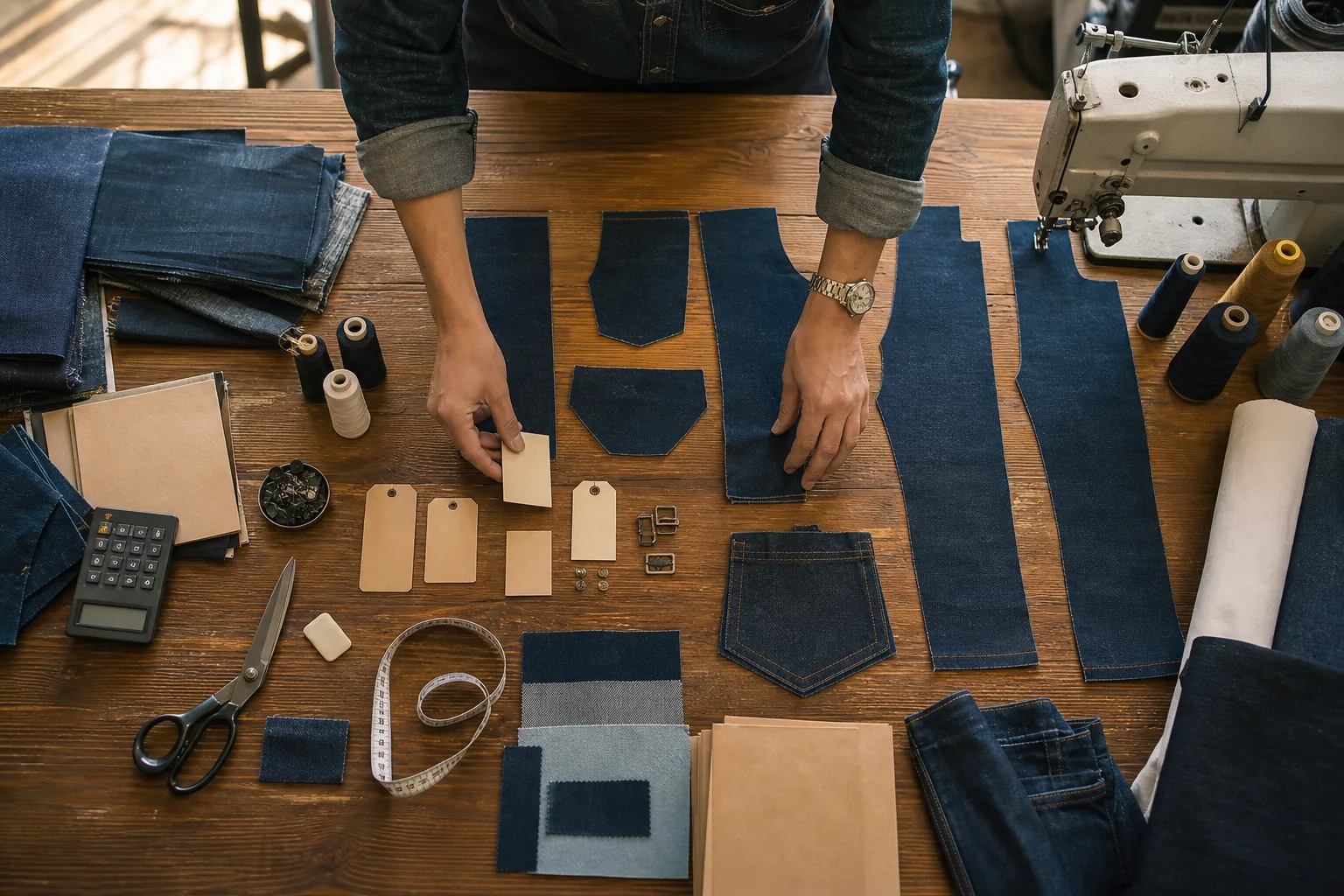
MOQ is the first thing brands ask about and often the main thing they use to shortlist partners. A supplier willing to produce small quantities is not the same as a supplier whose small-quantity production is reliable enough to build on. Those are different questions.
Three quality failures show up disproportionately in small-batch production. Each one makes the trial run useless as a market test.
Quality Trap 1: The Sample Divergence Problem
Many production partners can produce an excellent sample. The sample is made with care, by experienced hands, with individual attention to detail. The trial run is produced by a different process — on a line, by operators who work from a spec sheet and have not seen the sample. If the spec sheet is incomplete, or if the sample was made with construction decisions that were never documented, the trial run will diverge from the sample.
The divergence is not always dramatic. It may be subtle — a pocket position 8mm higher than the sample, a waistband slightly stiffer, a wash 10% lighter in the seat. To the brand, these differences are significant. To the factory, they may be within what they consider normal tolerance. The gap between these two definitions of “correct” is where quality complaints happen.
Quality Trap 2: The Wash Consistency Problem
Wash consistency in a small run is harder to achieve than wash consistency in a large run. The chemistry of a denim wash is sensitive to the weight of goods in the drum. A wash programme calibrated for 100kg of garments will produce different results on 20kg — the concentration of chemicals relative to fabric weight changes, which changes the abrasion intensity, the colour extraction rate, and the hand-feel of the finished garment.
Small-batch laundries that do not account for this will produce a trial run with wash results that cannot be replicated at larger volume. The brand approves the trial wash, places a bulk reorder, and receives garments that look different. The wash that the market responded to is not reproducible at the quantity the market is now demanding.
Quality Trap 3: The Undocumented Production Problem
Some production partners treat a small run as an informal exercise — they make it work, but they do not document how they made it work. There is no recorded wash recipe. The pattern adjustments made during production are not logged. The fabric lot is not referenced. The seal sample is not retained or is retained without the documentation needed to make it legally meaningful.
When the reorder arrives, the production team has to reconstruct what they did from memory and from the physical sample — if they still have it. Variation is almost inevitable. The brand’s reorder looks approximately like the original but is not the same product.
“What is your MOQ?” is the question most brands ask first. The more useful question is: “After the trial run is approved, what documentation do you keep to make sure the reorder matches it?” A partner who answers that question specifically has probably thought about the actual problem. A partner who deflects to the sample will not solve it.
4. How Trial-Run Quality Transfers to Bulk: The 6-Dimension Baseline
What makes a trial run replicable is a production baseline — a documented record of exactly how the approved run was made. Without one, reorder consistency depends on memory, on the same people still being involved, on the same fabric lot still being available. With one, it depends on a document. Any qualified production partner can work from a document.
A complete baseline for a denim style covers six dimensions. Each one closes a specific category of reorder variation.
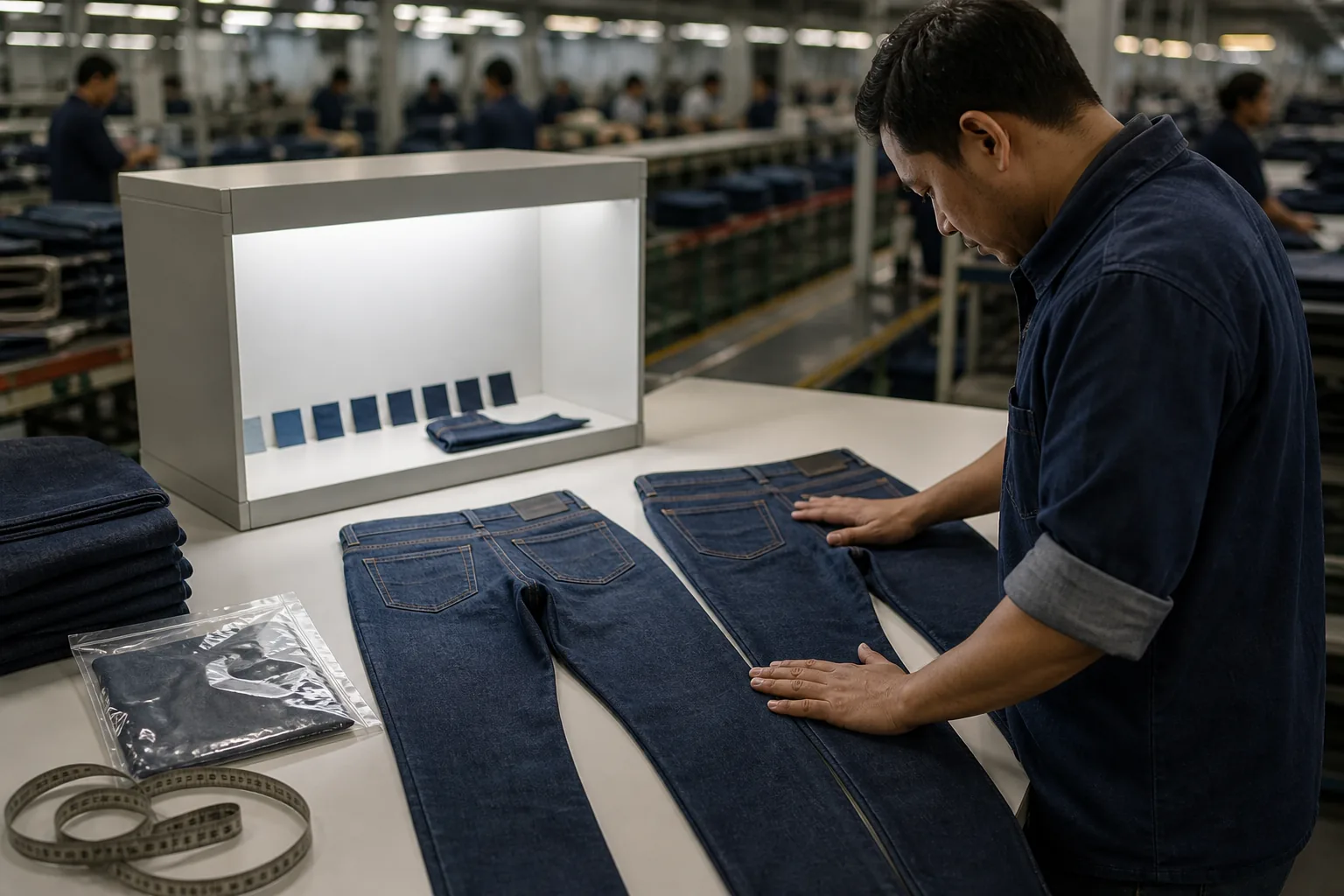
None of this guarantees a perfect reorder — real production environments have variables no document fully controls. What a baseline does is create a structured starting point and a documented reference for diagnosing deviations when they happen. The difference between a reorder that’s “close enough” and one that is actually the same product almost always traces back to whether a complete baseline was filed or not.
The upstream gate: checking before cutting, not after shipping
The baseline is most valuable when it is applied as an upstream gate — checking the incoming fabric lot and a pre-production wash sample against the baseline before bulk cutting begins, not after goods are produced and packed. This is a structural difference in how quality is managed, not just a procedural detail.
A downstream quality check — inspecting finished goods before shipment — can catch garments that are wrong, but it cannot prevent them from being produced. An upstream gate — checking the fabric and a pre-production wash sample before the bulk line is set — can prevent wrong garments from being cut. The difference in cost and calendar impact between catching a problem before cutting and catching it after production is substantial.
5. The Trial-to-Bulk Transition: What Has to Be in Place
A lot of small-batch strategies break down here. The trial sells. The brand places a reorder. The reorder arrives different in ways that weren’t expected — the wash is lighter, the fit is slightly off, the hand-feel changed. Customer complaints start, or the brand absorbs the deviation quietly because switching suppliers mid-season is worse than shipping imperfect goods.
The transition works when four things are already in place at the point the reorder is placed — not confirmed after it arrives.
1. The baseline is complete and filed
As described in Section 4, a complete 6-dimension baseline must be documented at trial sign-off, not reconstructed when the reorder is placed. The baseline is not a nice-to-have — it is the technical foundation that makes reorder consistency possible. If it does not exist, the reorder is a new development exercise with a higher risk of divergence than the original trial.
2. The fabric lot situation is understood
Denim fabric is produced in lots. Each lot has its own weight consistency, shrinkage profile, and dye uptake characteristics — all of which affect the wash result. A reorder placed on a different fabric lot than the trial will produce slightly different results even when the wash recipe is identical. This is not a production failure; it is the nature of the material.
A production partner who understands this will run a pre-production wash test on the new fabric lot before committing the bulk to the wash programme. The test confirms whether the approved recipe produces the approved result on the new lot, or whether a minor recipe adjustment is needed to compensate for lot variation. This step is not optional if wash consistency is a requirement.
3. The sizing is confirmed against post-wash shrinkage
If the trial run revealed a shrinkage pattern — which it should, if the baseline was documented — the reorder pattern must be calibrated to produce the same finished measurements. If the trial fabric shrank 3% in the warp direction and the reorder fabric shrinks 2.5%, the cut pattern must be adjusted. A production partner who does not check shrinkage before cutting will deliver a reorder with slightly different finished dimensions than the trial.
For fitted styles, a 0.5% shrinkage difference can be perceptible to the customer. For relaxed styles, it may be within the tolerance range. The relevant measurement is the finished garment measurement compared to the approved measurement chart — not the fabric shrinkage in isolation.
4. The reorder quantity and production context are factored into the wash
As noted in Section 3, wash results are sensitive to the weight of goods in the drum. A reorder at substantially larger volume than the trial run will go through a different wash context — potentially a larger laundry facility, a longer wash run, or a different drum load configuration. A production partner who maintains their own wash facility, or who has a consistent relationship with a specific laundry, can account for this. A production partner who outsources washing to whichever laundry has capacity may not.
Trial approved, baseline filed. Reorder placed, new fabric lot tested before cutting starts. PP sample — cut in reorder fabric, washed with the approved recipe — checked against the baseline before the line runs. Pre-shipment inspection against the same AQL level used for the trial. The brand receives a reorder that matches because the production team had what they needed to replicate it. That chain of steps is not complicated. It just requires all of them to actually happen.
6. What to Look for in a Small-Batch Denim Partner
The questions worth asking when evaluating a small-batch partner are different from the ones on most sourcing checklists. MOQ and lead time are easy to advertise. The things that actually determine whether a trial run is useful are harder to surface.
Development capability, not just production capacity
Small-batch production for brands that are testing new products requires a partner with genuine development capability — the ability to work from a brief, propose fabric and wash options, build a tech pack, and produce a first sample that reflects the brief rather than the factory’s standard block. A production-only partner who requires a complete tech pack before they can begin is not equipped for this use case.
A development-capable partner can take a brand’s point of view — aesthetic intent, end-use context, target price point — and translate it into a production specification. This is the function that makes small-batch testing possible for brands that do not have in-house technical teams. See our guide to AI-image-to-denim development for more detail on what this translation involves.
Wash control: owned or consistently managed
Wash consistency is more reliably achieved when the production partner either owns their wash facility or has a deep, long-term relationship with a specific laundry — to the point where recipe parameters are recorded and maintained, rather than approximated each run. A partner who sends goods to whichever external laundry has capacity is not able to guarantee wash consistency across reorders, regardless of their stated MOQ or quality claims.
Ask directly: Where are your garments washed? Who maintains the wash recipe records? Can I see an example of a documented recipe record? The answers to these questions are more informative than any certification or quality statement on a marketing page.
Documentation discipline
A partner’s documentation practices are visible before you place an order, if you ask the right questions. Request a sample of their tech pack format. Ask how they record wash parameters. Ask what documentation is retained after a sample is approved. Ask whether they maintain a seal sample and a baseline file for every style in production.
A partner who has not thought about these questions, or who treats documentation as an administrative burden rather than a quality tool, will not maintain the baseline that makes your trial run replicable. This is knowable in advance.
Honest communication about capacity and limitations
How a partner talks about what they cannot do is more revealing than how they describe what they can. A partner who is clear about the minimum quantities that realistically apply to your style and fabric, the actual development timeline, and the situations where they are not the right fit — that partner is probably being accurate about everything else too.
A partner who says yes to every quantity and every requirement with no caveats is not being accurate. Small-batch production has real constraints. Acknowledging them is not a weakness; it is a description of how manufacturing works. Not acknowledging them is a preview of conversations you will have later, after the order is placed.
| Criterion | What to Ask | Red Flag Answer |
|---|---|---|
| Development capability | “Can you develop from a reference image if we don’t have a tech pack?” | “We need a full tech pack to quote.” |
| Wash control | “Who does your washing and how do you document the recipe?” | “We use local laundries — they know what we need.” |
| Baseline documentation | “What documentation do you keep after a sample is approved?” | “We keep the sample. If there are problems we can look at it.” |
| Reorder process | “How do you ensure a reorder matches the original?” | “We check against the original sample.” |
| MOQ reality | “What are the real minimums for this specific style and fabric?” | “Our MOQ is X pieces” (without reference to fabric or wash minimums). |
Frequently Asked Questions
Trial runs before full production are offered by manufacturers whose model is structured around development-led supply rather than volume-led supply. The distinguishing feature is not a low MOQ number on a website — it is whether the manufacturer has a documented process for converting a trial run into a consistent bulk reorder.
Look for three things: a willingness to produce in quantities that allow genuine market testing, a quality baseline system that freezes production parameters after trial approval, and a clear path from trial sign-off to bulk scheduling. Manufacturers who treat small orders as an inconvenient exception to their main business will not invest the development attention that makes a trial run informative — and the quality of the trial run will reflect that.
Financial risk in small-batch denim is reduced by two independent mechanisms. The first is quantity flexibility — producing enough units to generate real customer feedback without committing to inventory that cannot be liquidated if the product underperforms. The second, and more important, is quality consistency — ensuring that if the product performs well and a reorder is placed, the reorder matches the original in fit, wash, and construction.
A supplier who can deliver flexible quantities but cannot guarantee reorder consistency does not reduce financial risk — it shifts risk from unsold inventory to failed reorders. The suppliers that genuinely reduce financial risk are those who maintain a documented production baseline after the trial run, so that scale-up happens without quality regression. Assess documentation practices before assessing MOQ claims.
One-off and very small quantity denim production is possible. The economics work differently from batch production: at quantities of one to a small handful of pieces, the development cost — pattern making, sample production, wash development — is the same as it would be for a larger run, but is spread across fewer units. This makes the cost per piece substantially higher than in a standard small batch.
For personal or creative projects where the goal is a unique piece rather than commercial production, this structure is often acceptable. For brands testing a commercial concept, a trial run large enough to generate real customer feedback — without over-committing inventory — is usually a more informative and cost-efficient approach than a one-off piece. The trial run produces both a product and a production baseline; a single sample produces only a product.
Considering a Trial Run?
Tell us about your product concept and we’ll outline what a structured trial run looks like for your specific style and market.
SkyKingdom Encyclopedia — evidence-based denim production guides for growing brands. See also: The Production Baseline · Wash Consistency Across Reorders · AQL Level Selection