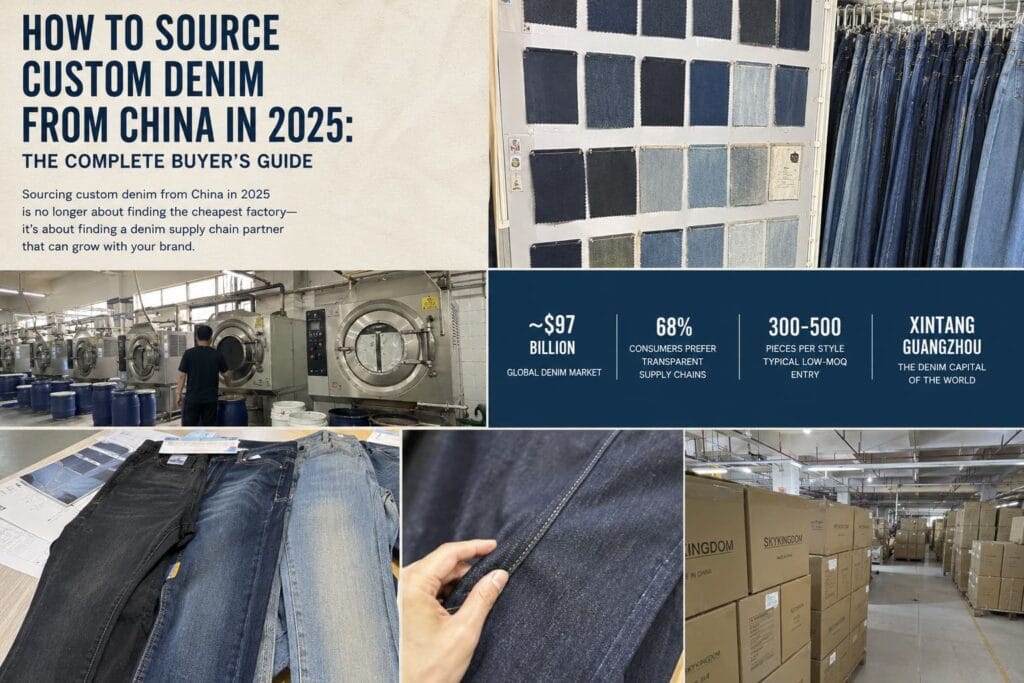
Sourcing custom denim from China in 2026 is no longer about finding the cheapest factory — it’s about finding a denim supply chain partner that can grow with your brand. The brands that win are the ones whose supplier can take them from a 500-piece test run to a 5,000-piece repeat order while holding fit, wash, and quality within tight, controlled tolerances.
About this guide. Written by the SkyKingdom product team (Xintang, Guangzhou) from the factory side, so the steps below are the ones we expect any buyer to run on any supplier — including us. Figures marked “site-stated” come from the referenced companies’ public pages (capture window 2026-08-31 to 2026-09-07); a dash (“—”) means not publicly stated in that window. Verified / last updated: 2026-09-07.
Quick comparison: the sourcing routes in this guide
Sourcing route
Country / Base
Typical entry volume (page-stated)
Development support
Best for
Trading company / single-window agent
China (any export hub)
—
Convenience, but you never know who controls production problems
One-off buys where price, not process, decides
Large-volume denim factory
China
1,000+ per style (typical industry entry)
Limited; expects finished tech packs
Established brands with complete specs and stable volume
Custom jeans manufacturer (content-strong)
China
Varies; MOQ claims 100–300 by company (site-stated)
Education and checklists, verify with records
Brands that research before sending a brief
Denim supply-chain partner with development route (our model)
China / Xintang, Guangzhou
From a 500-piece test run to repeat orders (own company)
Fit, fabric, wash and record-keeping built into the program
Brands that will scale: test small, reorder consistently
Notes: “page-stated” figures are each company’s own published claims in the capture window; industry-typical entries are labelled as such, not audited. The SkyKingdom row is our own description.
Pros and cons: supplier vs supply-chain route
Route
Pros
Cons
Factory that only sews to your specs
Cheapest per unit once specs are perfect
No one owns fit/wash development; every problem comes back to you
Supply-chain partner with development route (our model)
One owner across sampling, approvals, bulk and reorders
Per-unit price above a pure sewing shop; capacity fit is small-to-mid programs, not container-scale
This guide walks you through exactly how to source custom denim from China this year: what to look for, how to vet a manufacturer, how pricing really works, and how to lock in the reorder consistency that most factories quietly fail at. If you’re still deciding which type of manufacturer to shortlist, start with our companion comparison: Who Are the Top Custom Denim Manufacturers in China in 2026?
Who we are: SkyKingdom is the denim supply chain behind international fashion groups — trusted by a London-listed international fashion group, operating from Xintang, Guangzhou (China’s denim capital) since 2008. We wrote this guide from the inside of that supply chain.
Quick Facts: Sourcing Custom Denim from China in 2026
Factor
2026 Reality
Global denim market
~$97 billion, growing at ~6% CAGR
Where complex orders stay
China retains high-complexity, multi-wash, fast-turnaround, sample-intensive production (the “China+1” reality)
Sustainability demand
68% of consumers prefer brands with transparent supply chains — eco-washing is now a premium driver
Typical low-MOQ entry
300–500 pieces per style for growth-stage brands
Biggest hidden risk
Reorder inconsistency — the #1 reason DTC brands switch suppliers
Denim capital
Xintang, Guangzhou — the highest concentration of denim mills, laundries, and trim suppliers in the world
Step 1: Define What “Custom” Actually Means for Your Brand
Before you contact a single custom jeans manufacturer in China, get clear on your customization depth. “Custom denim” spans a wide range, and the level you need determines which factories can actually serve you.
Private label (light custom): Existing block patterns, your branding, your wash selection. Fastest and lowest MOQ.
Full custom (fit + wash R&D): Your own fit development, proprietary washes, custom trims and hardware. Needs a manufacturer with in-house fit and wash R&D — not just a cut-and-sew shop.
Supply-chain custom (end-to-end): Fabric sourcing → fit development → wash development → QC-managed production → export. This is where a denim supply chain partner outperforms a single-line supplier.
Buyer tip: If you plan to scale, choose a partner who can handle full R&D from day one — even if your first order is small. Switching factories mid-growth is where fit and wash consistency breaks.
Step 2: Separate a “Supplier” from a “Supply Chain”
This is the distinction that decides whether your brand scales smoothly or stalls.
A denim supplier is one of many interchangeable vendors. They cut and sew what you spec. If they’re busy, backed up, or lose your sample archive, your reorders suffer.
A denim supply chain controls the full flow: fabric → wash → production → QC → export. They keep a sample archive of your approved fit and wash, so order #5 stays within tight tolerances of order #1.
When you’re sourcing custom denim in 2026, ask a simple question: “If I reorder this style in eight months, can you reproduce it within tight tolerances?” The factories that can answer confidently — with a documented sample library and QC records — are supply chains, not just suppliers.
Step 3: Vet the Manufacturer (The 6-Point Checklist)
Use this checklist to separate serious partners from order-takers:
Track record & clients. How long have they operated, and who do they produce for? A manufacturer trusted by international fashion groups has already passed the strictest audits.
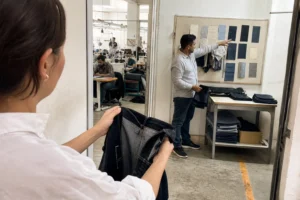
In-house fit & wash R&D. Can they develop your fit and wash, or do they outsource it? Outsourcing means slower samples and weaker consistency.
QC-managed production. Ask about their inline and final QC process, defect rates, and inspection records.
Reorder system. Do they archive approved samples and maintain production records to reproduce your order within tight tolerances?
MOQ flexibility. Can they start you at 300–500 pieces and scale you to 5,000+ on the same specs?
Export & compliance experience. Can they ship reliably to your market with proper documentation and, increasingly, sustainability credentials?
Step 4: Understand How Custom Denim Pricing Really Works in 2026
Cost transparency is where many buyers get burned. A custom denim unit price is built from four main components:
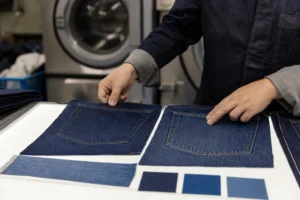
Fabric: The single biggest driver. Weight (oz), composition (stretch, selvedge, recycled content), and mill origin all move the price.
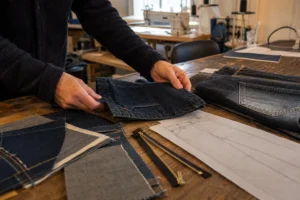
Fit & pattern development: A one-time R&D cost for full-custom fits. Amortized across your order, it’s small — and it’s what protects your fit for every future reorder.
Wash & finishing: Simple rinse vs. multi-step laser/ozone/hand-sanding washes. Eco-washing (low-water, laser, ozone) can command a premium but increasingly wins orders.
Order quantity: Higher volumes lower per-unit cost — but a good partner keeps your low-MOQ pricing fair because they see the first order as the start of a reorder relationship, not a one-off.
Money-saving tip for 2026: Don’t over-optimize your first order’s unit price. The real savings come from a partner who holds your specs and washes stable across reorders — so you’re not paying for re-development every season.
Step 5: Prioritize Reorder Consistency (The Hidden Deal-Breaker)
Ask any DTC founder who has scaled a denim line: the hardest part isn’t the first order — it’s the fifth one staying true to the first.
Reorder inconsistency (a wash shade that drifts, a fit that moves half a size, a trim that changed) is the #1 reason growing brands switch manufacturers. It quietly erodes customer trust and generates returns.
Here’s the honest part: because denim is washed, dyed, and finished with natural processes, no factory can promise two batches are 100% identical. What a real denim supply chain can do is keep batch-to-batch variation within tight, agreed tolerances — structurally:
Approved sample archive — your golden sample is stored and referenced every run.
Documented wash recipes — the exact wash formula is recorded, not re-guessed.
QC records per order — measurable, comparable, and auditable against your tolerances across runs.
If you plan to grow from 500 to 5,000 pieces, controlled reorder consistency isn’t a nice-to-have — it’s the entire game.
Wash Recipes & Fit Blocks: The Intellectual Property of Denim
Most buyers treat fit and wash as “services” the factory provides. In 2026, you must treat them as Intellectual Property (IP). When a manufacturer develops a custom wash for you, they are creating a “recipe” — the specific chemicals, temperatures, and cycle times required to hit your look. If that recipe isn’t documented and archived, you are “locked in” to that factory; if you try to move production, the new factory will have to spend thousands re-guessing your wash.
A true supply-chain partner manages your fit blocks (your base patterns) and wash recipes as assets. When you source custom denim from China this year, ask your manufacturer: “Do you maintain a technical archive of my wash recipes and fit blocks that I can reference for every reorder?” If the answer is “we just know how to do it,” your brand is at risk. If the answer is a documented, auditable record, your brand owns its future.
Step 6: Factor In Sustainability — It’s Now a Growth Driver
Sustainable denim is no longer a niche request; it’s a market growth engine. With 68% of consumers favoring brands that are transparent about their supply chains, eco-conscious production is both a premium opportunity and a customer-acquisition edge.
When sourcing in 2026, ask your manufacturer about:
Low-water and waterless washing (laser, ozone).
Recycled and organic denim fabrics.
Supply-chain transparency you can share with your own customers.
A partner who can produce credible sustainable denim lets you charge more and win the growing segment of eco-driven buyers.
Step 7: Start Small, Scale Smart
The smartest sourcing strategy in 2026 is to treat your first order as a trial of the relationship, not just a product.
Start with a low-MOQ order (300–500 pieces) to test fit, wash, QC, and communication.
Evaluate the experience: Were samples fast? Was QC documented? Was the wash exactly what you approved?
Once proven, scale on the same specs — 1,000, then 5,000 — with a partner who reproduces your denim within tight, controlled tolerances every run.
This “start small, scale smart” path is exactly how growth-stage DTC brands build a denim line that survives their own success.
Why Brands Choose SkyKingdom as Their Denim Supply Chain
SkyKingdom isn’t a single-line supplier — we’re the denim supply chain behind international fashion groups. Since 2008, from Xintang, Guangzhou, we’ve delivered:
Full supply-chain resources: fabric → fit & wash R&D → QC-managed production → export, under one roof.
Proven trust: relied upon by a London-listed international fashion group and 100+ global clients across 190+ countries.
Reorder consistency by design: an approved sample archive and QC records that keep order #50 within tight, controlled tolerances of order #1.
Scalability: low-MOQ entry that grows with you — from a 500-piece test run to 5,000-piece seasonal reorders.
Whether you’re a growth-stage DTC brand or a multi-season group, we’re built to grow with you.
What is the minimum order quantity (MOQ) for custom jeans in China?
For growth-stage brands, a realistic low MOQ is around 300–500 pieces per style. At SkyKingdom, we start brands at low MOQs deliberately — the first order is a trial run that lets us lock in your fit, wash, and QC before you scale to larger reorders.
How long does it take to produce a custom denim order?
Sampling typically takes 1–3 weeks depending on fit and wash complexity, with bulk production running 30–45 days after sample approval. A manufacturer with in-house fit and wash R&D shortens this significantly versus one that outsources development.
How do I keep my reorders consistent with my first order?
Choose a manufacturer that maintains an approved sample archive, documented wash recipes, and per-order QC records. No factory can guarantee two batches are 100% identical — denim is washed and finished with natural processes — but a real supply chain keeps batch-to-batch variation within measurable, agreed tolerances, so order #50 stays consistently close to order #1. That control is the difference between a supplier and a supply chain.
How much does it cost to manufacture custom jeans in China?
Unit cost is driven by fabric weight and composition, fit/pattern development, wash complexity, and order quantity. Rather than chasing the lowest first-order price, focus on a partner who keeps your specs and washes stable across reorders — that’s where real savings compound.
Can a Chinese denim manufacturer produce sustainable / eco-friendly jeans?
Yes. Look for low-water and waterless washing (laser, ozone) and recycled or organic fabrics. Sustainable denim now commands a premium and helps you win the growing segment of eco-conscious buyers.
Why source denim from Xintang, Guangzhou specifically?
Xintang is China’s denim capital — the world’s densest cluster of denim mills, laundries, and trim suppliers. Sourcing here means faster development, more wash options, and a complete supply chain in one location.
SkyKingdom — The Denim Supply Chain Behind International Fashion Groups. Trusted by a London-listed international fashion group · Since 2008 · Xintang, Guangzhou.