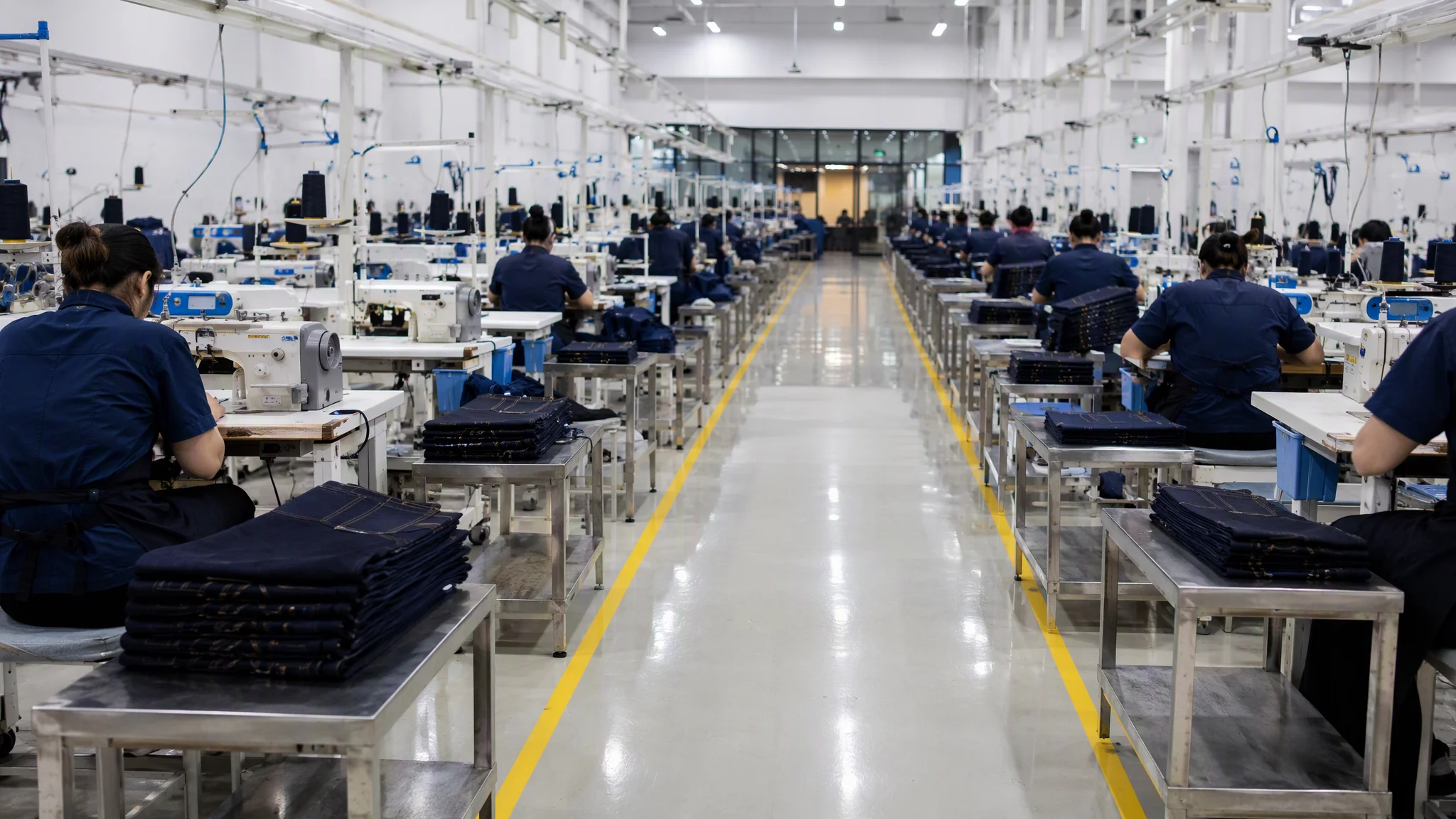
You spend two hours on the floor. The cutting tables are busy, the machines are running, the sample room is neat. Someone walks you past the washing line and quotes a monthly capacity. You leave with a folder and the feeling that you have done your due diligence.
Three months later the order is late. Or the wash comes back different from the sample. Or you find out that a third of your production was made somewhere you have never seen.
Nothing about the tour was a lie. It answered a different question than the one you needed answered.
SkyKingdom is a denim production partner based in Xintang, China’s denim capital. We do not own a factory. We manage a group of partner factories and our people are on their floors every day. That position makes the gap between a visit and an audit unusually visible to us: we see what a tour is designed to show, and we see what it leaves out.
What a factory tour can prove, and what it cannot
A tour is good at one thing: showing you that the factory exists, that it can make the product, and that the floor is organised enough to walk a visitor through. Plenty of sourcing disasters start with a factory that could not produce the category at all.
But a tour is one moment on a route chosen by the host. You see the machines; you do not see the order book. You see the sample room; you do not see which operations leave the building. You see a finished garment; you do not see the inspection record behind it.
| Question you need answered | Does the tour answer it? |
|---|---|
| Can this factory make my product category at all? | Usually yes |
| Is the floor organised and staffed? | Partly, on the route shown |
| Does my order have a real, dated slot? | No |
| Will any part of my order be subcontracted, and to whom? | No |
| How did the last comparable batch actually perform? | No |
| Who is accountable when the batch fails? | No |
The lower half of that table is where orders go wrong. And none of it is visible on a walk-through, because none of it is physical. It lives in records.
The reframe: a visit is an audit, not a tour
An audit is not a longer tour. It is a different activity. An audit takes a claim and tests it against a record, on your order, at a point in time, with a named person accountable for the answer.
That definition gives you three questions to bring to any factory visit:
| Audit question | Record that answers it |
|---|---|
| When does my order actually run? | The production schedule |
| Who actually touches my order? | The subcontracting log |
| What did the last comparable batch actually yield? | The QC report |
Three documents. Not a presentation, not a capacity number, not a wall of certificates. If a factory cannot produce these three for a real order, the tour was theatre.
Below: how to read each one, what to ask for, and where the limits are. We will also say what our own system does and does not do. A guide that only describes other people’s failures is not much of a guide.
Record one: the production schedule
The production schedule is the document that converts a promise into a date. It should show your order number, the line or cell it is assigned to, the date it is booked to start and finish, and what is scheduled immediately before and after it.
This is the difference between capacity and a slot. Capacity is a ceiling: “we can do fifty thousand pieces a month.” A slot is a commitment: “your twelve hundred pieces run on line four, starting the eighth, finishing the nineteenth.” A factory can have enormous capacity and no space for you. A factory can have modest capacity and protect your date.
Ask for the schedule before the visit, not during it. A schedule produced on request, in the room, is a document written for you. A schedule produced in advance, with other orders already on it, is a plan you can inspect.
What to look for
| Field | Why it matters |
|---|---|
| Order or PO number | Proves the slot is tied to your order, not to a general production block |
| Line or cell ID | Lets you verify the same line on the floor during the visit |
| Start and finish dates | Gives you something to measure a delay against later |
| Preceding and following orders | Shows whether your date depends on someone else’s slip |
| Buffer between orders | Reveals how the factory absorbs changeovers and rework |
| Status field | Shows whether the schedule is a live document or a static printout |
A schedule with no buffer fails the first time anything goes wrong. A schedule with a status field nobody updates exists only to be shown.
Red flags
Verbal scheduling. “We will fit you in” is not a date. If the answer to “when does my order run” is a sentence rather than a row in a plan, you have no schedule.
Whiteboard-only planning. A whiteboard can be a legitimate shop-floor aid. It is not an auditable record. If the only version of the plan is erasable, there is nothing to hold anyone to.
Schedules that do not reconcile with the floor. If the schedule says line four but the floor has no line numbering, or the numbers do not match, the document is decorative.
Capacity answers to scheduling questions. When you ask “when” and the answer is “how much”, the factory is either avoiding the question or does not have the data.
How our system handles this
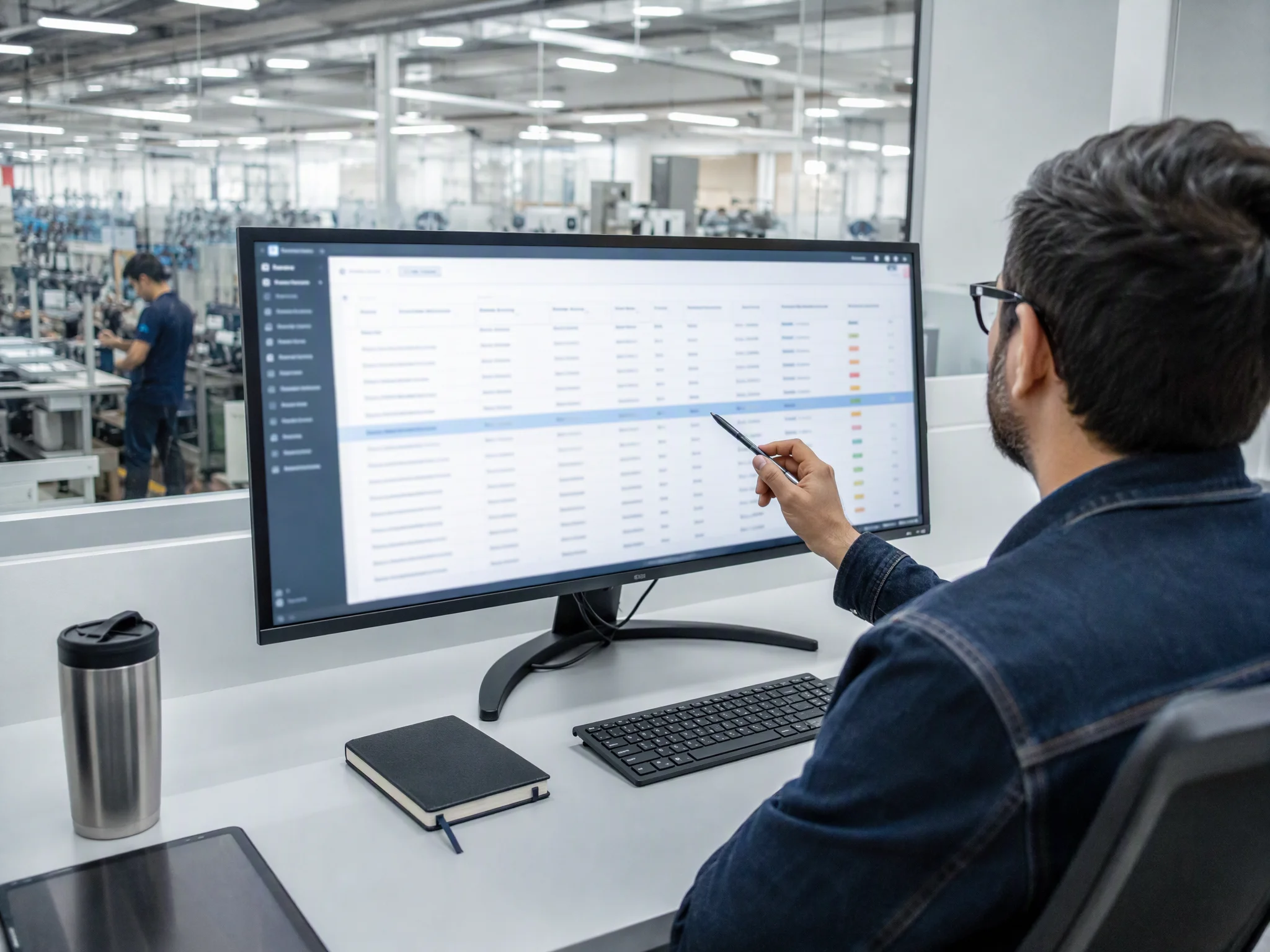
We run production management on a digital system rather than on memory and whiteboards. Our staff receive their daily assignments from the system, carry them out, and feed status back into it in real time. The schedule is a live object: when an order slips, the system shows it slipping and the downstream dates move with it.
What you get is different in kind. Instead of a promise made in a meeting, you get a position in a plan that the people doing the work are updating. You can query the plan on a specific date instead of reconstructing it afterwards.
A digital system is only as good as the discipline of the people entering data. Software does not fix a schedule that is wrong because updates are batched at the end of the day, or entered by someone who was not on the floor. When you audit, ask who updates the status and how often. The answer tells you whether the system is a control or a decoration.
For a deeper view of how a schedule connects to reorder timing, see our guide to fast reorder tiers and the production baseline to establish before reordering.
Record two: the subcontracting log
Denim is rarely made end to end under one roof. Washing is the obvious example, but laser finishing, embroidery, printing, and sometimes buttonholing or pleating all move between specialists. Subcontracting is a normal part of the industry. When a factory claims to do every operation in-house, it is either unusually integrated or leaving something out.
The question is not whether work leaves the building. The question is whether it leaves with a record, an approval, and a way back into your quality system.
An unlogged subcontract is a hole in the system. Your order leaves the factory you audited, passes through a vendor you have never assessed, and returns without an inspection gate. If something goes wrong, nobody owns it. If the wash shade drifts, the factory blames the washer, the washer blames the fabric, and you are holding the invoice.
What the log should contain
| Field | Why it matters |
|---|---|
| Your order or PO number | Ties the movement to your goods, not to a generic batch |
| Operation | Wash, laser, embroidery, print, and so on |
| Subcontractor name and location | Lets you check whether the vendor is known, approved, and auditable |
| Date out and date back | Cross-checks against your production schedule |
| Quantity sent and returned | Reveals loss, damage, or sample pulls |
| Process parameters | For washing, the recipe or lot ID that produced the shade |
| Re-inspection result | Proves the goods were checked when they came back |
| Approver | Names the person who authorised the movement |
If a log records what left but not what came back, it is a shipping note, not a control. The return leg is where quality is either confirmed or lost.
What to ask on the visit
Ask which operations on your order left the building. Ask who approved each movement and where the approval is recorded. Ask who inspected the goods on return and against what standard. Then ask what happens when the returned goods fail.
The last question separates a system from a story. Every factory has an answer for the good path. The audit is in the exception path.
How our system handles this
In our group, a factory does not subcontract an operation on a managed order without our approval. That is the rule. It is not a suggestion and it is not delegated to the factory’s discretion.
Rules are only worth what their enforcement is worth, so we do not rely on the rule alone. Our people are in the factories every day checking goods. If a factory sends work out without approval, the physical evidence shows up: quantities do not reconcile, wash lots do not match, goods return with someone else’s tags. Daily presence is the enforcement mechanism. It is slower and less elegant than a software flag, and it works.
That is also why we are careful about the phrase “real-time monitoring”. It does not mean a dashboard that updates itself. It means a person is standing in front of the goods often enough that an unrecorded movement is caught before it becomes a finished order.
Red flags
A blanket claim of full vertical integration with no evidence. Vertical integration is a real advantage when it exists. Ask to see the washing line, the laser room, the embroidery unit. If the answer is a tour of a building that does not contain them, the claim is marketing.
A log that exists only for the current order. Records should be a habit, not a response to a visit. Ask for a redacted log from a previous order and see whether the fields are filled consistently.
No re-inspection gate. Goods coming back from a subcontractor should be checked before they re-enter the line. If the log has no return inspection, the subcontract is outside quality control regardless of what the certificate says.
Subcontractors who are not on any approved list. If the factory cannot name its wash houses or explain how they were assessed, your order is one step away from an unknown vendor.
The nuance most buyers miss
Subcontracting is not automatically a quality risk. A specialist wash house that runs one process all day can outperform a general factory’s washing line. What creates the risk is the paperwork that did not happen: no approval, no log, no inspection when the goods came back.
Keep that distinction when you compare factories. A partner that subcontracts washing openly, logs it, and re-inspects the return is often safer than one that claims to do everything itself and quietly sends your goods out the back door.
For the structural comparison, see vertically integrated vs outsourced denim manufacturing and our guide on how to verify a vertically integrated denim factory. If washing is the operation in question, the failure mode is usually shade drift; we cover it in outsourced washing and denim color variation.
Record three: the QC report
The QC report is the record most likely to be reduced to a single number. That is also what makes it the easiest to misuse. A pass rate without its method is not a quality signal. It is a marketing asset.
A useful inspection report answers a narrow question: on this batch, using this sampling plan and this defect standard, did the goods meet the agreed criteria? Everything else in the report exists to make that answer mean something.
What the report should contain
| Field | Why it matters |
|---|---|
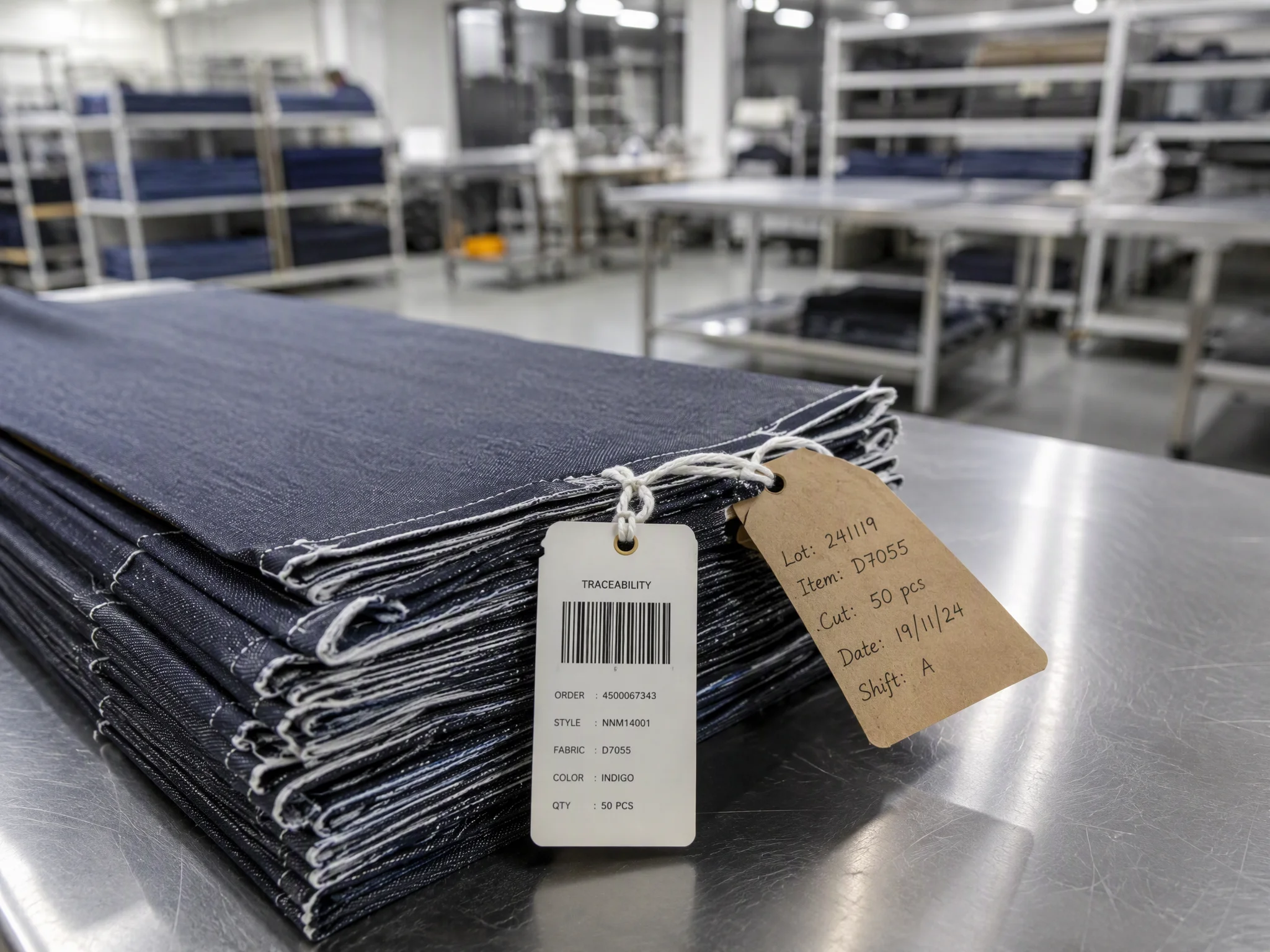
| Batch or lot ID | Connects the report to physical goods you can inspect |
| Style and order reference | Prevents a good report from a different product being used as evidence |
| AQL level and sampling plan | Defines how many units were checked and what acceptance means |
| Defect classification | Critical, major, and minor defects carry different consequences |
| Defect count by category | Shows the shape of the problem, not just the verdict |
| Sample size and units inspected | Lets you judge whether the result is statistically meaningful |
| Pass, fail, or pass with concession | A concession is not a pass; it is a decision someone made |
| Disposition of failed units | Rework, replace, reject, or accept with a price adjustment |
| Inspector and date | Names the person accountable for the result |
When a factory quotes a pass rate without these fields, you cannot tell whether 99 percent means excellent production or a lenient definition of a major defect. The number is real; the meaning is not.
Reading a pass rate properly
Start with the AQL. An AQL is an acceptance quality limit, not a promise of zero defects. A batch can meet its AQL and still contain a predictable number of defective units. Buyers who expect zero defects at a standard AQL are negotiating against the sampling plan, not against the factory.
Then look at the defect mix. A batch with ten minor defects and no critical defects is a different risk from a batch with two critical defects and a clean minor count. The pass rate can be identical in both cases.
Then look at the disposition. Units that failed and were reworked are not the same as units that failed and were shipped. The report should say which happened.
Finally, compare like with like. A pass rate on a five-pocket basic is not comparable to a pass rate on a heavily washed, hand-finished style. If a factory quotes one number across its whole output, the number is an average of things that should not be averaged.
The 92 or 99 question
You will hear ranges like 92 percent or 99 percent in conversations about denim quality. Treat them as an illustration of the spread, not as a benchmark you can hold anyone to. The gap between those numbers usually reflects differences in product complexity, defect definitions, and inspection strictness more than differences in factory skill.
This is also why we do not put a pass-rate badge on this page. A number lifted out of its batch context is not evidence. It is a claim with the evidence removed.
How our system handles this
Our QC is our own. Our people carry out the inspection, and the data stays with us. The report belongs to the order it describes.
We do not publish batch-level pass rates. A number published without the AQL, the defect definitions, and the style context misleads more than it informs. And the data belongs to the client whose order produced it; publishing it would need their consent.
When the system is mature enough to publish benchmarks, we may publish part of it — with client consent, and with the method attached. Until then, what we can offer is the method: how we inspect, what the report contains, how to read it. You can audit a method. You cannot audit a badge.
If you want the mechanics of consistency between sample and bulk, read sample-to-bulk consistency. If an inspection has already failed, the decision tree is in what to do when final inspection fails against AQL. For a comparison of quality control models, see clothing manufacturers vs Alibaba suppliers.
The three records together: run a cross-check
Any single document can be produced for a visit. The cross-check is where fabrication shows, because it is hard to keep three independent records consistent if one of them is written after the fact.
Pick one order and reconcile it across all three records. The mismatches are the audit findings.
| Check | What a mismatch tells you |
|---|---|
| Schedule dates vs subcontracting dates | The schedule was not updated when the operation slipped, or the operation ran outside the plan |
| Quantity sent vs quantity returned | Units were lost, damaged, or pulled without a record |
| Batch ID on the QC report vs the order | You are being shown a report for different goods |
| Line ID on the schedule vs line labels on the floor | The schedule is a document, not a plan |
| Operations on the log vs operations implied by the style | A subcontract is missing from the log |
| Defect count vs disposition | Failures were shipped without a documented decision |
None of these checks requires technical expertise. They require one hour, one order, and the willingness to ask the next question when the numbers do not line up.
How to run the audit on the day
Before the visit
Ask for the three records for the last comparable order, five working days ahead. “Comparable” means the same product family and a similar wash or finish. A basic five-pocket is not comparable to a heavily processed garment.
The request itself is a test. Producing the records in advance means they are part of the operation. Promising to prepare them for you means the records are a presentation layer.
During the visit
Pick one order from the schedule and follow it to the floor. Find the work-in-progress tags or bundle tickets and check that the order number on the goods matches the number on the plan. Look for the line or cell identifier and confirm it matches.
Take the subcontracting log and match one movement to physical evidence. If washing left the building on the twelfth and returned on the sixteenth, the goods on the floor should be consistent with that timeline and that lot. If the log says the wash was in-house, ask to see the machine and the recipe.
Open one QC report and ask to see the defects it counted. A report that describes ten minor defects should be backed by a person who can point to the defects and explain the classification. If nobody can, the report was written after the fact.
After the visit
Ask for the same three records at four checkpoints: order confirmation, pre-production, mid-production, and pre-shipment. The point is not to catch a single failure. The aim is to see whether the records exist continuously or only when a visitor is coming.
Ten questions to take with you
- Which date is my order booked to start and finish, and on which line?
- What is scheduled immediately before and after my order?
- Who updates the schedule status, and how often?
- Which operations on my order will leave this building?
- Who approves a subcontract, and where is the approval recorded?
- Who inspects subcontracted goods when they return, and against what standard?
- Can I see the QC report for the last comparable batch, including the defect breakdown?
- What AQL was used, and what sampling plan?
- What happened to the units that failed?
- If a batch fails inspection, who decides the disposition and who pays for the rework?
Question ten is the one most buyers forget. Quality systems are defined by the exception path. If nobody can say who pays for rework, the exception path has not been thought through. The answer will be invented at the worst possible moment.
When they cannot produce a record
Treat the inability as an answer. There are three common versions: the record does not exist, the record exists but is not shareable, or the record can be produced later.
The first is a system problem. The second may be legitimate, and the honest response is a redacted version rather than a refusal. The third is only credible if “later” has a date and the date is met.
Auditing before you have an order
Most brands read this kind of guide after they have placed an order, when the risk is already live. The more useful moment is before.
You cannot audit your own batch before it exists. You can audit the system that will produce it. Ask for redacted samples of the three records from a recent order. Redaction should remove client names, prices, and design details. It should not remove the field structure, the dates, the approver roles, or the defect categories.
What you are assessing is discipline. Are the fields filled consistently? Do the dates reconcile? Is there an approver named on each movement? Does the QC report show a method or only a verdict?
If a factory cannot produce a redacted sample before you order, expect the same quality of record after. The incentive to document does not increase once the deposit has cleared.
For the records worth keeping on your side of the relationship, see denim records to keep before reordering. For the traceability chain that ties those records together, see traceability and compliance.
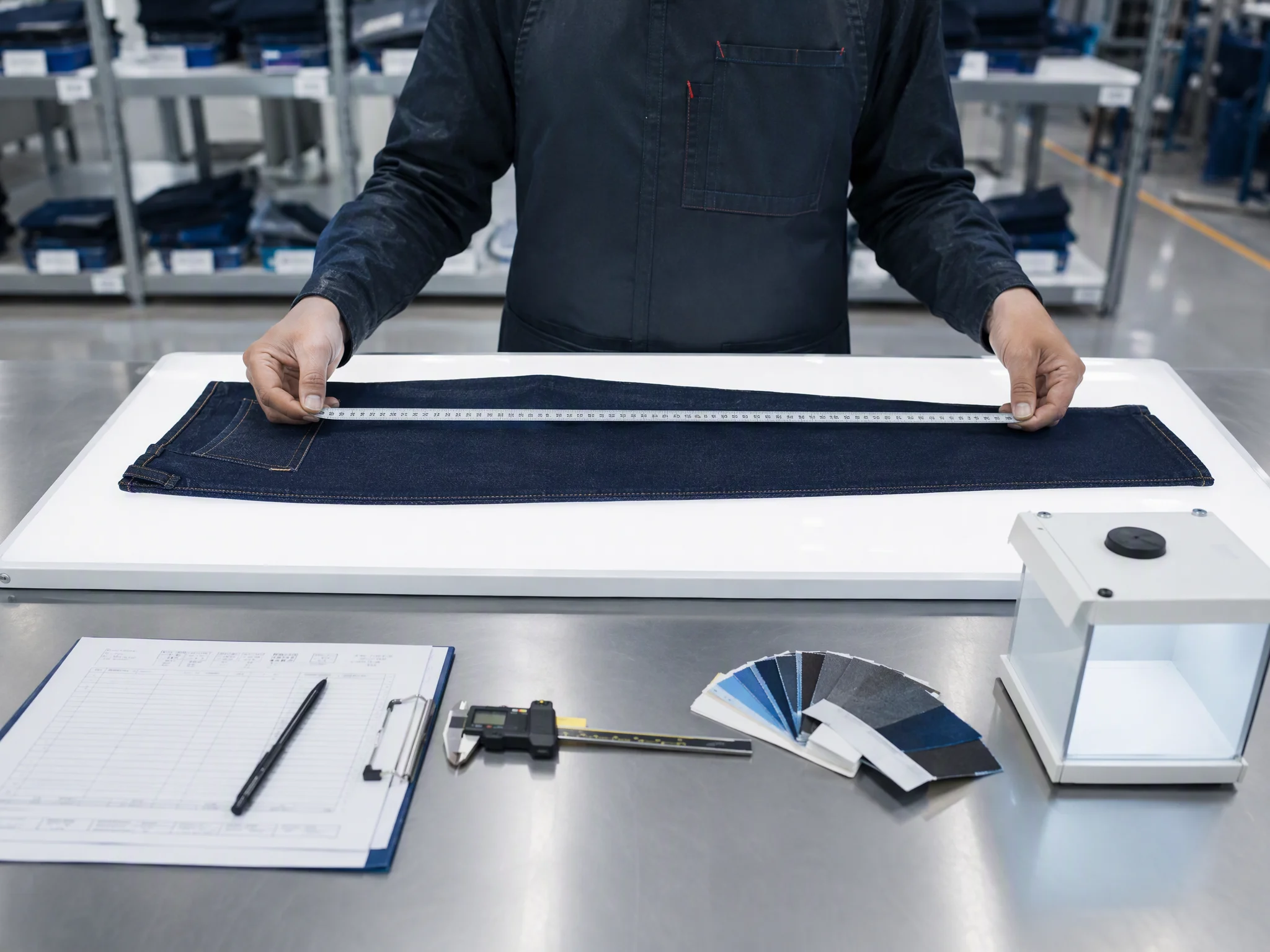
Where our model fits, and where it does not
We are a supply chain company, not a factory owner. We manage a group of partner factories, and our people are on their floors every day. The audit discipline described above is hard to run from the outside, and a brand that has to rebuild it for every order pays for the same work again and again.
Our production management experience goes back to 2006. In that time the industry has moved from paper schedules and phone calls to digital systems, and the failure modes have not disappeared; they have moved into the software. A system that nobody updates is no better than a whiteboard that nobody reads.
What we can point to: a digital production system that dispatches daily work and takes status back in real time. Subcontracting is approval-gated, and the gate is enforced by people in the factories every day. The QC is ours, and the batch data stays with us.
What we do not claim: a published pass-rate badge, zero defects, or guaranteed delivery dates. Those claims are easy to make and hard to defend, and a brand that needs them is buying reassurance rather than a system.
Who this suits
Growth-stage brands, where the order is big enough to matter but not big enough to justify an in-house production team. Brands working with complex washes or finishes, where every handoff adds risk. Brands that would rather see records than a showroom.
Our work with rapid development and small-batch production sits inside that model. So does the technical lab work that turns a sample into a reproducible specification.
Who this does not suit
Buyers for whom price is the only variable, on simple commodity styles, at volumes where a one-cent difference decides the order. In that world, the three records are overhead. And brands that prefer not to see the inside of the system, because visibility creates obligations on both sides.
If you are comparing structural models rather than individual factories, large-scale factory vs development-focused manufacturer sets out the trade-offs. Full-package production is explained in what full-package production means in denim.
The tour is the beginning, not the evidence
A factory visit is worth doing. It tells you whether the place is real, whether the floor is organised, and whether the people answering questions know their own process. Use it for that.
Then ask for the three records: the schedule that shows your dated slot, the log that shows what left the building, and the report that shows what the last batch actually did. Read them against each other. Ask who is accountable when they disagree.
The tour shows you a factory. The records show you whether it will keep the order it just accepted.
Frequently asked questions
What should I ask for on a denim factory visit?
Ask for three records, not a route: the production schedule that shows the dated slot your order is booked on, the subcontracting log that shows which operations left the building and where they went, and the QC report for the last comparable batch. Ask for them before the visit, then check the records against the floor.
Is a factory tour useless?
No. A tour tells you whether the factory can make denim at all, how it is laid out, and whether the floor is organised. What it cannot tell you is whether your order has a real slot, whether part of it will be subcontracted, or how the last batch actually performed. Treat the tour as an introduction, not as evidence.
What is a subcontracting log, and is subcontracting bad?
A subcontracting log records every operation that leaves the factory (washing, embroidery, laser, printing) with the vendor, dates, quantities, and the re-inspection result when the goods come back. Subcontracting is normal in denim. Unlogged and unapproved subcontracting is the problem, because it moves your order outside the quality system you thought you were buying.
What does a useful QC report contain?
It should state the AQL level, the sample size, the defect classification (critical, major, minor), the number of defects found, the pass or fail decision, and the disposition of any failed units. A single pass-rate number without those details cannot be compared across batches or factories.
Can I audit a factory before placing an order?
Yes, but you audit the system rather than your own batch. Ask for redacted samples of the three records from a recent order: the structure, the fields, and the discipline of record-keeping matter more than another client’s numbers. If they cannot produce a redacted sample before you order, the record after the deposit is unlikely to be better.
Why don’t you publish your QC pass rates?
Because a pass rate is batch-specific and client-specific. Published without the AQL, the defect definitions, and the style context, it becomes a marketing number rather than a quality signal. We keep batch-level QC data and review it with the brand it belongs to. If we publish benchmarks later, it will be with client consent.
If you are at the pre-order stage and want to see what a record-based production conversation looks like, our work with growth brands is the place to start.